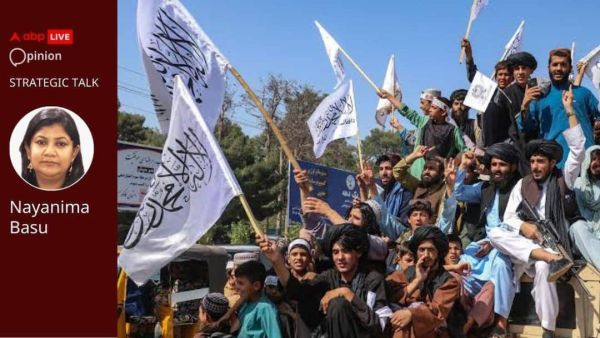
The bilateral relations between India and Afghanistan have taken an extraordinary and unprecedented turn this month, marked by a historic event that reverberated beyond borders. The Taliban, celebrating their resurgence to power in Kabul, declared "Victory Day" for the first time on Indian soil, right within the confines of the Afghan Embassy in New Delhi, nestled in the bustling heart of the capital.
As one approaches the embassy, the atmosphere is heavy with tension and a sense of surrealism. The building, still bearing the title of the Embassy of the Islamic Republic of Afghanistan, now presents a strikingly different façade. The once familiar symbols of the previous government have been replaced by the stark white flag of the Taliban - a white banner featuring the Islamic declaration of faith, the Shahada, written in black calligraphy across the center – which flutters prominently from flagpoles and decorates the premises.
Inside, the air is charged with a mix of uncertainty and cautious optimism as Taliban officials now hold the reins of power at this diplomatic outpost, calling the shots with an assertiveness that feels both new and unsettling. Conversations among diplomats and staff reflect a complex web of emotions-anxiety about the future, a grappling with the surreal reality of the situation, and an uncertain path forward in a region fraught with historical complexities.
This striking transformation sends a clear message: India now faces a profound and challenging reality that it must navigate for the years and decades ahead. The dynamics of regional politics, security concerns, and economic interests will be forever altered, as India seeks to establish its stance in an evolving landscape that has seen a dramatic shift, blending tradition with an unanticipated new order.
On August 15, 2021, the Taliban regained power in Afghanistan following the swift collapse of the U.S.-backed government, which had been in place for nearly two decades. This dramatic turn of events was set in motion by a controversial “peace deal” signed with the United States in February 2020, which included commitments by the Taliban to reduce violence in exchange for the withdrawal of U.S. troops. However, as the Taliban advanced and took control of Kabul, the security situation in the country rapidly deteriorated.
In the aftermath of the takeover, the international community's response was largely reactive and immediate. Many nations quickly moved to shut down their diplomatic missions in Afghanistan, either partially or completely, as fears grew over the safety of their personnel amid the chaos.
The Taliban's alliance with the notorious Haqqani Network, a group known for its links to terrorism, further fuelled concerns about the future stability of the region. This combination of factors created an atmosphere of uncertainty and alarm, leading to widespread evacuations and a re-evaluation of foreign policies regarding Afghanistan.
At that time, the international community, particularly through the United Nations Security Council (UNSC) and influential global powers, reached a critical consensus regarding Afghanistan's political transition. This consensus hinged on several key preconditions that needed to be met before any formal diplomatic recognition could be granted and before state assets that had been frozen could be released.
These conditions included a robust commitment to the protection of human rights, with a specific emphasis on safeguarding the rights and freedoms of women and girls, assurances countering terrorism, the establishment of a genuinely inclusive government, and the provision of safe passage for those seeking to leave the country as well as unfettered humanitarian access for aid organizations striving to assist the Afghan populace.
However, the current situation presents a stark contrast to those expectations.
Over time, many nations have seemingly chosen to turn a blind eye to these critical issues, continuing to engage with the Taliban despite the failure to meet the previously outlined conditions. As a result, the international pressure that once existed to prevent the imposition of regressive laws targeting Afghan women or to promote the formation of an inclusive government has significantly diminished.
The consequences of this shift raise serious concerns about the future of human rights and governance within Afghanistan, as the Taliban's policies increasingly reflect a disregard for the very principles that initially conditioned international support and recognition.
This has happened primarily due to two main reasons: the ongoing Russia-Ukraine war and the escalating conflict involving Iran. These events have redirected international focus away from Afghanistan, leading to a precarious oversight of its developments. In this shifting landscape, the Taliban has managed to establish a semblance of stability within the country, albeit through a regime marked by severe measures and strict governance.
Despite the oppressive methods employed to maintain order, the Taliban has been notably effective in dismantling and containing terrorist networks that pose a threat to their control, particularly against the Islamic State-Khorasan (ISIS-K). This group has persistently aimed to undermine the Taliban's authority, launching attacks in a bid to disrupt their rule.
Interestingly, there appears to be a growing consensus among global observers that the security situation in Afghanistan has improved under the Taliban's watch. The frequency of terrorist attacks has significantly dwindled, lending some weight to the Taliban's claims of restored order.
However, this fragile peace comes at a daunting price, as the brutal repression of women and minority communities continues unabated, casting a shadow over any progress made in terms of security and governance.
OPINION | India Losing Ground In West Asia
India And Taliban
During the Taliban's first rule from 1996 to 2001, India adopted a firm stance of opposition, a complete lack of diplomatic recognition, and an active resistance to their regime. New Delhi considered the Taliban a fundamentalist security threat and a direct proxy of Pakistan's Inter-Services Intelligence (ISI).
Just before the Taliban took control of Kabul in September 1996, India evacuated its diplomatic staff and closed its embassy and consulates in Afghanistan.
In fact, India supported the Northern Alliance by providing arms through a covert military and logistical operation that involved millions of dollars. This operation was primarily coordinated by India's external intelligence agency, the Research and Analysis Wing (RAW), in collaboration with the Ministry of External Affairs.
Since India did not share a physical border with the Northern Alliance's stronghold, the entire operation depended on securing access through third-party countries, specifically Tajikistan and Russia.
The Northern Alliance, officially known as the United Islamic Front for the Salvation of Afghanistan, was a military-political coalition formed in late 1996 to resist the Taliban's initial takeover of Afghanistan. It was led by Ahmad Shah Massoud, an ethnic Tajik military commander famously known as the 'Lion of Panjshir.'
Massoud served as the Alliance's primary military strategist and was the prominent figure representing the coalition to the world. Others influential figures of the Northern Alliance included Abdul Rashid Dostum, Burhanuddin Rabbani and Karim Khalili, among others.
Nestled in the Hindu Kush mountains, the Panjshir Valley, a naturally fortified valley, served as the Alliance's primary fortress. In 1996–1997, India negotiated with the government of Tajikistan to use the Farkhor Air Base, located near the Afghan border, to facilitate supplies for the Northern Alliance.
The lowest point in relations occurred in December 1999, when Pakistani terrorists hijacked Indian Airlines Flight IC-814 and forced it to land in Taliban-controlled Kandahar. The Taliban provided safe harbour to the hijackers and acted as a hostile mediator, forcing India to release three high-profile militants in exchange for the hostages. India watched with deep concern as the Taliban's Afghanistan became a training ground for Pakistan-backed jihadi groups targeting Jammu and Kashmir.
However, today that situation does not exist anymore.
Today, India has opened its doors wide to the Taliban, even allowing them to celebrate their comeback on Indian soil. This is primarily due to New Delhi’s nearly decimated ties with Islamabad. While India now has a fully operational embassy in Kabul, its four consulates in Herat, Jalalabad, Kandahar and Mazar-i-Sharif remain closed.
Therefore, India must carefully consider how far it is willing to go with the Taliban. It must also consider how the large Afghan diaspora living in exile outside Afghanistan view India’s changed stance. India also needs to assess its own security architecture in relation to the ongoing conflict between Kabul and Islamabad regarding the presence of Tehreek-i-Taliban.
Perhaps it is time for India to give the Taliban in Afghanistan full diplomatic recognition and hold them more accountable for their policies towards women, their counterterrorism measures, and the formation of an inclusive government.
Exclusive | Bangladesh Needs India’s Support, New Delhi Should Change Its Policy: Muhammad
-
Your go-to laughing emoji is officially out, meet the new favourite

-
Lawyers protest in Delhi, demand BCI chairman’s resignation
-
Pakistani actor Fahad Mustafa spotted with rumoured 2nd wife

-
WATCH: Sehwag’s Son Aaryavir Plays Father’s Iconic Shot In Identical Fashion

-
Iran Hits Back At Trump’s ‘Economic D-Day’: ‘US Trying To Hide Its Own Crisis’