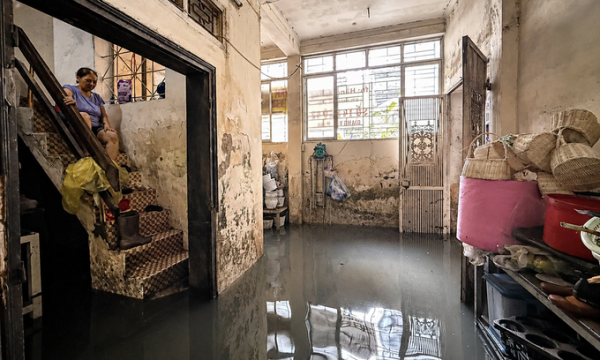
On the morning of July 28, floodwaters in alley 42, Giang Van Minh, Ba Dinh Ward, receded partially following a 30-minute downpour the previous afternoon. At the alley entrance, six of the 40 houses were still under 20 centimeters of water.
Inside the house of Cu Thi Bac, 69, it was half a meter. “Because the house is 50 centimeters lower than the alley, it does not drain until the road is completely dry,” Bac said.
Her family built the three-story house in 1993, and the flooding after a rain began in 2008 since the street was raised multiple times. She did not bother to raise her house after seeing that neighbors who did so still had water pouring in.
With three days of rain meaning seven days of floods, the family has moved all electrical sockets to two meters above the floor and installed a drainage pit at the gate and hangs bicycles on the wall. “Living in the middle of the capital is no different from living in a flood zone; worse, actually, because the whole house sits in foul-smelling sewage water,” Bac lamented.
Daily life is upended if it rains. During less flooded days, she wades through the water to cook; on days when it is heavier, the whole family retreats to the second floor or eats at her younger sister’s house nearby.
Bac’s husband has moved back to their hometown to escape the waters. She suffers from joint disease, and so usually hires someone for VND250,000 (US$9.5) to dredge the mud after the waters recede.
|
Cu Thi Bac, 69, sits on the second-floor staircase of her home in Alley 42 Giang Van Minh Street, Ba Dinh Ward, after more than 50 cm of floodwater submerged the ground floor following overnight rain that lasted until the morning of July 28. Photo by Quynh Nguyen |
The house of Nguyen Duc Minh, 38, at the intersection of alley 42 Giang Van Minh and sub-alley 34 of alley 100 Doi Can, is usually flooded from two directions.
With his rice meal business being run in a cramped space, it is difficult to take everything to higher ground when his home is inundated. Every time heavy rain is forecast, he and his wife move belongings up and park their motorbikes at a nearby lot.
After the July 27 downpour, the alley was under 60 centimeters of water, and Minh waded through thigh-deep water to deliver food to 50 customers.
With the water level staying high for more than a day, his wife Linh used a large laundry basin as a makeshift boat to row their child home from a kindergarten 300 meters away. “The road was deeply flooded and uneven, and so sitting the child in the basin and pulling them was safer,” she said.
But the family cannot move because their livelihood depends on the meal business. After each flood, neighbors gather to help families with fewer able-bodied members dredge the mud and clean their homes.
As a defense against the routine flooding, 80% of people living there have raised their houses by 30-50 centimeters. Many families have also spent tens of millions of dong (VND10 million = $382)on installing metal flood barriers or automatic sensor systems in place of the old tarpaulin method.
 |
|
Hien, 80, who lives in Alley 100 Doi Can Street, Ba Dinh Ward, installed a flood barrier system at the entrance to her home in early 2026 after years of experiencing floods 50–60 cm deep. Photo by Nga Thanh |
A representative of the Hanoi Urban Infrastructure Management Center said at around noon on July 27, there was 50 mm of rain in 30 minutes, above the local drainage capacity.
Water rushed in rapidly, causing flooding of 35-40 centimeters in alleys 42 Giang Van Minh and 100 Doi Can. The center directed the Hanoi Drainage Company to stand by, clear debris, unblock drainage flows, and operate pumps.
According to Ngo Manh Son, head of residential group 15 in Ba Dinh Ward, the flooding in this area stems from a long-delayed project to culvert the Ke Khe canal and build a connecting road between Nui Truc and Son Tay.
The project for 1.04 kilometers of canal culverting and a 25-meter-wide road was approved by the city government in 2008 at a cost of VND205 billion.
The unfinished construction and littering habits that block drainage flows badly affect all residents in alleys 42 and 36 Giang Van Minh and alley 100 Doi Can. “Residential group 15 has repeatedly petitioned the authorities for a definitive solution, but the situation has not improved,” Son said.
 |
|
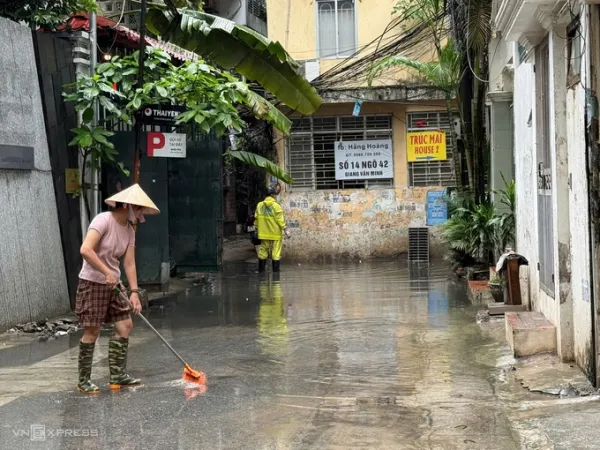
At 9 a.m. on July 28, Alley 42 Giang Van Minh Street in Ba Dinh Ward remained flooded with more than 20 cm of water after two days of heavy rain, as drainage workers stood by clearing debris from storm drains. Photo by Nga Thanh |
Businesses in the low-lying area suffer from financial losses. A café in alley 42 Giang Van Minh managed by Phan Duc Anh, 26, saw a sharp drop in sales every third quarter for three years.
Despite building the cafe 60 centimeters above the alley level, rains still submerge the furniture inside by 30-40 centimeters.
Hanoi has recently set a deadline of Dec. 31, 2026, for the completion of the Ke Khe canal culverting project. “I want to live in a dry house, with my belongings properly arranged to welcome guests, done with the years of piling everything up and running from floods,” Bac said.
-
Want to be a friend of the environment? Instead of buying it, make it from paper and cloth, here are 4 novel ideas

-
Condom, contraceptive pill or Copper-T? Which method is most effective to avoid pregnancy, know the whole thing from the doctor

-
Sun cream banned from sale in UK as shoppers warned it is ‘high risk’ | UK | News

-
Dengue vs Swine Flu: If there is body ache along with high fever, is it dengue or swine flu? This is how to recognize the difference between the two

-
“They Are Afraid”: Bengaluru-Based Parenting Expert Explains Why Teenagers Lie