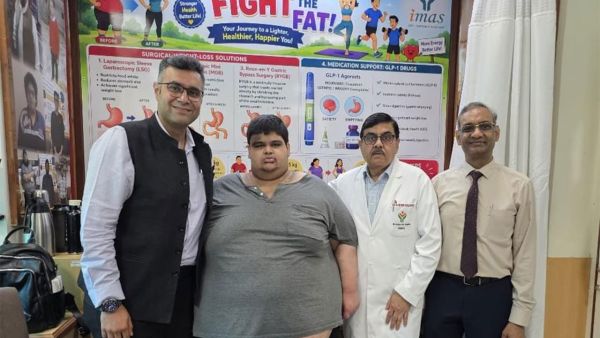
A 16-year-old boy weighing 275 kg successfully underwent a high-risk bariatric surgery at a Delhi hospital. The teen suffered from severe breathing issues and other complications. He has since lost nearly 50 kg in two months post-surgery.
In a complex and high-risk bariatric surgery case, a 16-year-old Delhi boy weighing nearly 275 kg underwent a successful laparoscopic sleeve gastrectomy at a private hospital after presenting with severe breathing difficulty, obstructive sleep apnoea and extensive skin infection.
His extreme obesity had progressed to the point where he could not fit into a conventional car and had to be transported to the hospital in a "Matador". On admission, he was found to have severe obstructive sleep apnoea and widespread skin infection and subsequently required treatment in the Paediatric Intensive Care Unit (PICU) for nearly two weeks for respiratory and other complications.
A Multidisciplinary Approach
With his BMI approaching 100, the case required detailed multidisciplinary evaluation. Nearly 20 specialists from paediatric critical care, bariatric surgery, paediatric gastroenterology, paediatric cardiology, anaesthesia and other specialities assessed the significant risks associated with surgery, anaesthesia, positioning, laparoscopic access and postoperative respiratory care.
Following detailed discussions with the family, the team decided that bariatric surgery offered the best available option to address his extreme obesity and associated complications. The surgery was performed by Dr Daksh Sethi, Dr Sudhir Kalhan, Dr Mukund Khetan and Dr Suviraj John from the Institute of Minimal Access, Metabolic & Bariatric Surgery, Sir Ganga Ram Hospital, New Delhi.
Despite the considerable technical challenges posed by his extreme body habitus, the team successfully performed a laparoscopic sleeve gastrectomy. "This was not a routine bariatric operation. The patient's age, weight and severe sleep apnoea meant that every step had to be carefully planned. Our first priority was to make him medically fit for surgery and ensure that we had a team prepared for every possible challenge during and after the procedure," said Dr Daksh Sethi, Lead Bariatric Surgeon, Sir Ganga Ram Hospital.
The Expert Team
The multidisciplinary team played a key role in stabilising the teenager before surgery and managing him through the perioperative period. Dr Anil Sachdev, Head of Department of Paediatric Critical Care, was involved in his optimisation and intensive-care management. The anaesthesia team comprised Dr Rakesh Saxena, Dr Shikha Sharma and Dr Savitar Malhotra. Dr Nishant Wadhwa, Paediatric Gastroenterologist, performed the preoperative upper gastrointestinal endoscopy, while Dr Neeraj Aggarwal, Paediatric Cardiologist, conducted the cardiac assessment.
Encouraging Early Results
The laparoscopic sleeve gastrectomy was successfully completed, and the teenager recovered well and was discharged just three days after surgery. The early results have been encouraging. Approximately two months after surgery, his weight decreased from around 275 kg to 223 kg, representing a reduction of nearly 50 kg.
Focus on Long-Term Quality of Life
The treating team, however, emphasises that the objective extends beyond weight loss to improving his long-term health, mobility and quality of life. Dr. Sudhir Kalhan, Chairman, Institute of Minimal Access, Metabolic and Bariatric Surgery, Sir Ganga Ram Hospital, said, "In a patient this young with such severe obesity, our priority was to look beyond immediate weight loss and focus on improving his long-term health and quality of life. His progress over the last two months is very encouraging, and we hope this marks the beginning of a healthier and more active life for him."
The long-term goal is sustained weight reduction and a reduction in obesity-related health risks, including sleep apnoea, metabolic and cardiovascular complications, restricted mobility and impaired quality of life. Dr Daksh Sethi added, "Bariatric surgery in someone this young is never a decision taken lightly. The objective is not simply to reduce the number on the weighing scale, but to change the trajectory of the patient's health and help him lead a more active and healthier life." (ANI)
(Except for the headline, this story has not been edited by Asianetnews Editorial staff and is published from a syndicated feed.)-
Princess Eugenie reveals daughter’s name honouring Queen Elizabeth II

-
Are you bored with everyday biscuits and namkeen? Make crispy semolina rings, learn the easy recipe

-
Is Buick Bringing Back The Grand National?

-
BGMI Lite is making a comeback in India, Krafton announced its launch

-
OpenAI Disbands Preparedness Team as AI Safety Strategy Takes a New Turn