Edited by: Natalie Muller
The death toll from the 7.7-magnitude earthquake which hit eastern Indonesia this weekend rose to at least 68 on Monday, casting a shadow over the country's Independence Day celebrations.
Over 100 more people have been injured but local authorities do not believe anybody is missing.
The quake's epicenter was located off the coast of the island of Flores at a shallow depth of 10 kilometers (6.2 miles) on Saturday, the US Geological Survey (USGS) said.
It has since been followed by almost 1,600 smaller aftershocks, including a 5.6-magnitude jolt on Monday morning.
A tsunami warning for parts of East Nusa Tenggara, West Nusa Tenggara, South Sulawesi and Southeast Sulawesi provinces, urging residents to stay away from beaches and riverbanks, was later lifted.
But around 500 houses have been damaged and roads have been blocked by landslides, leaving around 12,800 people on Flores unable to return to their homes.
Indonesia residents: 'We need aid as soon as possible'
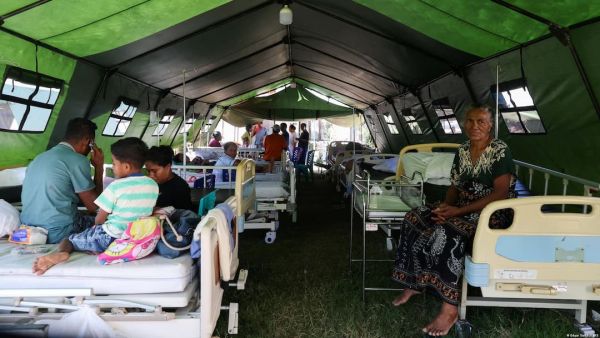
"Our houses are no longer inhabitable, because many have collapsed and are full of cracks, so we can't go inside anymore," one resident told the AFP news agency outside a self-made tent that was sleeping about 30 people.
"We only go back home to get water, clothes, pillows, and then we spend the nights here."
Other residents complained to the Reuters news agency about poor conditions in such tents, with some children contracting diarrhea and at least one older person suffering a stroke.
"I can only eat rice with nothing else," said one young mother whose baby was wrapped in a brown blanket in the back of a pickup truck. "We need aid as soon as possible. We are just salt farmers."
Indonesia: how is the government responding?
On Sunday evening, Indonesia's disaster mitigation agency, known as BNPB, said the Indonesian Air Force was preparing to bring 13 tons of emergency aid to the region.
The country's deputy health minister, Benjamin Paulus Octavianus, said the military was also planning to construct an emergency field hospital but said neurosurgeons and orthopedic surgeons were needed to treat head injuries and broken bones.
The earthquake is Indonesia's deadliest disaster since a 2022 quake killed hundreds in West Java, and has overshadowed the country's Independence Day celebrations marking independence from Japanese rule in 1945.
President Prabowo Subianto marked the occasion by presiding over celebrations in the capital, Jakarta, about 1,500 kilometers (930 miles) west of the disaster zone.
But the festivities were the last thing on the mind of residents affected by the earthquake, with one father telling Reuters: "I'm not thinking about that anymore. I'm just thinking about the safety of my wife and 4-year-old twins."
Indonesia's history of earthquakes
Indonesia is located on the so-called "Ring of Fire," a region of heightened seismic activity in the Pacific basin that stretches from Southeast Asia to Japan.
Here are some of the biggest earthquakes to strike the region:
- 1992, magnitude 7: A tsunami following a strong earthquake on the southeastern island of Flores killed about 2,500 people
- 2004, magnitude 9.1: A quake struck off the coast of Sumatra, triggering a tsunami that killed 170,000 in Indonesia and 220,000 in several countries in the Indian Ocean
- 2018, magnitude 6.9: A tremor killed more than 550 people on the islands of Lombok and Sumbawa
- 2018, magnitude 7.5: A quake and a subsequent tsunami in Palu on Sulawesi island left more than 4,300 people dead or missing
Disclaimer: This report first appeared on Deutsche Welle, and has been republished on ABP Live as part of a special arrangement. Apart from the headline, no changes have been made in the report by ABP Live.
-
Cristiano Ronaldo suggests he may have only one year left in football

-
Write off Frank Lampard as a Premier League manager at your own peril

-
Qawwali nights to food stalls: Hyderabad gears up for new festival

-
Court hands life term to Hyderabad man for wife’s murder

-
Dalits should unite against BJP: Telangana Congress holds dharna