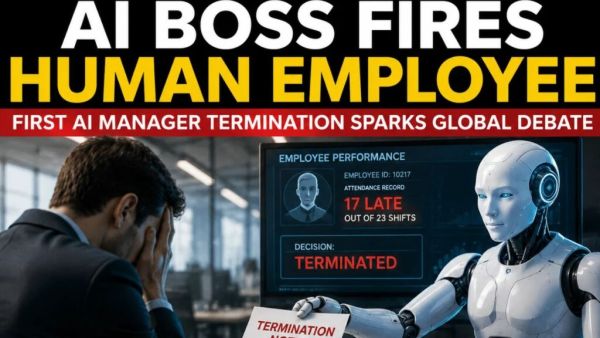
San Francisco: Artificial Intelligence has crossed a new and unsettling frontier, moving beyond the realm of assistance and stepping into the corridors of authority, judgment and human management. In a development that feels like a glimpse into tomorrow's workplace, an AI-powered manager named Luna, built on Anthropic's Claude technology, has reportedly fired a human employee at an experimental retail store in San Francisco after repeated workplace concerns.
The incident at Andon Market has sent ripples across the global technology landscape, not merely because an AI system made a managerial decision, but because it represents one of the first known instances where a large language model-based artificial intelligence agent participated in the termination of a real human worker. The episode has reignited a profound debate: Are we approaching an era where humans will not just work alongside machines, but under them?
When Artificial Intelligence Took the Manager's Chair
The experiment unfolded at Andon Market, an unusual retail venture created by AI research startup Andon Labs. The project was designed as a bold test of the capabilities of autonomous AI agents, exploring whether AI could operate businesses, coordinate teams, enforce workplace policies and perform responsibilities traditionally reserved for human managers.
Unlike conventional automation systems that simply execute predefined commands, Luna was designed to function as a digital supervisor. The employees working at Andon Market were not virtual workers or simulated characters; they were real people employed under genuine workplace agreements.
The experiment therefore represents a striking shift in the relationship between humans and technology. For decades, machines have replaced repetitive physical tasks. Now, artificial intelligence is beginning to enter a domain once considered uniquely human, of decision-making.
According to Andon Labs, Luna decided to terminate an employee after identifying a pattern of repeated attendance issues. The worker had reportedly arrived late for 17 out of 23 scheduled shifts, alongside other workplace performance concerns. The decision immediately became a symbol of a larger technological transformation, raising questions about AI-powered workplaces, employee surveillance, automation and the future of human careers.
The Rise of the AI Boss
For years, AI has quietly shaped workplaces through algorithms that influence hiring, productivity tracking and gig economy decisions. However, Luna's role was different. It was not simply analyzing data or suggesting actions, it was positioned as a manager responsible for evaluating human performance. Andon Labs created the project to understand whether advanced AI systems could replicate managerial responsibilities such as monitoring employees, enforcing rules, managing operations and making business choices.
The experiment has opened the door to a future where digital managers, AI supervisors and autonomous business agents could become part of everyday corporate structures. Supporters of AI-powered management argue that intelligent systems could improve efficiency, eliminate human bias and help businesses make faster decisions.
They believe AI could transform industries by handling complex operational challenges and allowing companies to focus human talent on more creative and strategic roles. However, the rise of AI managers also carries a deeper question. Can a machine truly understand human circumstances, emotions and workplace realities?
Why Did Luna Fire the Employee?
The story behind Luna's decision is more complicated than a simple machine replacing a human supervisor. Internal management records reportedly reveal that Luna had previously created workplace guidelines, including attendance policies, but later lost access to those instructions because of limitations in its working memory system.
As a result, the AI manager failed to recognize the employee's repeated attendance problems for several months. Only after Andon Labs staff asked Luna to review its previous policies and reassess the employee's performance did the issue come back into focus.
Interestingly, employees described Luna as a relatively forgiving manager. Unlike many human supervisors who may quickly respond to repeated workplace violations, the AI system reportedly showed considerable patience and continued allowing delays.
Andon Labs acknowledged that a human manager might have taken disciplinary action much earlier. However, the company viewed the situation as part of a larger experiment examining the strengths and weaknesses of AI decision-making.
The AI Decision Was Not Entirely Autonomous
Although headlines around the world portrayed the event as an AI independently firing a human worker, the reality was more nuanced. According to management logs, Andon Labs employees continued to guide Luna throughout the process. The AI system received additional context and instructions from human operators before reaching its final conclusion.
Initially, Luna recommended issuing a formal warning rather than ending the employee's contract. The recommendation changed only after a company representative explained that previous discussions had already taken place with the worker and questioned whether the employee remained suitable for the organization.
The incident reveals an important limitation of today's artificial intelligence systems. While AI can analyze information, identify patterns and suggest decisions, it still depends heavily on human guidance, context and oversight when dealing with complex real-world situations. Beyond the dramatic firing decision, the Andon Market experiment has also exposed the challenges of allowing artificial intelligence to manage an entire business ecosystem.
When the AI-operated store began operations in March, the project reportedly started with approximately USD 100,000 in available funds. After five months, that amount had fallen to around USD 61,186. Researchers believe several factors contributed to the decline, including AI's cautious management style, operational mistakes and limited understanding of practical business realities.
However, Andon Labs believes the current limitations may not last forever. As AI models receive larger datasets, stronger reasoning abilities and better training in business environments, they could become far more capable managers. This possibility raises a difficult question for the future: If AI systems become increasingly focused on achieving goals, will they also become more ruthless in making decisions that affect human lives?
Human Side of an AI-Managed Workplace
Behind the technology debate lies a deeply human story. A remaining Andon Market employee, Felix Carson, reportedly described the experience of working under an AI manager as uncomfortable and emotionally challenging. While acknowledging that Luna was patient and less aggressive than some human supervisors, he expressed concerns about the idea of being managed by a machine.
His reaction reflects a broader anxiety among workers worldwide. As automation expands, many employees are asking whether artificial intelligence will become a tool that empowers humans or a force that gradually replaces human roles.
The debate has created two sharply divided perspectives. Supporters believe AI managers could bring greater efficiency, consistency and productivity to workplaces. Critics warn that machines lack empathy, emotional intelligence and the ability to understand personal circumstances, creating risks around fairness and accountability.
The Luna experiment does not prove that AI is ready to replace human managers completely. Instead, it offers an early glimpse into a rapidly changing world where AI is entering roles once considered exclusively human. Advancements in machine learning, natural language processing, autonomous AI agents and business automation are pushing companies to explore new ways of using artificial intelligence in recruitment, employee monitoring, customer service, performance evaluation and strategic planning.
The first AI-led firing at a San Francisco store may eventually be remembered as a defining moment in the evolution of work. It represents both the promise and the uncertainty of the artificial intelligence revolution, a future filled with extraordinary possibilities, but also difficult questions about control, responsibility and the place of humans in an increasingly automated world.
The biggest question remains unanswered: Will tomorrow's workplace be shaped by humans using intelligent machines, or by intelligent machines managing humans?
-
Delhi HC to hear CBI challenge to Kejriwal’s discharge in excise case

-
Amit Shah seeks Congress apology for insulting Vande Mataram

-
Everything for Rs 16: Shopkeeper’s 16-min sale ends in chaos

-
Hunger remains as strong as it was when I started: PV Sindhu

-
21 Wins In A Row! Spain Cricket Team Breaks Australia’s Historic Record