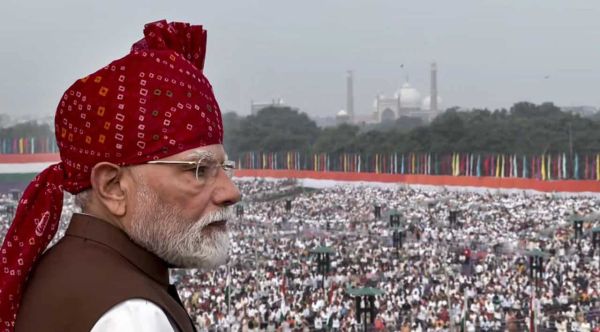
New Delhi: Prime Minister Narendra Modi’s Independence Day address from the Red Fort on Saturday, August 15, ran 75 minutes, his shortest speech in four years and the fourth shortest of his tenure, as he used the shorter address to unveil a seven-point reform framework called “Sapta Dhara” and warn that countries were increasingly turning resources and shipping routes into tools of geopolitical pressure.
Speech record
Modi’s address was well below last year’s 103-minute speech, itself a record that broke his own 98-minute address from 2024. His longest speech remains the 96-minute address he delivered in 2016, while his shortest came in 2017 at 56 minutes. His first Independence Day speech in 2014 lasted 65 minutes.
This was Modi’s 13th consecutive Independence Day speech from the Red Fort, a run that puts him second only to Jawaharlal Nehru, who delivered 17 in a row between 1947 and 1963; last year Modi had overtaken Indira Gandhi’s record of 12 consecutive addresses. Among Modi’s predecessors, Nehru’s 1947 speech and I K Gujral’s 1997 address were the longest at 72 and 71 minutes respectively, while Nehru and Indira Gandhi hold the record for the shortest at 14 minutes each, in 1954 and 1966. Manmohan Singh and Atal Bihari Vajpayee also delivered some of the shortest Red Fort speeches on record, with Singh speaking for 32 and 35 minutes in 2012 and 2013, and Vajpayee for 25 and 30 minutes in 2002 and 2003.

Sapta Dhara framework
Modi invoked the idea of the ancient “Sapta Sindhu” to introduce what he called seven new streams of strength the country must build over the next five to seven years to become a developed nation by 2047.
He listed manufacturing as the first stream, calling for India to build complete value chains from design to production and establish itself as a trusted global supply partner on cost, quality and scale. The second stream, agriculture and food processing, focused on getting Indian farmers into global markets, with Modi suggesting millets, spices, traditional cuisine and chemical-free produce could become international brands, aided by free trade agreements.
The third stream, technology and innovation, centred on artificial intelligence, quantum computing, space and robotics, with Modi calling for India’s digital public infrastructure and homegrown 6G technology to reach globally. The fourth, which he termed Gati Shakti, emphasised high-speed rail connectivity between cities and turning ports into engines of growth rather than mere loading points.
Defence formed the fifth stream, with Modi calling for self-reliance and global leadership in hypersonic technology, drones, counter-drone systems and cyber security. The sixth stream, the green and blue economy, covered green hydrogen, renewable energy and green manufacturing alongside fisheries, coastal tourism and ocean technology. The seventh and final stream, soft power, spanned yoga, Ayurveda, the “Heal in India” push, handicrafts, films and gaming, with Modi also flagging India’s underused potential in tourism given its forest cover and more than 100 national parks.
He said the seven streams were meant to work together rather than as separate sectoral efforts, forming a holistic push toward the 2047 development goal.
Energy security
Without naming specific countries, Modi said fuel, medicines and technology were being used as instruments of pressure internationally, and that key sea routes were also being squeezed. His comments came as fallout from the US-Israel conflict with Iran continues to disrupt shipping through the Strait of Hormuz, a corridor that carries a large share of the world’s oil and gas trade and matters heavily to India, which sources much of its crude and LNG through it.
Modi pointed to the government’s Rs 84,084-crore Samudra Manthan scheme for offshore oil and gas exploration as a step toward reducing that exposure, alongside a decision to open nearly all of India’s sedimentary basins to exploration. He also cited the expansion of piped cooking gas to 700 cities from 70 and a jump in solar power generation to 160 gigawatts from 2 GW a decade ago.
Economy
Modi said India had gone from being labelled part of the “Fragile Five” economies to the world’s fastest-growing major economy over his 12 years in office. He cited a fourfold rise in defence production, a sevenfold increase in electronics manufacturing and a 21-fold jump in modern railway coach output, along with sharp gains in internet use and digital transactions. He said India had begun production at three semiconductor plants, with several more planned, and announced plans to train one crore youth in artificial intelligence-related skills.
Defence and security
On internal security, Modi said Maoist violence was “breathing its last” in India, four decades after it first took hold, and credited his government’s push since 2014 with freeing large tracts of previously Naxal-affected territory. He said armed insurgents in forested regions had largely been dealt with, but accused what he called “dimagi Naxals” — people he described as sympathetic to Maoist thinking within institutions and policy circles — of trying to stir unrest, and called for identifying and isolating them.
On external security, Modi said progress was underway on the indigenous Sudarshan Chakra air defence system and that domestic defence production had risen to Rs 1.78 lakh crore in 2025-26 from Rs 46,000 crore in 2014, with exports reaching Rs 38,424 crore.
Education and youth
Modi said nearly 650 universities had been added over the past decade compared with fewer than 350 between 2004 and 2014, and that medical seats had more than doubled from about 400 before 2014 to nearly 850 now. He also announced free online coaching for students preparing for competitive exams, saying it would ease the financial strain on families who feel pressured to pay for private coaching.
Anti-drug campaign
Modi called drug addiction a major threat to the country’s youth and urged families, NGOs, volunteers and spiritual leaders to join the Nasha Mukt Yuva Abhiyan, a 100-week nationwide campaign he had launched virtually on August 2. Under the initiative, awareness activities including walkathons, meditation sessions, cultural events and community programmes are being held every Sunday across the country.
Infrastructure
Modi said 70 per cent of India’s rail network had been electrified in the past decade, compared with 30 per cent in the 90 years since electrification began in 1925. He also highlighted the country’s first hydrogen-powered train, which began service on Haryana’s Jind-Sonipat stretch in July.
Reforms and calamities
Modi called for closer coordination between the Centre, states and industry to meet the government’s 2047 goal of a developed India, saying decades-old habits of governance needed to change. He opened his address by expressing solidarity with families affected by floods and landslides this monsoon season in states including Assam, Kerala, Uttarakhand and Nagaland.
-
Take a trip around the world and shop without leaving Hyderabad

-
EAGLE probe finds Cyberabad cops, peddlers nexus in ganja racket

-
Bhagwat: Youth are demographic dividend but can be a burden too
-
Nagarjuna changes phone password every 15 days, know why
-
Manchester City star set to link up with former Liverpool boss in Saudi Pro League: report