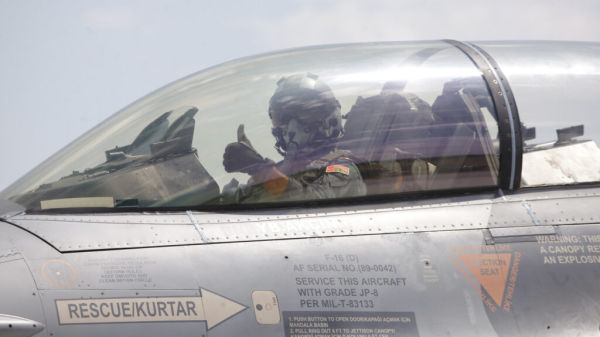
Unlike airliners, fighter aircrafts routinely experience multiple times the force of gravity, especially while maneuvering aggressively. These intense G-forces place enormous strain on the human body, making even simple tasks increasingly difficult. At the same time, success in a dogfight requires maintaining constant visual contact with an opponent, often while the aircraft is banked steeply through tight turning maneuvers. The Viper’s reclined seat was designed to help pilots withstand those extreme forces of air combat, while also improving their ability to keep an adversary in sight. Two advantages that contributed directly to the Viper’s success.
Since entering service on August 17, 1978, the F-16 Fighting Falcon (nicknamed the Viper by those lucky enough to work with them) has earned its reputation as one of the world’s most successful multirole fighter aircraft, due to features like the aforementioned reclining seat. A product of the USAF’s Lightweight Fighter Program, the Viper’s strengths and weaknesses were designed around one primary goal: Dominate the within-visual-range combat domain through exceptional maneuverability, supreme energy management, and an unbeatable sustained turn rate. It’s superior in many ways over F-4E fighter jets, with its design focused relentlessly on creating a small, agile dogfighter that gave pilots every possible advantage in a post-merge, turning dogfight.
This philosophy was ultimately realized across a number of design choices. Relaxed static stability, a blended wing-body design, and long leading-edge extensions gave the Viper its exceptional dogfighting performance. That performance was complemented by the introduction of several unconventional cockpit features that were revolutionary for the time, including a side-mounted control stick, a frameless bubble canopy, and, perhaps most noticeably, a cockpit seat reclined at 30 degrees. While unusual compared to almost every other fighter aircraft, all of these components and design choices were the result of extensive research into both pilot physiology and combat effectiveness.
Surviving the forces of air combat in a fighter jet
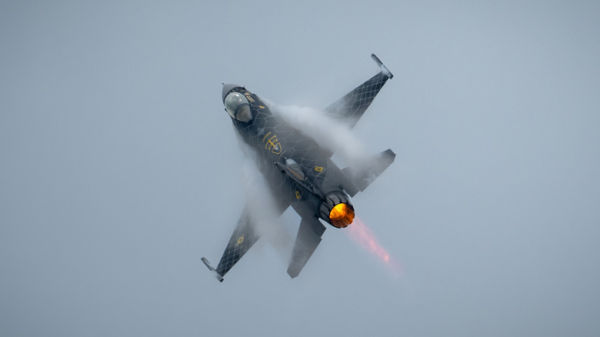
High-G maneuvering is one of the greatest physical challenges a fighter pilot faces. Throughout the aggressive turning and banking of a dogfight, a pilot’s body experiences extreme G-loading; forces attempt to pull blood away from the brain and towards the lower body, blood pressure in the head drops, and vision begins to narrow. This escalates to gray-outbefore eventually progressing to total G-LOC, or G-induced loss of consciousness. In the fast-paced, high-stakes competition that is an aerial gunfight, losing consciousness for even a few seconds can have catastrophic consequences.
The Viper’s 30-degree reclined seating position helps reduce this risk by changing the direction in which G-forces act on the body. Rather than pulling blood almost directly from the head to the feet, the reclined posture shifts more of the force through the pilot’s chest and back. This shortens the vertical distance between the heart and the brain, making it easier for the cardiovascular system to maintain blood flow to the pilot’s head during those high-G maneuvers.
The benefits of this seating design extend beyond improved G tolerance. Supporting more of the pilot’s weight across the back also reduces strain on the neck and spine during prolonged patrols or ferry flights, particularly when wearing a heavy flight helmet or night optic device. Today, pilots rely heavily on anti-G suits and specialized straining techniques to remain conscious under high G-loads, but only Viper drivers have that deep, reclined sitting position providing another layer of mitigation to the dreaded grasp of G-LOC. That extra layer of protection, perhaps an few more seconds of useful consciousness, may be what separates victory, defeat, or UFIT (Uncontrolled Flight Into Terrain).
Keeping an eye on enemy fighters
A key aspect of both basic and advanced fighter maneuvering is maintaining tallyor keeping the enemy within your field of vision. This allows a pilot to determine how and where they should maneuver to gain an advantage, or how an enemy may be counter-maneuvering. Lose sight of your opponent and you lose situational awareness, or, as the old saying goes, “lose sight, lose fight.”
Fighter maneuvers therefore prioritize positioning the aircraft to pull the reticle up and onto the target, a technique known as lag pursuit. This generally results in the target aircraft being held slightly above the horizontal focal plane of the pilot, and is where an adversary will naturally be positioned within one and two circle flow dogfights. This requirement to constantly look up and around through the higher aspect of the canopy demands enormous amounts of stamina in a fighter pilot’s neck and upper back muscles.
By leaning the pilot backwards by 30 degrees, the Viper’s seating position naturally positions the head and eyes to look higher through the canopy with less neck extension. This reduces muscle stress without reducing visibility across those critical vision sectors. Although this reclined seating position does sacrifice some comforts (particularly during use of the in-flight bladder release system) and reduces forward visibility during routine straight-and-level flight, those compromises were considered worthwhile.
That’s because the Viper was never intended to be optimized for cruise efficiency. It was built to win a knife fight in a phone booth, and almost every aspect of the aircraft represents that dogma. From its size, weight, and wing profile to its blended fuselage, bubble canopy, and reclined seating position, every aspect of the Viper reflects the uncompromising design philosophy behind one of the greatest rate fighters ever built. It’s no surprise the F-16 Fighting Falcon would go on to make history.