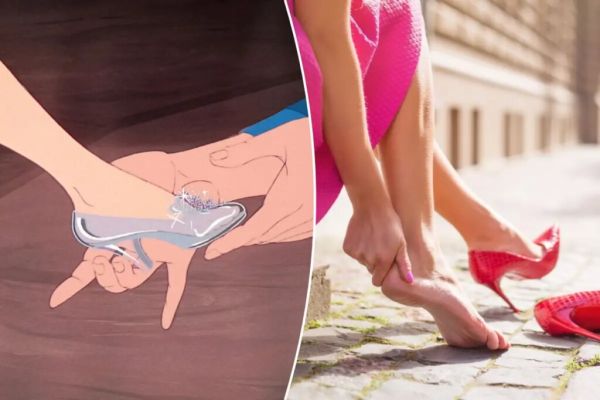
Walking a mile in someone else’s shoes is one thing. Fitting into your own shoes — decades after buying them — is another story.
“A very common misconception is that a person’s shoe size doesn’t change,” Dr. Rock Positanoa podiatrist and co-director of the Non-Surgical Foot and Ankle Service at the Hospital for Special Surgery in NYC., told The Post.
In reality, he said, “it is unlikely that your shoe size at age 20 is going to be the same at age 50.”
But plenty of people never get the memo. A large body of research shows that most people are wearing shoes that don’t properly fit their feet.
One landmark study found that, among 356 women examined, a majority were cramming their dogs into ill-fitting footwear — and had gone up in shoe size since their younger years.
There’s even a name for trying to squeeze your feet into a pair that’s too small. “It’s the so-called ‘Cinderella complex’ of trying to fit a Size 9 foot into a Size 7 shoe,” said Positano.
But that fairy tale can have a seriously painful ending.
The same study found that many women wearing too-small shoes had foot pain and deformities, problems that can take a major toll on quality of life.
“Foot and ankle pain may not be life threatening, but it certainly is lifestyle threatening,” Positano said. “Exercise, walking and socializing can be greatly affected in an adverse way.”
Feet can change with age for several reasons. For starters, putting on a few extra pounds can also mean needing a little more room in your shoes.
“It causes the foot and its soft tissue muscles, tendons and ligaments to change shape to accommodate the weight gain,” Positano said.
Women who have had children can also see their feet grow.
“The increase in weight causes foot changes and swelling increase, but there is also a hormone called relaxin that is produced in the first trimester that helps the ligaments to loosen in the birth canal to facilitate delivery,” Positano explained.
“The foot has many ligaments, and this hormone affects them as well, which can cause an increase of one or two shoe sizes.”
Aging itself can also bring a greater risk of foot problems that alter shoe size.
Especially after 50, women are more likely than men to develop problems such as joint pain, collapsed arches, plantar fasciitis, bunions and hammertoes, all of which can change fit and comfort.
Hormonal fluctuations during pregnancy and menopause play a role, but footwear choices can also be a culprit. Narrow, tapered toe boxes and high heels shift weight forward and squeeze the toes into unnatural positions, potentially causing structural damage over time.
And wearing the wrong size can make matters worse, contributing to deformities as well as pain that can travel well beyond the feet.
“Shoes that don’t fit correctly may cause a variety of problems such as tendonitis, blisters, ankle swelling and knee, hip and lower back pain,” Positano said.
So before you kick off your old shoe-shopping habits, take a few tips to heart.
“It is recommended to fit new shoes in the afternoon when the foot is most swollen from daily activities such as walking and standing,” Positano said.
When measuring your feet, stand up and put your full weight on them. Check both feet, too — one is often bigger than the other. When choosing shoes, fit the larger foot.
You should also leave about a thumb’s width of space between your longest toe and the front of the shoe to prevent toe crowding. The ball of your foot should line up with the widest part of the shoe sole.
And forget the old idea that a little discomfort will eventually disappear.
“There is no such thing as ‘breaking in a shoe,’” Positano said. “The shoe fit should be comfortable in the arch, the heel and the front of the foot.”
-
Fiber Benefits: Lack of fiber in the diet can prove costly, know why it is important and which things will provide you with plenty of fiber.

-
Asian Games 2026: India’s Jemimah Rodrigues ruled out

-
T20 leagues pushed international cricket to backseat: Harbhajan – Tezzbuzz

-
Hockey World Cup Winners: India or Pakistan, who has won more Hockey World Cup?

-
JP Nadda Health Update: JP Nadda underwent coronary angiography, treatment is going on in the cardiology department of Delhi AIIMS, know why this test is done?