Edited by: Darko Janjevic
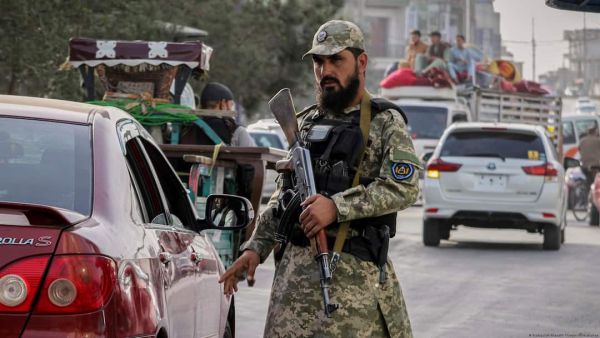
Less than a month before the five-year anniversary of the Taliban retaking power in Afghanistan, the Islamist regime lost control of the Yaftal-e Payeen district capital in the northeastern province of Badakhshan. The disruption was temporary, but it nevertheless marked the first time the Taliban lost control of a district center since returning to power in August 2021.
Reports from Badakhshan also indicated internal clashes among Taliban fighters and fatal attacks on high-ranking Taliban officials.
On August 2, some two weeks after the brief loss of the district center, former Afghan army general Sami Sadat ordered his forces to launch attacks against the Taliban across the country.
"Today at 5:00 AM, I ordered all military members of the United Front to begin military operations," General Sadat said in a video message released from the US, where he has lived since the fall of Afghanistan to the Taliban.
Other armed groups, including the National Resistance Front led by the son of the late commander Ahmad Shah Massoud, have been engaged in a continuous armed struggle against the Taliban since 2021. While armed insurgents have not been able to pose a major threat to the Taliban's overall grip on power, experts are questioning whether the clashes in Badakhshan could pave the way for more impactful resistance.
"In these five years, this opposition existed in two forms: political and military... As the five-year mark approaches, both forms of opposition have taken shape," former Afghan Interior Minister Mohammad Umer Daudzai told DW.
Fear of new proxy wars in Afghanistan
The Taliban have reigned with an iron fist since the collapse of the US-backed Afghan government five years ago. The Islamist regime denied basic human rights and imposed strict restrictions on women, banning them from work and education beyond the sixth grade. Women are mostly banned from public life in Afghanistan as well, and have few rights at all.
Most former government officials are in exile. While the Taliban maintain that all Afghans are free to return and lead ordinary lives, opponents counter that return is only viable if political activity is permitted.
While the regime managed to cultivate some contacts internationally, they are still viewed as illegitimate by most of the world's governments. To date, only Russia has acknowledged the Taliban as the official government of Afghanistan.
Facing pressures both within and outside of the country, the Taliban repeatedly pointed to the restoration of nationwide security as their primary claim to legitimacy. However, experts warn that their governing style could in fact enable armed rebels to challenge them in various parts of Afghanistan.
"If this policy of the Taliban continues, armed forces will emerge against them, opposition will emerge, interference from neighbors will arise, and ultimately the ground will be prepared for proxy wars," former Acting Minister of Defense Shahmohammad Miakhel told DW.
Beyond political opposition, the regional branch of the "Islamic State" (IS) remains active in Afghanistan. The group has claimed responsibility for several high-profile attacks against Taliban officials, including a January explosion at a Chinese restaurant in central Kabul that killed at least seven people, and a December 2024 suicide bombing in Kabul that killed the regime's Minister of Refugees Khalil Ur-Rahman Haqqani.
Taliban claim Pakistan supports insurgents in Afghanistan
The strongest challenge to Taliban control could originate from outside Afghanistan's borders. Relations between Afghanistan and Pakistan — once considered one of the Taliban's closest allies — have been fraught with tension since 2021, erupting in full on clashes this year. According to a United Nations report from May, cross-border hostilities during the first three months of 2026 resulted in at least 372 Afghan civilian deaths and nearly 400 injuries.
"When Mr. Sami Sadat issues such an order from America to those who must fight the Taliban, he has certainly seen a green light. And remember that in Afghanistan, no group and no one can carry out any activity without the support of one or more foreign countries," former defense ministry spokesperson Mohammad Radmanish told DW.
While the Taliban publicly downplay the threat posed by rebel groups, they also allege that external support for armed resistance is rising.
"We are aware that lame ducks were invited to Pakistan [...] A large group has been invited to Islamabad who are now discussing where they can have an office and center and refuge," Taliban spokesman Zabihullah Mujahid told DW in an interview.
When pressed by DW to provide evidence for these claims, Mujahid offered no proof.
'Islamabad has used all its options'
Pakistan accuses the Taliban of providing safe havens to militants executing attacks inside Pakistani territory, particularly the Tehreek-e-Taliban Pakistan (TTP). The Taliban deny these charges, in turn accusing Pakistan of harboring hostile elements and violating Afghan sovereignty.
Qamar Cheema, an Islamabad-based security expert, told DW in February that it is Pakistan that is targeting the militant groups.
"Pakistan wants the Afghan people to understand that the Taliban are harboring terrorists. Therefore, Pakistan will continue targeting military sites associated with the Taliban, TTP and ISIS-K hideouts," Cheema said.
"Islamabad has used all its options, including regional diplomacy and direct communication, but nothing has been honored," he added. "As a neighboring Muslim country, Pakistan appears to inflict damage in an attempt to alter Taliban behavior."
Disclaimer: This report first appeared on Deutsche Welle, and has been republished on ABP Live as part of a special arrangement. Apart from the headline, no changes have been made in the report by ABP Live.
-
Army personnel who saved comrades' lives, injured terrorist chosen for Kirti Chakra posthumously

-
Ex-employee, three others arrested for robbing liquor contractor of Rs 1.53 lakh in Faridabad

-
IAS officer hearing Jauhar University case gets central deputation

-
Minister Agnimitra Paul, celebrities take part in women's ‘Freedom Beyond Midnight’ march in Kolkata

-
NHRC notice to states, UTs, FSSAI over concerns raised about sale, consumption of 'analogue paneer'