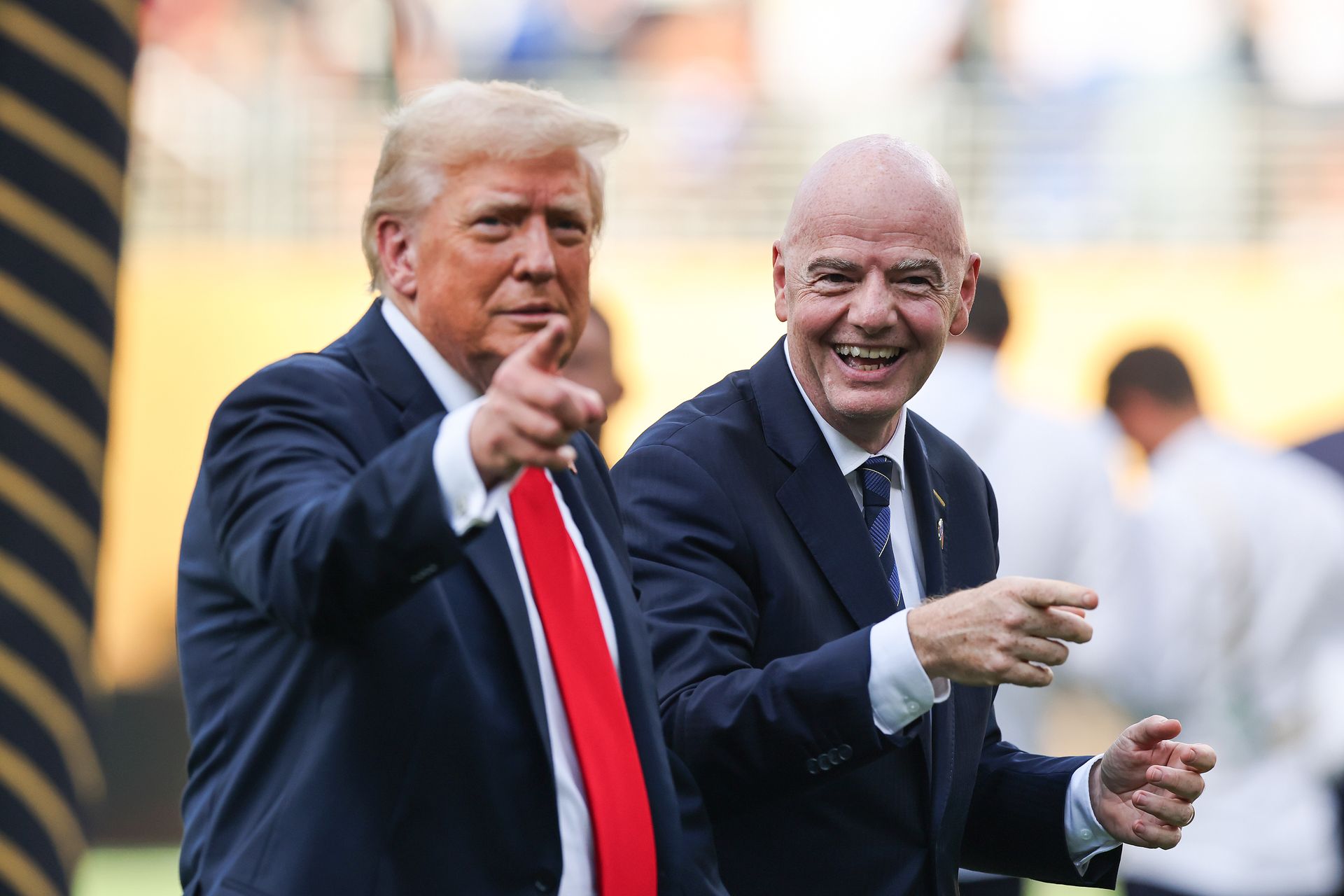
FIFA president Gianni Infantino, who is under heavy pressure, has the clear backing of Donald Trump, yet he remains in office in any case.
Infantino is holding on to his position despite broad criticism of his proposal to sell a sizeable share of the World Cup’s commercial rights to private investors. People linked to Trump were reportedly set to be involved, but opposition from across the world and from within FIFA brought the proposed sale to a halt.
UEFA seized the moment to assert itself. The fact that Infantino’s plan gave the European confederation the chance to raise concerns about the integrity of football only underlines how deeply unpopular the FIFA president’s leadership has become.
Resistance to Infantino’s sell-off proposal, and to his presidency more generally, has come from around the globe, though it has not been universal. UEFA is among the organisations prepared to stand firm, but there are reasons why Infantino has retained such broad support, and those factors are not disappearing.
Dangling huge sums of money in front of financially strained federations was meant to help secure backing for Infantino’s World Cup plans. But when it comes to safeguarding his position, he has more than one way to do it.
“Gianni Infantino has reportedly expressed a willingness to support another expansion of the World Cup,” the Mirror reported.
“It has been suggested that Infantino would be in favour of the tournament increasing from 48 to 64 teams, amid ongoing uncertainty around his future in the job.
“Infantino travelled to Colombia on Friday to attend the inauguration of the country’s new president, Abelardo de la Espriella, where discussions over a potential expansion of the World Cup are said to have taken place.”
Any expansion of the men’s World Cup from 48 teams to 64, just as with the earlier move from 32 to 48, is driven by considerations beyond the pure commercial value of a bigger tournament or any flimsy claim that it brings in more federations in the name of developing the sport.
Every FIFA Member Association has one equal vote. Major decisions are approved on that basis, a system that is open to smaller federations being disproportionately swayed by, for instance, £30 million, and also to issues such as bloc voting.
With 211 members worldwide, FIFA’s president would effectively be telling a large section of his electorate that he is giving them a route into the World Cup for the first time.
That is a difficult offer to reject, and it is equally difficult to vote against the president who supports it, regardless of how far he may be neglecting his responsibility to a sport for which he appears to have little regard.
The problem for Infantino is that a 64-team World Cup can only become a meaningful part of his manifesto if some of those additional places go to European teams.
For now, the shelving of his earlier plans has not removed UEFA’s threat to boycott FIFA competitions. The European governing body demanded guarantees for the future and appears to believe Infantino is vulnerable.
UEFA is not acting in isolation, but even if a larger World Cup were to pull away some of its allies, and even if all 156 non-UEFA nations voted in favour of the move and then backed Infantino, Europe could still bring the World Cup to a halt in one move.
-
5 hours from Hyderabad, this tiger haven is worth the drive

-
Trump’s antisemitism lawsuit against Harvard University dismissed

-
We are beggars: JNU Vice-Chancellor pitches for campus temple

-
What have I done: Jinnah’s reported reaction to Partition
-
Samay Raina gets last laugh as SC quashes all FIRs against him