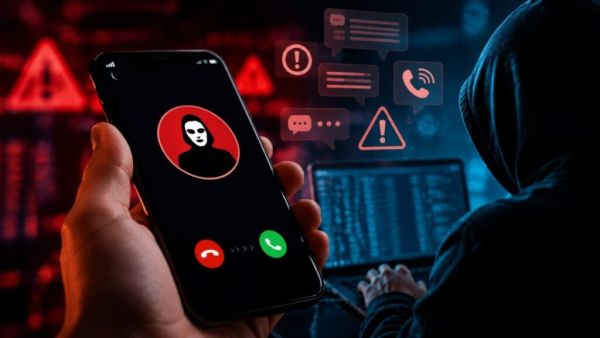
Technology Desk: The problem of spam calls and unwanted messages is continuously increasing in India. Telecom companies and the government are taking the help of AI i.e. Artificial Intelligence to stop these calls. Now the latest data from Telecom Regulatory Authority of India (TRAI) has revealed the big picture of this problem.
According to TRAI, between April and June 2026, more than 24.4 billion calls and messages were identified as potential spam in the country. These include about 22.99 billion incoming calls and 1.44 billion SMS. That is, during this period, an average of about 266 million communications every day were considered potential spam.

3.2 percent of total calls are suspicious
According to TRAI data, about 3.2 percent of the total calls received during April to June were identified as potential spam. Telecom companies analyze caller patterns and messaging activities with the help of AI based systems. If the activity of a number or organization appears suspicious, it is flagged as a potential spammer. In this way AI systems are helping to identify suspicious activities by analyzing large numbers of calls and messages simultaneously.
More than 22.99 billion suspicious calls identified
The AI-based spam detection system used by TRAI and telecom companies identified about 22.99 billion suspicious calls. A large number of these calls may be used to harass people, give wrong information or commit fraud. Apart from this, about 1.44 billion suspicious SMS also came under the monitoring of the system. Methods like fake KYC updates, banking information, loan offers, rewards and false claims to UPI are used in spam calls and messages.
action against spammers
The government and TRAI have taken action at several levels to stop spam communication. Action has been taken against more than 1.83 lakh telecom resources for violating rules.
Of these, about 1.37 lakh numbers were blocked for 15 days for breaking the rules for the first time. At the same time, 46,786 connections that repeatedly violated the rules were disconnected for one year. The purpose of this action is to remove such numbers and connections from the network that are being repeatedly used for spam or suspicious activities.
263 Bulk SMS sending blacklist
Action has also been taken against institutions sending spam and fraudulent messages. According to TRAI, 263 bulk senders have been blacklisted.
Apart from this, 2,873 SMS headers were also blocked. SMS headers are used by companies and organizations to send large numbers of messages. Action was also taken against them if any violation of rules or suspicious activities came to light.
Big telecom companies also fined
The responsibility of stopping spam does not lie solely with the spammers. Telecom companies also have to keep an eye on suspicious activities happening on their networks. TRAI has also taken action against major telecom companies for lack of compliance with the rules. These include companies like Reliance Jio, Airtel and Vodafone Idea. Financial penalty has been imposed on these companies in cases to negligence in stopping spammers.
Spam calls are being used in cyber fraud
Spam calls are not just limited to being annoying. They are also being used for cyber fraud.
Fraudsters often call people pretending to be bank officers, government employees, representatives of telecom companies or employees of any big company. After this, sensitive information is sought from people in the name of KYC update, information to bank account, credit card, loan or UPI. In many cases people are also asked to click on a link or download an app. After this an attempt to cheat is made.
Trying to identify spam with AI
It is not possible to manually check such a large number of calls and SMS. Therefore, telecom companies are identifying suspicious activities with the help of AI and data analysis.
The AI system tries to see how many calls are being made from a number, what is the calling pattern and whether the messaging activity is normal or not. If activity from a number or organization appears to deviate from the standards, it may be flagged as potential spam. This helps in taking timely action on suspicious numbers and resources.
Why increased concern for common people?
The large number of spam calls also raises concern because not every call is just an advertisement. Some calls and messages can be used to scare, lure or extort money from people by gaining their trust. People are targeted by making excuses like fake KYC, bank account closure, electricity bill, loan, job, reward and UPI transaction.
In such a situation, it can be risky to share banking information, OTP, UPI PIN or other sensitive information on a call or message from an unknown number without checking.
-
Jamie O’Hara urges Tottenham to ask Manchester United for Marcus Rashford: ‘How much do you want?’

-
Hair will be nourished and strong with curry leaves, just mix these 5 types of oil before applying it on your head

-
Mumbai's Iconic Shree Thaker Bhojanalay Shut Due To Food Safety Violations? Eatery Clarifications

-
Floral tributes on the 231st death anniversary of Ahilyabai Holkar at Samarpan Arts and Commerce College.
-
IND vs SL: Will Sri Lanka trap Shubman Gill's team in goal? Dhananjay told the complete game plan