Quite often, it takes losing something—or having it stolen—to fully understand what it meant to you.
Creativity finds expression in countless ways in the world of cars. One person with an airbrush can transform the sides of a 1975 Ford Econoline into rolling artwork. Colin Chapman was endlessly inventive; Banjo Matthews somehow spotted possibilities in NASCAR chassis that others missed; Don Garlits was the one who made rear-engine Top Fuel dragsters work; and Bill Stroppe changed off-roading with the Big Oly Bronco. Add names such as Aurelio Lampredi, Marcello Gandini, Giorgetto Giugiaro, and more than a few Germans as well. Every one of them has rightly been celebrated for brilliance. Legends.
Now think about the bench racer. This is a more everyday kind of automotive creativity, and most of the time it leads to... nothing. It is those of us fiddling with Porsche’s configurator to dial in our ideal 911 while our Wells Fargo account is already stretched too far. It is car enthusiasts knocking back Michelob Ultras from lawn chairs while explaining how they would build the ultimate ’69 Camaro. It is me.
And this was the one occasion when one of my daft ideas actually became a real car. And then it went back to being only an idea again. Because thieves.
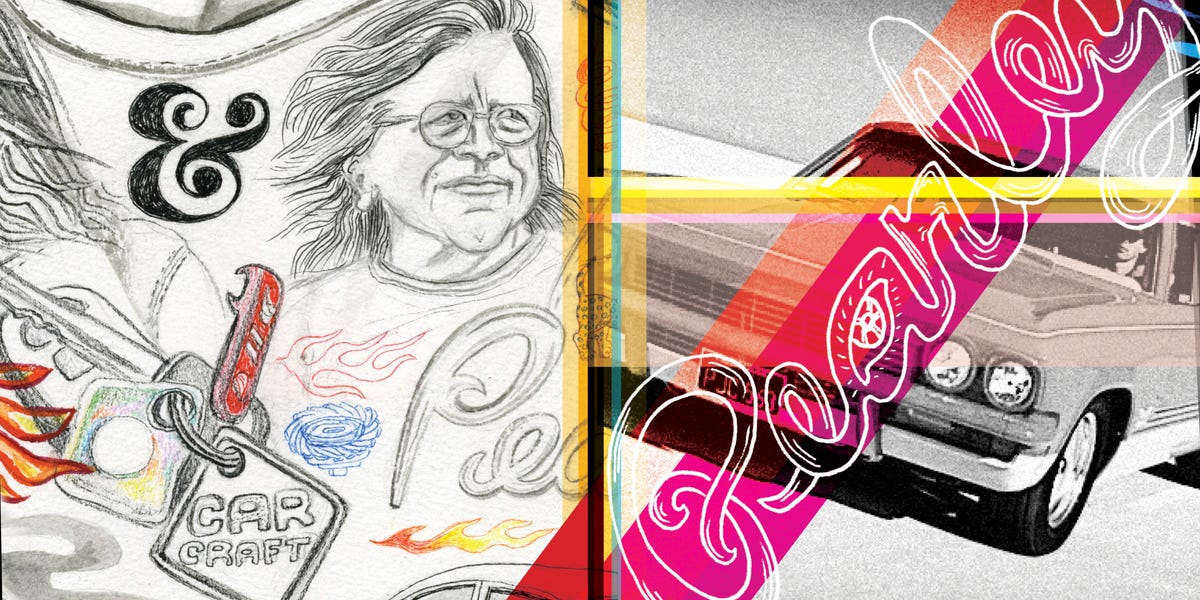
In 1990, I joined the staff of Car Craft magazine. It was a proper “wrench book” for people passionate about modifying American metal. It was my first magazine job, and I was only just beginning to understand both the limitations of the medium and my own.
By early 1991, there were already signs of softness in the magazine market. “We need to start something new,” my then-boss Jim McGowan said. Or something very close to that—it was a long time ago. Project cars were a dependable staple for magazines. “Let’s build an Impala,” I suggested.
At that point, the accepted wisdom was that nobody cared about the big cars—everything revolved around Sixties and Seventies mid-size Chevelles and compact Camaros. But California was cracking down, as it always seems to do, on modifying cars that had originally been fitted with emissions controls. That meant anything built after 1965. So if Car Craft was going to do something different, but not too different, it had to be a 1965 Chevrolet Impala. Almost nothing else could thread that very specific must-be-a-Chevy needle.
After several rounds of corporate manoeuvring, I found a red ’65 Impala SS for sale in the San Fernando Valley. It cost $1700. My boss’s boss, Len Emanuelson, gave it the rather trite name “Project Heavy Metal”. By the end of 1992, it had become a huge coupe, eventually painted orange and beige for no particular reason, powered by a 560-plus-hp fuel-injected 496-cubic-inch (8.1-litre) big-block, and finished with every tired early-1990s cliché in the book. That meant billet machined parts, tweed upholstery, and Center Line wheels.
I wanted wheels with a larger diameter, a cleaner paint treatment, and a flat bonnet. Even so, it still reflected my basic idea. Broadly. More or less. No car built by committee is ever going to match one individual’s vision exactly. But the central idea—that big cars could make entertaining street machines—was mine.
And the car was quick, covering the quarter-mile in 11.8 seconds with a 114-mph trap speed, running open exhaust and eight-inch slicks. It stopped well too, thanks to JFZ brakes borrowed from NASCAR racing, handled astonishingly well for something of its size, and turned out rather brilliantly.
So Heavy Metal was sent out on the car-show circuit, where the people responsible for looking after it treated it terribly. When it returned to Car Craft, we repaired the damage they had caused and stored the car in a shop in the San Fernando Valley. Then I left Car Craft in July 1993 and started freelancing.
Then Heavy Metal was stolen. Someone broke into the shop and took it in 1994. My friend Ed Taylor phoned to tell me. “The Impala is gone,” he said with a firmness just shy of requiring an exclamation mark. “We came in this morning, and it was gone.” Nothing else had been taken from the shop, so we spent about 20 minutes entertaining several conspiracy theories. Ed called the police.
I had other things to worry about, and I assumed whoever had taken Heavy Metal had already chopped it up. Then in 2002, a full eight years later, I was out with my infant son Jack, pushing him in a stroller around my neighbourhood in Santa Barbara. On Hope Avenue, literally 100 yards from my house but 100 miles from the shop where the orange Impala had been stolen, there sat a 1983 Ford Country Squire wagon carrying Heavy Metal’s fenders and fuel tank in it. They were impossible to miss: huge, painted orange and cream, and wearing the “496” and crossed-flag logo applied by the great Steve Stanford. There was no other car those fenders could have come from. What the... ? Practically outside my house?
I wrote a short item for Car Craft and left a note asking the owner of the Country Squire to contact me. That person did get in touch, saying he had bought the parts in the wagon from a service man at a dealership in Palmdale. But after speaking with him, I realised my heart was no longer in chasing down Heavy Metal’s fate. I had no financial stake in the car. It was not as though I could file an insurance claim.
Looking back now, though, I wish I had stolen those parts out of that Country Squire. Because it was still my idea. My imagination was the seed that started that car.
I am not claiming that nobody else built big cars, but no popular magazine had done it before. And I am not pretending it was as significant as inventing ground effects or using an engine as a stressed chassis member, but it was my idea. And that idea did not disappear when the car did. I still possessed the notion.
When I think about Heavy Metal now, I think about the friendships that came with it. Big Mike Johnson and Eddy Taylor did most of the work, and both are gone now. Master fabricator Larry Ruth later moved to South Dakota and built an America’s Most Beautiful Roadster winner. Kenny Duttweiler built the engine, and he remains one of my heroes. We invested so much time in that thing that, in the end, the time mattered more than the thing itself. It would be nice if the car still existed, but it would not alter my memories or the unreasonable pride I still take in having come up with the idea. The car was only an artefact.
And I am still daydreaming and bench racing.
In our heads is where all good things begin. Whether that means Enzo Ferrari in 1948, Mate Rimac in 2009, or the people at GM losing their minds in the best way and conjuring up the Corvette ZR1X. Or me persuading my bosses that an old Impala could be cool. That is also one of the useful things cars do for those of us who simply love them—they let us imagine greatness even if we never get to drive a Lamborghini or race the Chaparral 2K at Indy. Even in my grumpy old age, I still think myself to sleep mentally specifying how to build killer Camaros, nasty Hondas, and the perfect Mercedes C123 coupe.
I still appreciate great concept art as well. Murray Komant is one of the finest artists around. We got talking, and I mentioned my affection for the 1969 Fiat 124 Sport Coupe. I owned two of them long ago, when I had only just started driving. They were tiny, not especially powerful, and absolutely beautiful.
Murray created two illustrations of what the ideal 124 Sport Coupe would be from our shared vision. I picture it with the naturally aspirated V-8 from a Ferrari 458 under the bonnet, paired with a T56 six-speed transmission and sending power through a custom chassis that would handle at least as well as an E46 M3. I also imagine building it out of something better than the dreadful Russian steel Fiat used back then, which seemed to dissolve if you merely looked at it from the side. Murray prefers the wire wheels, but I favour the Ferrari discs. I would not call either of these cars—which will never exist anywhere beyond the illustrations—Heavy Metal. But they are spiritual successors to that car because they began in my head.
Artificial intelligence can create illustrations too. But imagination? That still requires something human, and Murray’s human touch gives the artwork real depth. And turning something like this into an actual build would require another thing AI cannot copy: ambition.
At the moment, I do not have the ambition—or the talent—to build something like that 124 Sport Coupe. But it is my idea, and that is wonderful enough. Heavy Metal is gone, but it is still wonderful too. And every time I see someone build a hot-rod Impala, or any other Dreadnought-class hot rod, I am deluded enough to believe that at least some of the inspiration traces back to my idea, now 35 years old, to build Project Heavy Metal. I still hate that name as well.
-
Zayn Malik promotes greenpeace ‘Be Cool’ Tee amid UK heatwave

-
Does Kulhar tea taste delicious in the rain? Know here whether drinking tea is beneficial or harmful

-
3 Zodiac Signs Attract Major Financial Success On August 14, 2026

-
World’s ‘most beautiful island’ named among Asia’s preferred destinations by European tourists

-
Now dearness allowance will be available four times a year! New secret revealed in front of 8th Pay Commission