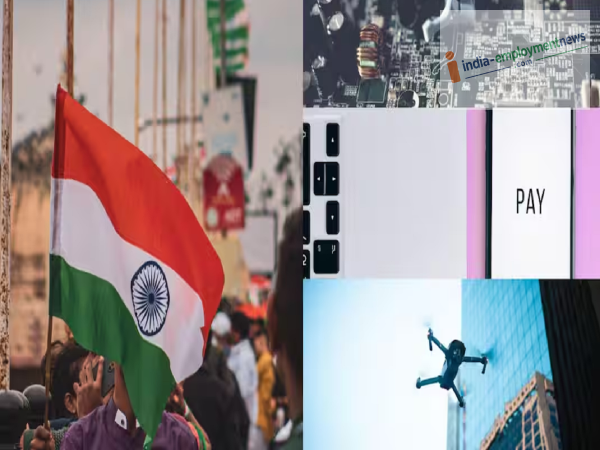
Digital India: As Digital India marks 11 years, initiatives like online banking, DigiLocker, FASTag, e-governance, digital payments, and rural internet connectivity have significantly simplified the lives of ordinary citizens.
Digital India: The Digital India initiative, launched on July 1, 2015, has now completed 11 years. Few government schemes have brought about as much change in the lives of the common man as this one. From long queues at banks to hours of waiting at toll plazas, technology has made tasks easier everywhere. On the occasion of Independence Day, let us explore the various ways Digital India has truly transformed our daily lives.
Online Banking
Previously, one had to visit a bank branch for even the smallest task; now, everything—from transferring money and checking balances to opening fixed deposits—can be done via mobile phones. Today, India handles nearly 50 percent of the world's real-time digital payments, demonstrating just how deeply online banking has integrated into people's lives.
DigiLocker
DigiLocker has completely revolutionized the way essential documents are managed. Documents such as Aadhaar cards, driving licenses, marksheets, and other important papers are now stored securely on mobile phones instead of as physical copies, allowing them to be presented anywhere whenever needed.
FASTag
Long queues at toll plazas are now a thing of the past. Thanks to FASTag, vehicles can pass through toll booths without stopping, which not only saves time but also reduces fuel consumption.
E-Governance
E-governance has played a pivotal role in making government services transparent and efficient. Through Common Service Centres (CSCs) established in villages, citizens can easily access a range of services—from applying for passports to purchasing insurance. Currently, over 400,000 such centres are active across the country, bringing government services right to the doorsteps of rural communities.
Digital Payments
UPI has completely transformed the way financial transactions are conducted. With the help of platforms like PhonePe, Google Pay, and Paytm, cashless payments have become commonplace everywhere—from vegetable vendors to large malls—significantly reducing the reliance on cash.
Rural Internet
High-speed internet is being extended to every village through the BharatNet project, making services such as education, healthcare, and banking easily accessible to rural populations. By June 2026, approximately 2.21 lakh Gram Panchayats had been made service-ready under this scheme, and by March 2026, the number of internet users in the country had crossed the 109.27 crore mark.
-
MI London Crush Sunrisers by Seven Wickets at The Oval

-
Hairline is thinning? For thick hair, use onion peel in this way, within a month, hemp will look fuller

-
Independence Day Special: A colorful feast of patriotic stories on Airtel IPTV

-
Google Pixel 11 Pro Fold launched in India, the company's most expensive phone with a price of Rs 1.86 lakh and a foldable screen

-
Pitch invaders take selfies with Fernandes as Manchester United draws with Leeds in friendly