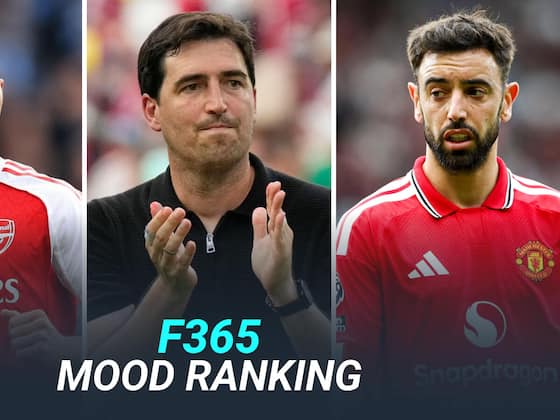
We are getting our excuses in absurdly early with this pre-season reading of Premier League moods. It feels almost uniquely difficult to judge how anyone is feeling before a season in which so many clubs, big and… less big, have such a huge spread of possible outcomes.
There are so many new managers, so much uncertainty, and so many sides who could be top by Christmas or dragged into an unwelcome relegation scrap that trying to capture one clear mood from each club is next to impossible.
The one thing that looked reasonably safe was Arsenal, the reigning champions and the one major club where some sense of certainty and stability still exists, feeling pretty pleased with life. But even there, nagging doubt and uncertainty have crept in.
Then there are your Aston Villas, where entirely justified excitement and optimism about the business they have done has been completely drowned out by bitter moaning about what those nasty Premier League bean-counters will not allow them to do.
There is simply no unanimous view anywhere about anyone. Not even at Newcastle, where there remain alarmingly large numbers of people, including many professional journalists, who do not think they are f*cked.
It is fascinating to read the replies on X-formerly-Twitter to Luke Edwards’ effort to persuade Newcastle fans – and perhaps himself – that everything might still be okay despite a summer in which the club have now lost three of their best players and their manager.
‘It’s been a car-crash summer but Newcastle 2.0 can still work’ is a headline that has certainly grabbed Newcastle Twitter’s attention.
What makes it interesting is that they are largely united in being furious about it. Just for two entirely opposite reasons.
There are those who are not willing, at this stage, to entertain any optimism at all about what might await Newcastle in the short, medium or long term. It must be said, this is the majority view.
But there is also a sizeable minority of happy-clappers whose annoyance is aimed not at the idea that things might somehow still turn out okay, but at the suggestion that it has even been a car crash in the first place. To us, that is a fascinating perspective.
We have to assume it is copium, because this has been a worse summer than Newcastle could realistically have feared. And they were already fearing another difficult one after a traumatic 2025 summer and a deeply disappointing 25/26 season.
Mediawatch has gone into Edwards’ piece in some detail, but the key point for us is the notion that losing a manager and, over the last 12 months, four of the biggest and most important players in the squad, then replacing them with a manager who has no big-league experience and a collection of young, inexperienced players, is somehow a plan that really works well for anyone, anywhere.
There is, as the wry old Mediawatch put it, more than a hint in Edwards’ desperate attempt to apply some positive spin of the Arrested Development ‘but it might work for us’ meme.
Perhaps more importantly, even this attempt to paint the most optimistic picture imaginable of recent events still contains an acceptance of failure.
The idea behind Newcastle 2.0 is to become a bigger version of the admirable and clever B teams – your Brightons, your Brentfords, your Bournemouths.
There are two problems here. First, even if it works, it is still a failure. Because that is simply not the vision supporters were sold when they were effectively being asked to hand their soul to the Saudis. Newcastle fans did not throw away the huge amount of goodwill that genuinely existed towards the club just to become a slightly bulkier version of Brighton.
They were promised – or at the very least clearly expected – a route towards Man City or Chelsea levels of success that might conceivably justify the means and generate enough noise to silence those awkward voices in their heads.
Becoming Bournemouth, only on a slightly larger scale, was never going to be worth all that trauma.
But there is a second and even more fundamental issue. It will not work. It cannot work. Newcastle cannot be merely a slightly bigger version of the B teams because that is not a real place in football’s food chain. It is not a rung Newcastle are prepared to accept.
This is a club whose supporters have started an online debate over whether Arsenal are even meaningfully bigger than they are.
Newcastle 2.0 looks like a club busy turning a floor into a ceiling, not so much trying to manage expectations as trying to flatten any remaining ambition or even hope.
How do they ever achieve escape velocity from these reduced circumstances? There were no guarantees that trying to become a proper member of the Big Six/Seven/Eight/Whatever would work, but at least it plausibly might have. If, in the wildly unlikely event, all these very talented but very, very raw new ingredients somehow combine by some alchemic miracle into a team capable of challenging the top six, what stops them all simply being picked off if Newcastle are only trying to become the Biggest Bees?
The current crop have been picked off at a time when Newcastle still had, at least in theory, loftier ambitions and could try to persuade those stars whose value had soared in black and white that they could fulfil their goals here.
How do you do that with a next generation where even that possibility apparently no longer exists?
A catastrophic worst-case scenario now looks far more likely for Newcastle than any best-case scenario. And that is not only because we are no longer entirely sure what a best-case scenario even looks like for a club that reached the Champions League only 15 months ago but has been doom-spiralling ever since.
So, in summary: things look much more likely to go badly than well. And even if they do go well on the club’s newly stated terms, they still probably end up being quite bad.
It could be a very long season on Tyneside.
Are they in You Fear For Them territory? They absolutely are. Marco Silva’s departure had begun to feel inevitable, but that does not mean we have to enjoy it. He had become one of the few dependable constants in the spinning chaos of the managerial merry-go-round.
You always knew what you would get from Silva, and therefore from Fulham. That certainty has now gone.
After a summer that has brought nine managerial changes among the 20 Premier League clubs – while two more have managers appointed only this year – it is not as though Fulham’s unpredictability is unique.
But it is one of the places where it feels most pronounced. To our minds, they have made the least convincing managerial appointment among the mid-table group who have either chosen or been forced down that route.
Add to that a squad which, in every area, looks short either on numbers, quality or both, and concern comes easily. Especially with last season’s talisman Harry Wilson having wandered off north to Leeds.
Another awkward summer for Villa, but you would like to think we all learned the lesson from last year that if there is one club where awkward summers – and even difficult starts to the campaign, if it comes to that – need not cause too much anxiety, it is Villa. As long as Unai Emery is there, everything will be fine.
They have actually done what looks like some very decent just-below-the-elite-tier-trading-club business this summer. Big money has come in for Morgan Rogers, and it has been reinvested in all manner of exciting ways – most notably Johan Manzambi.
And yet the dominant emotion pouring out of the club this summer has been resentment and frustration and a kind of teenage howl that it is just not fair.
We do think Aston Villa fans would be happier if they stopped directing their frustration over not being able to spend money they do not have at a Tottenham side spending money they do.
It is obviously #NotAllVillaFans, but a large number of Villa supporters do keep asking the same question even after it has been answered several times. At this point, the only conclusion is that they simply do not want to hear an obvious but boring answer involving two decades of development, building the best stadium in the country, and spending so carefully that it once reached the low point of going through three transfer windows without a single signing.
We understand why Villa – and Newcastle – see Spurs’ spending as the most visibly frustrating thing when they themselves feel shackled by the rules, because Spurs always seem the nearest of the ‘Big Six’ to the rest, even when they are not the conspicuously weakest of that group on the pitch, as they have hilariously been for the last two years.
But Spurs are not the villains here. They are a roadmap for how to crash the party where the real villains are found, but they are also a reminder that the only route to that status that does not involve cutting corners or taking shortcuts is long and hard, and neither Villa nor Newcastle really want to hear that. Understandable, perhaps, but not especially helpful.
Everything comes down to whether Pierre Sage turns out to be an Oliver Glasner or a Frank de Boer. It genuinely feels as though it could be either.
His Glasner-like credentials are solid. If you manage a French club that is not PSG, then winning the Coupe de France and finishing a reasonably close second in the league is about as good as it gets. But the thing with France is that it is still France.
This is not France. This is England, mate. You know, proper football.
And while the new manager is a bold and interesting appointment, asking lightning to strike twice is a huge demand. It is asking an awful, awful lot for him to be another Glasner.
There is also not very much in their transfer business so far to get excited about, with Maxence Lacroix’s move to Chelsea meaning this is currently a weaker squad than the one that won last season’s Conference League and is now preparing for a Europa League campaign under a new, impressive but less proven manager.
They are not the only side this season for whom European football could become an albatross, but they are absolutely one of them. Which brings us neatly to…
We absolutely do not want to p*ss on anyone’s chips when they are excited about being back in Europe just one season after returning to the Premier League.
We do not want to do that. But that does not mean we will not, in fact, do exactly that. Because it is alarmingly easy to imagine this becoming the most Second Season Syndrome campaign ever seen.
There has been nothing like last season’s squad-transforming transfer splurge. That is understandable in one sense, because there was no need to perform the same level of surgery on a squad that is now of Premier League standard, which, with the best will in the world, was not true of the one that got promoted.
But the extra challenge that comes with at least eight Europa League matches is very real. Continuity is good, but without at least a few additional bodies, the European adventure can very quickly become a European burden.
It does feel as though a strong start domestically before the extra workload arrives will be vital. If Sunderland hit the Europa League treadmill feeling good about life, it could all be tremendous fun.
Ipswich, Fulham, Brentford is not a bad opening trio if you are trying to begin the season with good vibes. But playing that first Europa League game between hosting Arsenal and visiting Man City has immense momentum-killing buzzkill potential.
You could be forgiven for forgetting Everton even exist this summer. While chaos, panic and wild dreams of unprecedented glory swirl around other corners of the Premier League, Everton have been quiet.
They have not even changed their manager. They have made some decent-looking signings, but in keeping with Everton’s trend-bucking approach this summer, it has all been quietly decent.
And so it will remain until they go mad and decide to sack David Moyes in November and everyone notices them again.
If any other club upgraded from Vitor Pereira to Oliver Glasner between seasons, you would be feeling hugely optimistic about them. We still feel a fair bit of that about Nottingham Forest, especially if they can keep Morgan Gibbs-White until the window shuts.
But this is also undeniably the club more than any other – perhaps with the possible exception of Chelsea – where any excitement about appointing a genuinely excellent manager has to be tempered by how quickly it could all grind to a halt.
One wrong word, one wrong look, and Glasner could be out on his arse like so many before him.
There is no denying that Mr Marinakis, absurd cartoon supervillain though he may be, has done a great many things right at Forest. This is a club in a far, far better place now than anyone could have dreamed even five years ago.
But at some point he surely has to let one manager have a proper go at taking things another step forward. Managers have perhaps never felt so disposable in the Premier League as they do now, yet even in that context Forest are a ridiculous outlier.
A club that had 15 permanent managers between 1889 and 1993 are now on their fifth since the start of last season.
The latest and, for now, current choice is surely the best of those five, and the optimism is both real and understandable. But the simple truth is that not one person reading this would be remotely surprised if Glasner were gone by November and replaced by, oh, let us say… Moe.
The only one of the promoted teams who would have fully expected to be in this position at the start of last season, and therefore the most disappointing of a trio who have not really done much this summer to suggest they are going to cook.
Not every promoted side will have Leeds’ heft, and that is fine, but last summer also gave us Sunderland. Nobody expected them to do as well as they did, but in hindsight the signs were there in a summer where, at the very least, they made it clear they were going to give Premier League survival a proper red-hot go after surprising themselves as much as anyone by ending up in the top flight.
None of the promoted trio have that feel this summer. Ipswich have made a few eye-catching signings, most notably Brazilian striker Emersonn, who still looks like a typo.
But they are all speculative signings. There is nothing reliably solid about any of it. Yes, Kieran McKenna’s departure has disrupted matters, and bringing in Gary O’Neil does at least show a willingness to fight for their Premier League lives.
We are just a little underwhelmed, that is all. It all feels a bit, dare we say it, Norwich. We had hoped Ipswich might take more of a Fulham approach in trying to shake the yo-yo label after bouncing back up.
Interesting times at the Etihad as they take the first tentative steps into the post-Pep era. We all knew it would have to happen one day, but that does not make it any less strange now that it is here.
It is also a Manchester City side without John Stones and Bernardo Silva and quite possibly Rodri. It really is a very new era.
It was not as blatant as Sir Fergie anointing the Moyesiah as his successor, but it also feels very much like Enzo Maresca is a Pep-approved continuity candidate. We find the whole thing a bit unconvincing.
We are not saying Maresca is about to go Full Moyes. He has a bit too much about him for that, and he has not been handed a squad in anything like the mess Ferguson left for his unfortunate successor all those years ago.
But however hard we try, we find it really, really difficult to picture Maresca being a success at City. He is a good coach, but one with a tendency to talk his teams down in what we assume is an act of self-preservation, only for it to become a little self-fulfilling and ultimately self-defeating. Maybe he will be a different beast at City from the one he was at Chelsea.
For all the superficial similarities between the two nouveau riche clubs, they function in very different ways, and City are the ones who place the actual football most firmly front and centre.
It feels like a less impossible job in the sense that you are not actively fighting against the organisation’s primary objective. But we are not sure who could follow Guardiola without looking like a pale imitation. Appointing a literal pale imitation is either genius or madness.
It has been a very, very long time since we expected less of Man City at this point of the year. About as long, in fact, as it has been since we were unconvinced by their manager.
Ergo, they will win the Premier League by 10 points.
We love Spurs. Such a ridiculous club in so many ways. And this summer they have managed the neat trick of boiling all of the p*ss. Rival fans’ p*ss by finally spending some of their money. Their own fans’ p*ss by still not spending enough of it or not spending it in the right way.
And you do have to say that is magnificent. For a good 20 years we have heard the same complaints from Spurs fans: why can we not just spend big money on Prem-proven players? Why can we not start behaving like a big club? Why do we always have to take punts on youngsters or foreigns from those silly little leagues over there on the continent?
This summer Spurs have spent big money on very Prem-proven players and the response from a large section of their fanbase has been: “No, not like that.”
We do sort of get it. The very understandable fear here is that, rather than the beginning of a new normal at Tottenham, what we may actually be seeing is a one-off summer of frantic activity designed to correct transfer mistakes stretching back a decade or more.
If this summer’s spending is a one-off, then you can see why it feels a little underwhelming. A bit belt-and-braces. All that money has been thrown at a series of very good footballers, but so far it has all gone into improving the defence and midfield.
And it is still big attacking signings that really grab you by the bollards, is it not? That is just human nature.
It is very clear what Roberto De Zerbi is trying to do with the demands he has set out in his first summer as Spurs boss. That heavy investment in defence and midfield was absolutely necessary for a team that had become so weak in those departments. For the last two years, Spurs have been unforgivably easy both to attack and to defend against.
At the very least, they should now be harder to attack. De Zerbi has understood that the first priority with the p*ss-poor squad he inherited was to raise the floor massively before worrying about the ceiling.
But Spurs fans would really like something flashy for that ceiling. Savinho is a chandelier, is what we are saying.
Overall, we would place Spurs among the many clubs currently under the ‘cautiously optimistic’ umbrella. They know better than anyone how quickly things can go full Spurs, and how meaningless ‘winning the transfer window’ can be. But there is also no denying that the business Spurs have done should make them far, far better – and far, far better to watch – than they were in that dismal 25/26.
How far it takes them is difficult to know and depends hugely on so many other teams who are equally difficult to read at this stage.
But we do also find it a little rich that there are Spurs fans grumbling at all about their summer when the absurd but undeniable truth is that if Guglielmo Vicario had not done his groin, they would now be in the Championship desperately hoping they could keep hold of Will Lankshear and Kevin Danso.
We also think Spurs fans will feel much happier once Cristian Romero has been fired out of a cannon in the general direction of Milan or Madrid after aiming one final indignity at a club that made him captain 12 months ago by eagerly and openly twerking for their most hated rivals despite knowing such a move would not and could not happen.
Cautious optimism also appears to be the prevailing mood around Anfield. We would broadly agree with that.
But, as with so many other clubs at the start of this season, the striking thing is just how vast the range of possible outcomes feels.
In Liverpool’s case, it feels entirely plausible that Iraola gets far more out of the 2025 arrivals than Arne Slot managed and that a proper title challenge follows. None of that sounds remotely like the fantasy of a deluded dreamer.
But we simply do not trust any mind that, even if it sees that glass-half-full scenario as the likeliest outcome, is not also devoting one small dark corner to the thought: ‘but what if Iraola starts with one of those 10-game winless runs he likes so much rather than one of those 20-game unbeaten runs he also enjoys?’
We like Iraola a great deal, but there is no doubt he has now placed himself under a spotlight where the wild peaks and troughs that defined his Bournemouth reign will not be tolerated.
At Bournemouth, the unbeaten runs grabbed attention while the winless runs largely passed unnoticed. If he carries on like that at Anfield, it will very much be the other way round.
Brentford’s 2025 summer was the perfect example of why it simply does not pay to get too worked up about all the comings, goings, trials and tribulations that can besiege the football fan in the off-season.
By any reasonable standard, it was one of the most traumatic summers an established Premier League club could endure. They lost the manager who had made them such an established Premier League club, both players largely responsible for the goals that preserved that status the previous season, and the club captain.
They replaced the manager with a rookie continuity candidate and largely replaced the departed players from within the existing squad.
Brentford were the ultimate ‘You fear for them’ team last summer. The result? They were absolutely fine. If anything, slightly better than before.
So there was never likely to be any wild mood swing at a club now enjoying a much less eventful summer. Such is the absurd amount of change going on around the rest of the league this year that Brentford, with no wholesale squad overhaul and a manager who has now been in place for a whole year, are – 12 months on from all that upheaval – now actually something close to a settled and known quantity.
It is a very curious era of Barclays into which we are all about to head.
There is no point pretending the loss of Andoni Iraola does not hurt, but Bournemouth knew this day would come. They are, like the other B Teams, well practised in this kind of summer upheaval and simply carrying on regardless.
They have also lost Marcos Senesi to Spurs but have so far avoided any other high-profile departures from the existing squad. It always feels to us that when an inspirational manager steps up a level, as Iraola has this summer, there is always a lot of noise about players following him to his new home, but that it is mostly just noise.
A lot of transfer reporting is essentially taking a couple of twos and inventing a plausible route by which they might equal five, and this ‘reunited with his former manager’ trope feels like one of those.
There is still plenty of time left in the window for things to change, but for now there still appear to be ample reasons for optimism around a squad with lots to like.
But the uncertainty that comes with a new manager is inevitable, understandable and valid. Especially when it is a manager entirely new to Our League despite a strong history of being linked with your Tottenhams and Newcastles of this world.
Even so, everything does seem remarkably and impressively cheerful at Bournemouth given the panic that would have swept through a dafter club upon hearing the disappointing but hardly shocking news that their brilliant manager was moving on.
We are very convinced that Man United will be one of the biggest disappointments – if that is the right word – of the season.
The one-game-a-week easy mode under which they were able to operate, and the not-being-Amorim easy mode under which Michael Carrick was able to operate, have gone. In their place is a proper Man United season with four competitions and sky-high expectations.
Seen in the cold light of a summer morning, they have a distinctly unproven manager with little transfer pull and therefore transfer business that leaves us, at best, whelmed.
Youri Tielemans is a very shrewd signing, but no more and no less than that. It should not feel like the standout headline act of a summer’s work in the way it currently does. This is, after all, Manchester United Football Club we are talking about.
But the vibe we are getting from United fans at the moment is one of broad contentment. And there is no doubt that an early-season fixture list featuring Hull, Ipswich and Everton offers a chance to make an eye-catching start to the campaign.
We are not at all convinced by United ourselves, but even we can see how the Manchester derby in mid-September could be a top-of-the-table clash.
They have got a good manager who has been in the job for more than two years. The number of Premier League clubs currently able to say that is absurdly small.
As ever, they have bought shrewdly while selling at top dollar. Jan Paul van Hecke will be missed, but effectively ending up a few million pounds up with Spurs from trading him for Luka Vuskovic could look like Brighton’s most spectacular transfer coup yet in a few years’ time, and with all due respect to Carl Rushworth and his loan exploits for Coventry last season, the 25-year-old would not be anyone’s idea of a player likely to feature on a list of the most expensive goalkeepers ever.
While the word of the summer across the Premier League has been chaos, Brighton just keep on keeping on. They will be very good again this season, and they do so in a campaign where the possibility of several big beasts falling flat on their faces is high.
They also have a wonderful chance to win a trophy after securing England’s place in the Europa Conference League, which Premier League clubs have won in three of the last four seasons. There is a very real chance that Brighton do not just have a good season, but their greatest ever. They could become the new Palace, while Palace themselves look destined to revert to being the old Palace.
Viewed coldly and logically, Chelsea should be really, really good this season. They have recruited incredibly well and brought in perhaps the most sought-after young manager in the game to tie the whole thing together.
In a season without European football, allowing total focus on domestic matters, Chelsea could and should be challenging right at the top given the doubts, distractions and heavier workloads everywhere else you look.
Counterpoint: this is Chelsea, and nothing at Chelsea is ever quite what it appears.
It is going to be fascinating to watch this play out. We have long held the view that a team who battle their way through the Championship by defying the numbers and the stats may actually be better equipped to have a crack at the Premier League than sides who have dogwalked the division and then get a rude awakening when they can no longer do that in the top flight.
We do not understand how, for instance, Burnley are constantly surprised every time they p*ss their way through a Championship season that life suddenly gets much harder in the Premier League. You would think they would have twigged by now.
But Hull, the clever sausages, will have no problem adapting to the Premier League being difficult because they made the Championship look difficult. It might be genius.
It also might have Derby fans interested until well into the second half of the season.
Arsenal have now reached the point where even disappointing days serve as a reminder of how far they have climbed in recent years, and how absurdly well positioned they now are. Yet those disappointing days currently seem to be carrying undue weight for a strangely restless fanbase.
When we suggested Arsenal were obviously top of any mood rankings, we were swiftly and repeatedly told no. We do not really understand it, but we must respect the data.
But it seems mad to us.
In a summer of unprecedented Premier League flux, Arsenal are the only thing offering anything close to a predictable, dependable central point around which everything else can orbit.
If we accept the tentative existence of a Big Eight, Arsenal are the only club for whom that is true. Six – six! – of the other eight have a manager who only took the job this year. Four of those managers were appointed only this summer.
And the other team in that group who do have the same manager have lost a vital player.
Arsenal are the only side whose changes have taken place entirely on their own terms.
Even the ‘disappointments’ of the last 24 hours have to be seen in comparison with the giant leaps into the unknown happening almost everywhere else. Arsenal’s setbacks over the last day or so amount to probably not signing Vinicius Junior, something nobody could reasonably have considered the dealbreaker for the success or failure of their summer when it began.
That this crushing low has arrived in the very same week they completed the signing of Bruno Guimaraes only underlines the point about how hard you have to work to make things look bleak for Arsenal right now.
But we do admire the effort, especially the particularly determined push from sections of the press to convince anyone that they should care about a pre-season defeat to Real Betis.
There were genuine headlines suggesting it threatened Arsenal’s title hopes. This is, obviously, a hilarious state of affairs.
It is always absurd to get worked up about pre-season results at any time, but especially so when it is Arsenal – the one team/manager/squad combination among the Premier League’s leading clubs who can say they head into this season with no question marks over their suitability for the challenge ahead.
And that is before we even consider how little effect last summer’s defeats to Villarreal and Tottenham had on their title challenge.
Arsenal fans are entitled to feel a little deflated about the likely collapse of the Vini pursuit. It would have been one of the greatest Premier League coups ever, and there is now a slight nagging suspicion that they may have been played, pawns in a game that always ended with a bumper new Real Madrid contract.
But look around the rest of the nominal contenders to Arsenal’s crown this season. Imagine the biggest issue for any of them being ‘did not quite manage to pull off the biggest Premier League transfer of all time’.
The clear and simple fact is that any of them would swap places with Arsenal right now. They were clearly the best team last season and are now the only known quantity in a post-Klopp, post-Pep era. Some of their rivals will improve because of the change, others will worsen.
But all of them are playing significant catch-up and, while retaining Premier League titles has long been horribly difficult, Arsenal look tremendously well placed, both because of their own development and because of the doubts that exist absolutely everywhere else.
Arsenal had the distinct misfortune of becoming a very good team at the exact same time that Guardiola was almost unstoppable.
How the turntables have… turned. Arsenal now enjoy the potentially trophy-hoarding good fortune of becoming the Premier League’s pre-eminent team for the first time in more than 20 years at a moment when the rest of the big beasts have rarely looked less certain or less convincing.
And yet there is clearly something gnawing away at them at the moment. We are certain they are wrong, and it is nothing that five straight wins at the start of the season will not fix. But there is no denying that Arsenal’s mood right now does not quite match the reality.
Is Frank Lampard now a decent Premier League manager? Nobody on either side of that debate actually knows. We will all find out soon enough, and the answer will also tell us what sort of season Coventry might have on a scale running from Derby to Sunderland.
For now, the giddiness of being back in the top flight after such a long and difficult absence understandably outweighs any concern about what comes next.
It is not Leeds’ fault or problem that almost everywhere else in the league there is chaos, upheaval, doubt and uncertainty. All Leeds have to do is take advantage of that, and there is a definite and growing sense that they expect to do exactly that.
We have said elsewhere that the bar for looking like a ‘settled’ Premier League club has never been lower than it is right now, but Leeds clear that bar.
They finished comfortably clear of relegation in the end last season, they have the same manager now as they had at the start of last season, and they have a squad that has undergone a quietly impressive evolution rather than a revolution this summer.
And that is now absolutely more than enough to make you look like a sensible grown-up football club who are here to stay.
At this point, there is more talk around Elland Road about a possible push for Europe than about a battle against relegation.
It could absolutely all prove to be a dreadful act of hubris, because this league can punish you harshly if you get ahead of yourself or allow any kind of relaxed complacency to creep in.
But with what appears to be a weak batch of promoted sides, it does seem unlikely that there will be any repeat of last season’s relegation fight in which the dear old 40-point barrier actually made a long-awaited and unexpected return to relevance.
And that does create an opportunity for teams like Leeds to dare to dream. It is easy to think Leeds’ apparent self-assurance after only one season back in the Premier League is a touch presumptuous, a bit bolshy. Arrogant, even.
But from the outside looking in, it is also difficult to argue that it is anything other than fair enough. They do seem very unlikely to be worryingly bad, and have every chance of being pretty, pretty, pretty good.
-
‘Reading did not allow me to join Southampton after my loan spell. I could have been part of their journey to the Premier League’ — Michail Antonio on the transfer that changed his career
-
Kyle Richards hopes for Little House cameo return

-
Easy ways to dry wet socks quickly in the rain, the work will be done in minutes even without sunlight

-
Rug Placement Tips: Can a rug make a small room look bigger? Designer reveals the trick that works |

-
Sara Tendulkar Says Brother Arjun’s Wedding Was A ‘Trial Round’ For Her Own Big Day