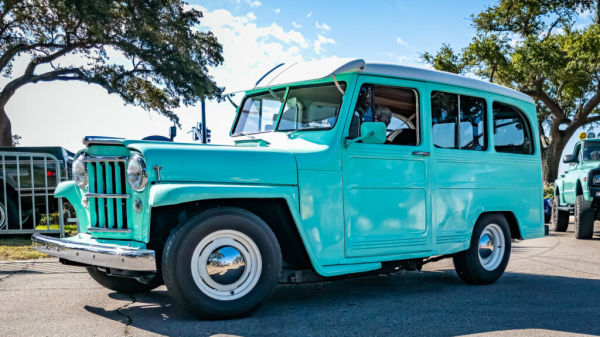
Anyone who grew up or was already driving in the 1990s remembers the era of the jellybean car — all smooth lines and soft curves. Today, many modern vehicles, even bulky SUVs, are still mostly comprised of sleek lines. It’s a dramatic shift from the 1970s and 1980s, when most automakers used flat panels and straight lines, producing vehicles that more closely resembled a cardboard box than the aerodynamic designs we see on the road today. You may have noticed another shift in recent years, however, as some automakers are bringing back those boxy blueprints.
SUVs trace their lineage back to the Willys Jeep that was used during World War II. The earliest SUVs mimicked this design, which was easy to manufacture, and offered lots of interior space for families to spread out and carry luggage or cargo. By the 1960s, other manufacturers had joined Jeep with their own boxy SUVs, and the style remained popular until the late 1990s. SUVs soared in popularity, and designs trended to more car-like lines. Stricter rules regarding fuel efficiency also helped soften lines for more aerodynamic designs.
Car design, like almost everything else, however, is cyclical, and boxy SUVs are making a comeback. Modern engineering and advances in engine design mean that those straight lines don’t have as much effect on fuel efficiency as they did in the past, and many Americans are hungering for retro designs in everything from cameras to cars. Here are five car brands that make boxy SUVs engineered for the modern buyer.
Ford
Ford is one the most iconic automakers in American history, so it stands to reason that it has produced vehicles of every shape and size over its more than 100-year history, and one of its most legendary models is the Bronco. First introduced in 1966, the Bronco was designed as an all-purpose vehicle that could easily take you off the road and go head-to-head with vehicles like the Jeep CJ. Ford ended production on the Bronco in 1996, but reintroduced the model with a retro vibe, including the boxy exterior that so many loved, in 2021.
Now a competitor to the Jeep Wrangler, the Bronco’s shape isn’t just an homage to a well-loved vehicle. Those straight lines and the flat hood make it easier for drivers to see where they are on a rocky path or muddy trail. The 2026 model starts at $40,795, and offers a four-cylinder engine and standard four-wheel drive. Buyers can opt for either a two-door or a four-door model.
Ford also sells the Bronco Sport, a more refined option that still offers that retro-inspired, rugged design. It has a lower starting price of $31,845 but comes with standard four-wheel drive. Unlike both the two-door and four-door models of the Bronco, the doors on the Bronco Sport are not removable.
Hyundai Santa Fe
When Hyundai debuted the fully redesigned 2024 Santa Fe, some enthusiasts were shocked at its transformation. The smooth, flowing lines of its predecessor were nowhere to be seen, replaced by a new boxy design that is reminiscent of days long past. The change wasn’t for simple aesthetics, however. Automakers try to stay ahead of emerging trends when it comes to design, hoping to satisfy buyers when these vehicles hit the sales lot.
The Santa Fe’s boxy look is geared toward outdoor enthusiasts, offering more interior space along with a wide tailgate opening that allows for easy loading and access to cargo. Tail lights are positioned low on the vehicle to enhance that wide space for even better accessibility.
Despite the boxy look, Hyundai carefully designed the Santa Fe to maximize aerodynamics, and it has excellent fuel economy. This three-row SUV also has a lower starting price than many competitors, with the base SE trim available for $36,650 including destination.
Other Hyundai models retain the flowing lines many modern consumers expect, but the Santa Fe isn’t the automaker’s only angular SUV. Its much smaller cousin, the Venue, also has a compact, boxy design to maximize interior space, while the fully electric IONIQ 9 offers a structured look. The Venue starts at $20,550, while the IONIQ 9 has an MSRP of $58,955, showcasing Hyundai’s commitment to providing thoughtfully-designed vehicles at different price points.
Jeep
Jeep has a long history of boxy SUVs, all the way back to the pioneering Willys, but it’s also produced many rounded, sleek models as well. Today, the Wrangler and the brand new Recon are Jeep’s most angular vehicles. The Recon is fully electric and trail-rated, with 650 horsepower and enough torque to easily get you up a rocky path. It’s more than a typical electric SUV, however.
The Recon has removable doors, removable rear-quarter glass, removable swing gate glass, and an available power-folding roof that opens with the touch of a button. The Recon’s retro look isn’t just rugged and cool, it also gives buyers a ton of interior cargo space. This new model has a starting price of $66,995.
Jeep’s iconic Wrangler has always had a boxy shape, even as both consumer preference and technology changed over the years. The 2026 Wrangler is no different. Starting at $36,035, the Wrangler’s shape is intrinsically tied with its history and utility. This much beloved vehicle is made for off-roading fun, and the outcry would likely be enormous if Jeep ever changed its basic design.
The large Grand Wagoneer, priced at $63,995, also has an angular silhouette. The design is a nod to the original Jeep Wagoneer, which was launched in the 1960s. The straight sides and flat roof offer plenty of room for your family to stretch out over three rows of seats.
Mercedes-Benz
Many words come to mind when you think of Mercedes-Benz. Luxurious, timeless, and high-performing, most Mercedes models have smooth, aerodynamic bodies with flowing rooflines. The G-Class is the exception to the rule. Nicknamed the G-Wagon, this SUV has been produced continuously since it first debuted in 1979, and Mercedes never smoothed out those iconic sharp corners.
The automaker originally partnered with an Austrian military vehicle manufacturer called Steyr-Daimler-Puch to design the Geländewagen for both military and civilian use. These roots are still evident in the vehicle’s ladder-frame chassis, tailgated-mounted spare tire, and rugged design. With a starting price of almost $200,000, however, the latest G63 AMG goes beyond your typical off-roading vehicle. It’s highly-capable on the trail, but it can also go from 0 to 60 mph in about four seconds, thanks to a 577 hp twin-turbo V8.
Inside, buyers will find leather seats available in a wide array of patterns and colors, a premium sound system, two 12.3-inch screens under a single pane of glass, and other truly cool features. There’s more than 37 cubic feet of cargo space and a side-hinged tailgate that looks great, but it might be cumbersome at times. Most of Mercedes-Benz’s other vehicles have a more streamlined design, even its wagons, but some of the more affordable SUVs like the GLB and the EQB offer harder edges that lend themselves to more cargo space.
Toyota
The Land Cruiser has been one of Toyota’s boxier SUVs since its launch in the 1950s, but there’s no denying that the automaker softened its lines in the late 1990s and into the 2000s. After discontinuing the model in 2021, the Land Cruiser made a triumphant return in 2024 with a look that harkens back to its original, boxy appearance.
The current model offers only two rows instead of three like its predecessor, and it offers ample cargo space. The retro touches are everywhere, from the TOYOTA heritage grille to the round headlights found on the base “1958” trim. Of course, it’s a different story when it comes to tech and safety features, and there’s also a modern hybrid powertrain with 326 hp and better-than-average fuel economy. It also boasts full-time four-wheel drive and three drive modes. Prices start at $59,675 including destination.
In addition to the Land Cruiser, several of Toyota’s other SUVs have boxy, rugged designs. The massive Sequoia has strong, muscular lines that maximize cabin space for both passengers and cargo. Nothing is small about the Sequoia, which starts at a much higher $67,920 including destination. The rugged, midsize 4Runner is designed to be as capable off-road as it is on the highway, and its square shape gives drivers a clearer line of sight, especially on the trail. The 2026 model starts at $43,865 including destination. Even the popular RAV4 is relatively boxy, with a squared-off roofline and fender arches that give it a distinctly Toyota off-roader shape.