
Meta has added another model to its growing AI portfolio with the introduction of Muse Glimmer, an open-weight model focused on running AI agents directly on customer devices. The 30-billion-parameter model is designed for local, always-on work flows rather than depending entirely on remote cloud computing.
According to Meta, Muse Glimmer is designed to run on hardware such as Macs and PCs equipped with capable GPUs. The company has also focused on reducing the model’s size and improving generation speed so it can support real-time interaction on devices. The model weights are being released under the Apache 2.0 license, allowing developers and researchers to access and work with the model under a permissive open-source license.
Built for Local AI
Muse Glimmer is designed around the idea of keeping AI agent work flows on the user’s own hardware. Mita says the model can run entirely on consumer devices, including Macs and PCs with performant GPUs. To make this practical, the company used quantization to reduce the language model to under 20GB.
Meetha has also incorporated a lightweight DFIash drafter model to accelerate token generation. The company says the combination allows Muse Glimmer to support fluid conversations and real-time agent interaction without moving the complete workfloor to the cloud. This local approach is particularly relevant for agentic systems that need to respond continuously while carrying out several actions.
Faster Token Generation
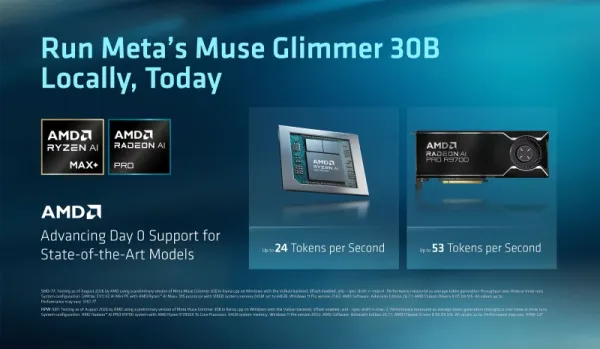
Meta’s testing also focuses on the generation speed achieved through DFlash speculative decoding. In the benchmark shown in the announcement, Muse Glimmer’s decode speed increased from 74.9 tokens per second to 233 tokens per second on an RTX-5090, representing a reported 3.1x speed-up over the baseline.
On an M5 Max, the displayed figures increase from 26.6 tokens per second to 50 tokens per second, a 1.8x improvement. On an M4 Max, the speed rises from 23.7 tokens per second to 38 tokens per second, representing a 1.5x increase. The reasons are hardware-dependent, and Meta’s figures are based on its own testing setup. The announcement therefore presents the numbers as performance measurements rather than a universal indication of how the model will perform on every customer computer.
Multi-Step Tasks From One Prompt
Muse Glimmer is also designed to perform multiple actions from a single natural-language instruction. In Meta’s demonstration, the model autonomously discovered a local Home Assistant instance through network tool calls and then queries device APIs. It subsequently creates a responsive HTML, CSS and JavaScript dashboard from scratch and deploys a local server to verify the result.
The demonstration shows the model moving through several stages of a task rather than simply responding with text. This is central to Muse Glimmer’s focus on agent workflows, where an AI system can plan and execute multiple actions based on a user’s initial instruction.
Benchmark Results
Meta has compared Muse Glimmer 30B with Gemma 4-31B and Qwen3.6-27B across several benchmarks covering agentic tasks, coding, multimodal capabilities, safety and general reasoning. Muse Glimmer records higher scores than both comparison models in several tests shown in the announcement. For example, it scores 75.5 on MCP Atlas, compared with 54.2 for Gemma 4-31B and 62.5 for Qwen3.6-27B. On DeepSearch QA, Muse Glimmer records 74.6, while Gemma scores 61.7 and Qwen scores 71.1.
The results are not uniformly higher across every benchmark. Qwen3.6-27B scores 77.2 on SWE-Bench Verified, compared with 76.0 for Muse Glimmer, while Qwen also scores higher on OSWorld-Verified, TerminalBench 2.1 and several other tests displayed in the comparison. In the general reasoning section, Muse Glimmer scores 94.7 on AIME 2026, compared with 89.2 for Gemma and 94.1 for Qwen. However, Gemma leads on GPQA Diamond with 85.7, compared with 83.5 for Muse Glimmer and 84.2 for Qwen.
The benchmark table therefore shows a mixed performance across different categories rather than a clean lead in every test.
Open-Weight Release
Alongside the model itself, Meta is making Muse Glimmer’s model weights available under the Apache 2.0 licence. The release follows Meta’s stated approach of sharing fundamental AI research and gives developers access to the model for their own work within the terms of that licence. The model’s open-weight availability, combined with its focus on local execution, positions Muse Glimmer differently from AI systems that depend primarily on cloud-based processing.
What It Means for Local AI
Muse Glimmer’s focus is less about being another general-purpose chatbot and more about enabling AI agents that can operate locally and continuously. Its ability to execute multi-step tasks, interact with local tools and generate code within a workflow could make local hardware more useful for agent-based applications. At the same time, the performance figures shown by Meta demonstrate that hardware capabilities remain an important part of the experience. The model’s under-20GB size after quantization also addresses one of the practical requirements of running large AI models outside data centres.
Conclusion
Meta’s Muse Glimmer 30B is an open-weight model built for local, always-on AI agent workflows. With under-20GB quantized operation, DFlash-assisted generation and multi-step task execution, it is designed to bring more agentic AI workloads directly to consumer hardware. Its benchmark results show strong performance in several areas, although competing models lead in others.
-
MNDY Stock Falls After Missing Q3 Expectations — Co-CEOs Say Early Results From Restructuring ‘Reinforce Our Conviction’

-
NeOnc Technologies to Host Investor Conference Call to Discuss Topline Phase 2a Results for Intranasal NEO100 in Recurrent IDH1-Mutant High-Grade Glioma

-
Davanagere Tragedy: Elderly Couple Dies Hours Apart On Same Day, Village In Mourning

-
Rapid AI evolution requires frequent policy updates, says CSIR chief
-
NeOnc Reports Second Quarter 2026 Financial Results and Confirms August 12 Topline Phase 2a NEO100 Data Readout