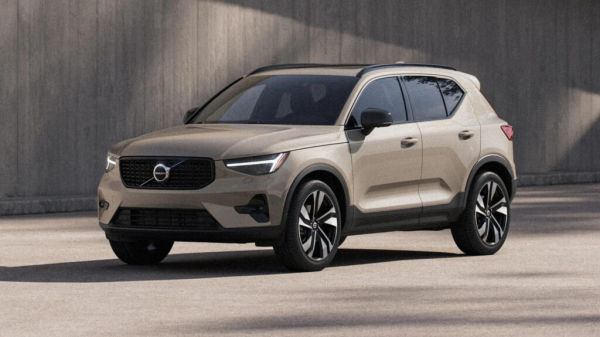
If there’s one automotive brand that has become synonymous with safety, it’s Volvo. Since the Swedish company introduced the very first three-point seatbelt over 60 years ago, its vehicles have continued to be among the safest machines on the road, often creating safety features that have become standard across the entire automotive landscape. While Volvo has that safety reputation, that doesn’t necessarily mean that the current iteration of the company is producing the safest vehicles. In fact, only two current 2026 Volvo models have earned a Top Safety Pick award from the Insurance Institute of Highway Safety: the EX90 large SUV and XC90 mid-size SUV (along with its plug-in hybrid version). Every other 2026 model comes up short, including the the 2026 Volvo XC40 small SUV.
That isn’t to say the XC40 gets poor ratings from the IIHS. On a scale of good, acceptable, marginal, and poor, it earned good ratings for the small overlap front and moderate overlap front crash tests, as well as providing good seat belt reminders. However, it only earned acceptable ratings for its side crash test and whiplash prevention. There are also several areas that the IIHS didn’t test the XC40 on, such as its headlights, front crash prevention, and LATCH (Lower Anchors and Tethers for Children) ease of use.
Because of these setbacks, a number of small SUV competitors from all around have been able to greatly outshine the Volvo XC40 in safety, earning either the IIHS’ Top Safety Pick or Top Safety Pick+ designations. Here, we’re going to look at five different models that are generally regarded as more safe by the IIHS than the model designed by the historically safety-minded automaker.
BMW X1
As Volvo is a luxury brand, we’re going to start in that realm with the BMW X1, which has earned a Top Safety Pick+ award from the IIHS for the 2026 model. Just like the XC40, the BMW earned the top good rating for its small overlap front and moderate overlap front crash tests, but it also earned that same rating for its side crash tests, rather than just acceptable.
The BMW X1 was also tested in a number of areas that the XC40 wasn’t. It earned good scores for its headlights, child safety anchors, and standard front crash prevention system for pedestrians. For the latter, it avoided a collision in every test scenario. However, it did only get an acceptable rating for its standard front crash prevention system for vehicle-to-vehicle scenarios. It passed every test for this rating except for one. Instead of avoiding the collision, the vehicle had to reduce its speed by 16 mph from a starting speed of 31 mph when approaching a motorcycle off-center. Meanwhile, the Volvo XC40 didn’t go through any of these tests.
There’s one area that the Volvo outperformed the BMW: the seat belt reminders. Here, the X1 earned just a marginal rating, which is due to two very specific places where it comes up short. The IIHS found that the sound to alert someone that their seat belt wasn’t properly fastened was too low, though the initiation time, audio frequency, and duration all passed. The other its that there’s no visual startup status alert for seat belts in the second row. While the BMW X1 has these issues, it still far outpaces the Volvo in totality.
Mazda CX-5
There were a few Mazda compact SUVs that could’ve made this list, but the one we’re going to spotlight is the Mazda CX-5. Yes, it’s the more expensive than the CX-30 and CX-50, both of which also received Top Safety Pick+ awards from the IIHS, but with that slightly larger price tag, you get a vehicle that’s rated about safe as one can be across the board.
In every single area that the IIHS tests, the Mazda was able to receive a good rating, whether it be crash tests, crash prevention tests, or seat belt reminders. For its child seat anchors, they were so exemplary that they received a good+ rating, which is as high as the IIHS goes in its ratings. There’s almost nothing bad that has been found regarding this SUV’s safety.
Yet while the CX-5’s safety ratings are excellent, they aren’t perfect. There are two important caveats that need to be addressed. The first is it wasn’t tested for whiplash prevention, which the Volvo XC40 earned an acceptable rating on. Secondly, it’s true the CX-5 earned a good rating for its headlights, but that good rating is exclusive to the S Premium Plus trim. For the S, S Select, S Preferred, and S Premium trims, the headlights only got an acceptable rating. This is because the headlights are not curve-adaptive for these lower-tiered trims. That means for the true good ratings from the IIHS across the board, you need to get the most expensive trim of the Mazda CX-5. Even with the other CX-5 trims, you at least know what you’re getting with those headlights, as the Volvo XC40 didn’t have its tested.
Hyundai Tucson
The Hyundai Tucson is another small SUV that has very similar IIHS safety ratings as the Mazda CX-5. At time of writing it’s the 15th best-selling vehicle in the United States in 2026 according to Car and Driver at 117,612 units sold, and that means a lot of people are pretty safe on the street. There are a couple of places that the Tucson does come short not only to the CX-5 but also the Volvo XC40, but it does so well elsewhere that it still earned that Top Safety Pick+ award from the IIHS.
In terms of crash tests, it received good ratings for small overlap front, moderate overlap front, and side crash tests. The one significant blight against the Tucson is that for its whiplash prevention test it received a poor result. The acceptable rating the Volvo earned for this was the result of it getting six demerits on the tests, whereas the Hyundai got 10 primarily for upper neck load and moment management. The XC40 got zero demerits for this but received more for everything else in these tests than the Tucson.
For crash prevention, the Tucson received good ratings across the board too. However, just like the Mazda CX-5, its headlights scores vary based on the trim. The top-level Limited earned the good rating, while the SE, SEL, and XRT trims earned an acceptable one. The seat belt reminder tests were all good, and for child seat anchors, they were deemed acceptable. The IIHS found the low anchors to be a little too deep in the seat, but considering the Volvo XC40 didn’t even have this tested, you at least know what you’re in for with the Hyundai Tucson.
Kia Sportage
The Mazda CX-5 and Hyundai Tucson had very similar safety ratings, and the 2026 Kia Sportage is right alongside those two in the eyes of the IIHS. Not only is Read a big fan of this SUV, this is another Top Safety Pick+ award winner that is about as well rated as you could hope for across the board, and there aren’t even any major caveats that need to be pointed out like with Tucson.
In the four primary crash test categories, the Sportage earns a good rating in three of them: the small overlap front, moderate overlap front, and side tests. The one exception is the whiplash prevention test, which still earned an acceptable rating. In total, it received five demerits during that testing, one fewer than the Volvo XC40.
The Sportage’s crash avoidance and mitigation tests also all received good ratings. Once again though, we see a split for the headlights tests among the various trims that Kia offers for the vehicle. Unlike the previous two models, there are actually two Sportage trims that earned a good score with the SX Prestige and X-Pro Prestige. The LX, EX, X-Line, and SX trims were still deemed acceptable.
The other acceptable rating the Kia received was for its child seat anchors. Like the Tucson, the low anchors were a bit too deep into the seats for the IIHS’ liking. However, the seat belt reminder tests were all good. All in all, the Kia Sportage fits right in line with what the IIHS values in selecting its safest models.
Subaru Forester
The IIHS gave a total of 11 different small SUV models the Top Safety Pick+ award for their 2026 model years. In every single case, each model has at least one area tested that received a rating of less than good. It’s so difficult to produce a machine this large and complex that doesn’t have at least one area to find minor faults. Well, in actuality, there was in fact one model that exclusively earned good ratings, and that’s the Subaru Forester.
Whether it’s the crash tests, the crash avoidance and mitigation tests, or the internal safety feature tests, the Forester passed with flying colors. It even managed to get a good rating on the whiplash prevention tests, only earning a single demerit in its testing. Among the 11 top-rated models, the only other one to earn that good rating was the Hyundai Ioniq 5, but that one still had three demerits in those tests.
When you get down to the child seat anchor tests, you get a score that’s even better than good, as it received the coveted good+ rating as the Mazda CX-5 did. Not only is the LATCH system easy to use, but it gets that plus designation for having extra latches, allowing for anchors for all three seats in the second row instead of just the window seats. If you’re deciding to get yourself a Subaru Forester over a Volvo XC40, there are many pros and cons you need to consider before buying, but when it comes to safety, the IIHS regards the 2026 Forester as about a safe as you can get on the road.