Panic spread quickly and people poured into the corridors, knocking on doors to pinpoint the source of the smell. Moments later, black smoke was seen billowing from an 18th-floor unit.
Building managers hastily obtained the door passcode from the owner and opened the door. Within minutes, the blaze was brought under control. The culprit? A clothes dryer that had short-circuited, setting fire to the dry laundry inside the drum.
“We were relieved there were no injuries, but we feel remorseful that our negligence put our neighbors at risk,” Thanh Vinh, 36, the homeowner, said.
The incident was a wake-up call for Vinh and his wife, who realized their dangerous routine of leaving appliances continuously plugged in—from rice cookers to electric kettles. The fire cost them more than VND50 million (US$2,000).
|
The washing machine and clothes dryer owned by Thanh Vinh’s family burned to ashes following an electrical short circuit in early 2026. Photo courtesy of Vinh |
For property managers across Vietnam, the incident at Vinh’s home is just one of many such examples.
Xuan Diep, head of the management of a 383-unit residential complex in Ha Dong, Hanoi, frequently witnesses near-disasters caused by residents bringing their habits from ground-level homes into high-rise living environments.
In 2021, Diep’s building went into emergency fire mode when sensors detected smoke rising from a 12th-floor apartment.
When technicians rushed to the scene and opened the door, they found a family returning from a funeral burning bo ket, dried soapberry pods traditionally burned to ward off bad luck, and filling their living room with thick smoke.
In a similar incident, Pham Van Chuong of PSE Building Operations recalls that last year his unit issued a violation notice to a resident who had set up a charcoal grill on their balcony.
While the embers never burst into open flame, dense smoke surged into the upper floors, triggering a deafening alarm that prompted hundreds of residents to evacuate.
Elsewhere, residents routinely turn shared hallways into personal storage areas for strollers, bicycles, shoe racks, and potted plants. In an emergency, these cluttered walkways create dangerous bottlenecks when hundreds of people attempt to flee simultaneously.
 |
|
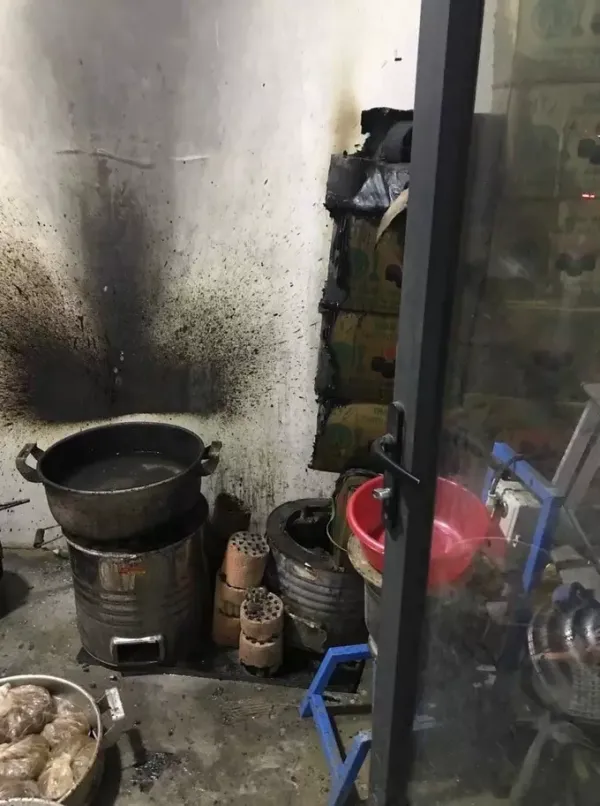
A fire caused by a resident burning honeycomb charcoal to cook pate at a luxury apartment complex in Phu Dien Ward, Hanoi, in 2019. Photo by T.L |
“Many residents don’t realize they are violating safety codes or putting others in danger,” Chuong says.
“Their typical defense is that they lived that way in ground-level houses for decades without issue.”
The second major category of fire risks stems from carelessness with electrical equipment.
Nguyen Duy Thanh, vice president of the Ho Chi Minh City Apartment Building Operations and Management Association, refers an incident from late 2025 when a robot vacuum started on its automated schedule while the owners were away. The device became entangled in window drapes, overheated, and sparked a fire, forcing management to break down the door to extinguish the flames.
Unattended stoves are another hazard. Diep recounts an incident when a nanny left a pot of sugar syrup boiling on the stove while taking a child down to the courtyard.
She lost track of time while chatting with neighbors for over two hours. By the time the alarm sounded and responders arrived, the cookware was charred black. “At one point, these false alarms were happening almost every month,” Diep says.
Property managers routinely warn against charging electric vehicles and power banks overnight, daisy-chaining multi-socket extension cords, leaving appliances running in empty apartments, and neglecting routine air conditioner maintenance, all major electrical hazards that people often dismiss.
There is another practice that threatens to turn minor incidents into catastrophes: tampering with fire safety infrastructure. Weeks after the balcony grill incident, Chuong’s team issued a violation notice to a household that used bricks to prop open a stairwell fire door for “better ventilation.” The practice damaged the hydraulic door closer, rendering the self-closing mechanism useless.
With false alarms being commonplace, some people, frustrated by the flashing lights and repeated sirens, take matters into their own hands by removing batteries, taping over smoke detectors, or disconnecting internal alarms entirely.
If a fire does break out, these homes are left with no warning.
Old habits in high-density spaces
Home fires are a major concern in Vietnam. Statistics from the Fire Prevention, Fighting and Rescue Police Department show that over 1,500 fires occurred in the first six months of 2026. More than three-quarters of them were caused by electrical system and equipment failures.
A 2024 study published in the Fire Safety Journal, which surveyed 32 apartment complexes in Vietnam, highlighted a persistent gap between awareness and practice: while most residents understood basic fire safety rules, few consistently applied them in daily life.
|
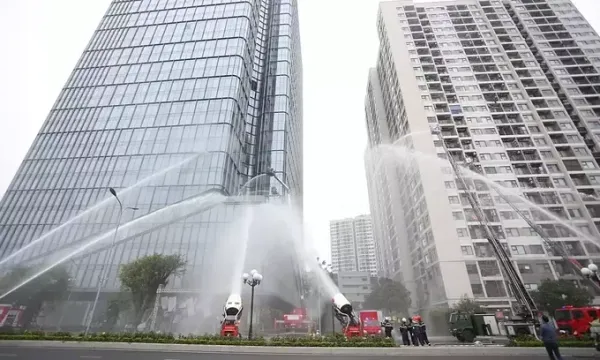
A firefighting drill at Ocean Park apartment complex in Hanoi in 2025. Photo by Pham Chieu |
Assoc. Prof. Ngo Van Xiem, former vice president of the University of Fire Fighting and Prevention, says modern high-rise risks stem directly from occupants clinging to private-home habits.
He recalls a tragedy that occurred over a decade ago at Hanoi’s Licogi 13 complex after a resident discarded charcoal embers down a trash chute. They ignited the paper and cardboard present inside the shaft, sending toxic smoke billowing back up through the building and claiming two lives.
Similarly, during the devastating 2018 Carina Plaza fire in Ho Chi Minh City, an initial motorcycle fire in the basement escalated rapidly because many of the emergency exit doors had been propped open.
The smoke asphyxiated people living in upper floors, resulting in 13 deaths and dozens of injuries. Industry experts emphasize that while technology and fire suppression systems are vital, human behavior remains the ultimate determining factor.
Overcoming dangerous habits requires sustained public education, realistic emergency drills, and clear personal accountability for every homeowner. “In a high-rise building, every individual action directly impacts the safety of hundreds of neighbors,” Xiem points out.
-
Nottingham Forest emerge as contenders for Manchester City midfielder Tijjani Reijnders

-
India Hits Back at Pakistan Over ‘Youm-e-Istehsal’ for Article 370

-
Eli Lilly CEO Bets On Weight-Loss Medicine Retatrutide As Next Growth Driver, Says Firm’s Future Has ‘Never Been Brighter’

-
Jiyaa Shankar Seals Her Love Story With Beau Kaaran In Dreamy Engagement!

-
WULF CEO Says TeraWulf Is Moving To ‘Scaled’ Execution’ With Power Defining The AI Race Amid Earnings Miss