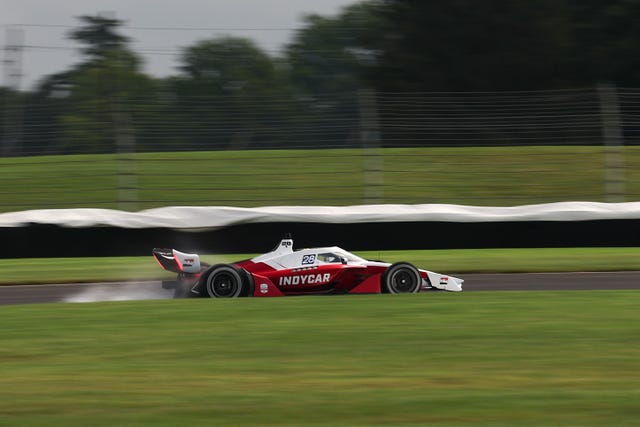
On a wet Saturday at Speedway, Indiana, Alexander Rossi became the first IndyCar driver to get behind the wheel of the first all-new IndyCar chassis since 2012. With the IR28 being prepared to replace the IR18 from the season after next, the California-born driver said the updated machine appears promising after a shortened and limited outing on the Indianapolis Motor Speedway Road Course due to the weather.
Ed Carpenter Racing driver Rossi was selected as Chevrolet’s representative for the initial test of the new car, while Chip Ganassi’s Alex Palou was chosen to drive for Honda.
“Man, it’s pretty cool,” Rossi told IndyCar’s in-house media. “It’s a very big honour to kind of be the first guy to experience it, and to do it at IMS is the cherry on top. It’s been a fun day and a half so far, and I look forward to seeing what else we can learn.”
The differences between the IR18 and the IR28 are noticeable even before the car gets fully up to speed, thanks to a more carefully designed cockpit that gives the driver extra room and improved ergonomics.
“The car feels, well, first of all, before you even drive it, when you sit in it. It feels substantially different; there’s quite a bit more room in the cockpit,” Rossi said. “The cockpit’s ergonomics and design is substantially better. You feel, leaving pit lane right away, all of the integrated cooling that comes into the cockpit, which is great.”
As this was the first proper test of the new chassis, apart from a few straight-line runs earlier in the week, Rossi described the ride as notably smooth, with very little vibration at speed.
“I think it’s a car where you don’t feel as many vibrations, so you can tell the build quality is quite high,” Rossi said. “From pure balance and performance, right now, it’s still hard to say because it’s super early days right now. We’re going through certain parameters and making sure it’s functioning as normal.”
The changes do not feel dramatically different overall; in the end, Rossi said it still drives and feels like the kind of car he has grown used to since his breakthrough 2016 season, when he moved into IndyCar from Formula One.
“It’s an IndyCar man, you brake at roughly the same spot,” Rossi said. “It was a drying track, and I could already feel that there was quite a bit of load in some of the high-speed corners.”
IndyCar Vice President of Competition and Race Engineering Mike O’Gara said one issue in the car’s plumbing system has already come to light, and these tests are helping the development team identify the areas that will need attention as work on the car progresses.
“So far, it’s doing everything it’s supposed to,” O’Gara said. “We’ve already found a couple of things, one thing on the plumbing system that didn’t stop the car from running, obviously. But something that needs a little attention. The more we run it, the more we get heat into the car, the more we see where wires and hoses may chafe on each other, where things may vibrate, and we need to put more insulation or padding. Just getting miles on the car and figuring out what the weak links are.”
Saturday’s running showed that the IR28 is viable, and by the close of the day, a completely new race car had gone out on track and run successfully, something O’Gara described as an uncommon achievement.
“The biggest thing is it just runs; we just bolted the car together, and it works. That doesn’t happen when rolling out new race cars.”
-
Ameenpur couple goes missing after Rs 2 crore chit fund scam
-
Iran rejects Trump claim of talks, Hormuz focus remains

-
Interim stay extended on demolition of Jauhar University in UP
-
Germany Considers Pension Reform Changes; Meta Smart Glasses Under Fresh Scrutiny

-
Aung San Suu Kyi Meets Red Cross: First Rare Contact Since 2021 Coup