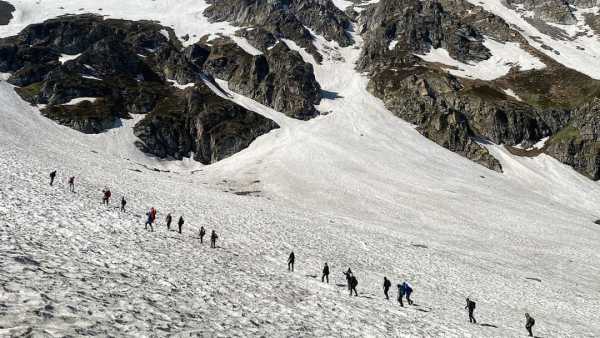
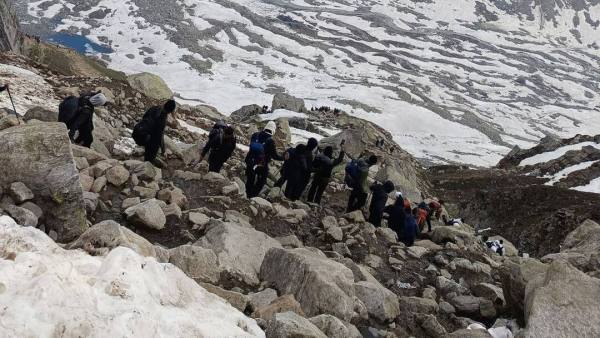
On a pitch-black night last month, nearly 100 trekkers, mostly amateurs, found themselves stranded on one of the most dangerous Himalayan trails amid torrential rain and hail. The trekkers’ wish for an adventurous journey to the scenic Hampta Pass in Himachal’s Kullu Valley turned into a nightmare on June 17 when their trek leaders allegedly ran away, leaving them without food, sleeping bags, tents, or an escape route.
“Two girls developed hypothermia, and one girl just collapsed. I was feeling better than others, so I tried to help,” said Riddhi Banerjee, one of the members of the group.
“Her pulse was fluctuating between 195 to 35. We put her in double sleeping bags, and she vomited seven times,” she added, explaining the girl’s condition.
Banerjee said she and her fellow trekkers found themselves at sea and didn’t know whom to reach out to. “Someone could have died, and no one would have been held responsible,” she added.
While this group of trekkers was lucky to finally find its way out of this experience alive, another batch trekking back from the famous Sahastra Tal in neighbouring Uttarakhand earlier in June wasn’t. Nine of 22 people on the trek lost their lives, struck by a spell of bad weather – and alleged bad planning.
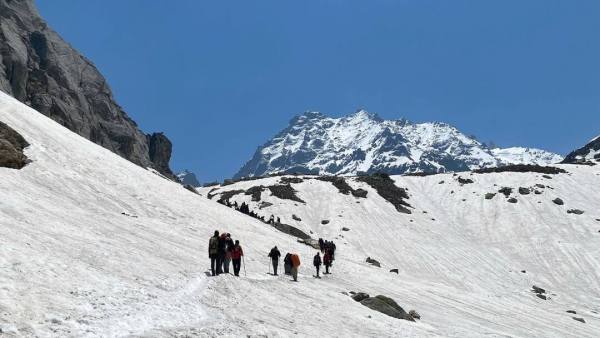
The two back-to-back incidents have brought to light what trekking experts describe as the mushrooming of an unregulated network that is promising adventure enthusiasts some of the most glorious mountain experiences without proper precautions, drawing people in with cheap packages that prize earnings over safety. When some companies charge Rs. 7500 or Rs 8000 for the Hampta Pass trek, others charge between Rs. 12,000 and Rs 14,000. Making adventure sports more affordable is important, but not at the expense of quality and reliability.
In the wake of the Covid lockdown, they say, there has been a surge in people seeking travel thrills, with social media adding to the glamour of such experiences.
Travel agencies involved in organising these tours, however, deny these allegations. Two of the orgnisations involved in the Hampta Pass debacle admitted the experience had taught them their lesson, but blamed the incident on a local operator they had tied up with.
In the Uttarakhand expedition, the Karnataka-based organisers, who had also partnered with a local operator, blamed the weather for the episode, saying the people involved were all fit and experienced trekkers. They denied they had skimped on preparations or precautions.
Overcrowding & Cheap Trekking: A Deadly Combination
India, with its diverse landscapes and vast geographical expanse, is a paradise for trekkers – be it the majestic Himalayas or lush green Western Ghats. Over the past few years, trekking has become a more sought-after activity, but the increasingly easy access has come with its own perils.
Experts say there are countless trails across India waiting to be explored, but a few have garnered immense popularity. These include the Kashmiri Great Lake, Hampta Pass, Sahastra Tal Lake, Valley of Flowers, and Kedarkantha, which are said to experience a daily influx of thousands of trekkers in peak season.
“Unfortunately, people tend to stick to these popular trails, ignoring others, which leads to heavy traffic and litter,” said Kamakshi Pal, an outdoor educator and a regular trekker. “The casual approach to these treks in the high-altitude Himalayas is a ticking time bomb waiting for one mishap to occur after another.”
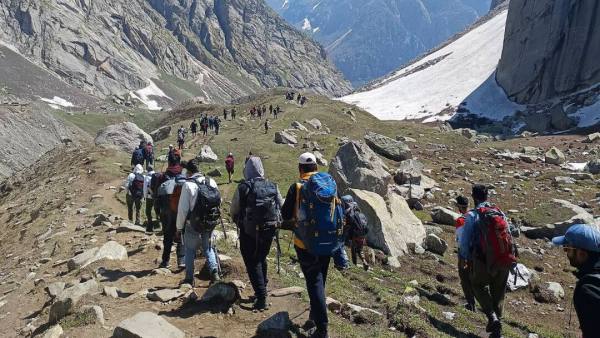
The surge in demand has resulted in a practice where three or four tour groups bunch together their batches for a single expedition. So, if you book yourself into a batch of 15-20 people, chances are you will find yourself on a trekking trail with 70 to 80 others who came via separate agencies, often with fewer guides than you would expect on such treacherous terrain.
The tour agencies involved have also been accused of, at times, not keeping the weather conditions in mind while planning schedules, and misleading customers about the exact time the expedition will take, and the level of preparation it demands, as noted by journalist Anusha Subramanian in an opinion piece for ThePrint. Talking about the Uttarakhand episode, Subramanian also asked if an emergency plan had been prepared before the expedition began.
'Survival Night': At Hampta Pass
Nestled among Himachal’s snow-clad mountains at 14,000 feet, the Hampta Pass offers mesmerising views. The complete trek to Hampta Pass is a 5-to-6-day moderate-category trek that requires a 30-to-35-km walk, demanding significant physical and mental effort. It’s a high-altitude trek, and the weather can prove unpredictable.
On June 15, more than 100 trekkers embarked on the trek from Manali, brought together by four companies — Byko Journeys, Trekyaari, Trekkers of India, and Mad Trekkers.
Participants told ABPLive that each of the organisers had promised smaller groups of 15 to 25 people. But they eventually found themselves in a group of 120, with only three trek leaders and six local guides. The experience was difficult from the get-go, some participants said.
“They (the guides) were very rude, demotivating, and disrespectful. Their rushed behaviour made almost 20-25 people descend after only completing two days of the trek,” said Simmi Gautam, who booked the trek through Byko Journeys.
Dev Agarwal, who booked his trek through Trekkers of India, said the real trouble began on the third day. While returning from the pass, they discovered that the companies had not arranged any tents at Shea Gour, where trekkers are supposed to spend the night after crossing the pass.
Another trekker from the same batch, who requested anonymity, said they were all hungry, tired, and fighting for breath, but the trek leaders – having failed to set up base at Shea Goru – sought to rush them to the next campsite at Chatru, 6 km away. To make matters worse, it had begun raining by then.
The route to the Chatru camp involved crossing the Chandra River, which can become turbulent in the rain. The trekkers were barely able to walk as they started shivering and falling ill, some participants said, adding that a few had begun to show severe symptoms of hypothermia and acute mountain sickness (AMS), exacerbated by exertion and hunger.
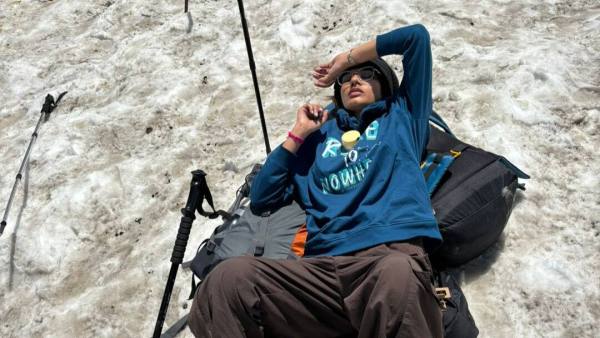
As the conditions worsened, the trek leaders allegedly duped the group and escaped. The group then returned to Shea Goru.
“Almost everyone was facing some issues,” said Riddhi. “We just sat down at Shea Goru near the other companies’ camps and requested help.”
In this dire situation, Ganesh Katara, a trek leader of another group, came forward to help. He bundled them into camps and arranged medical help.
“He was a man sent by God for us,” said Dev. “He provided us with basics like food, warm water, camps, and sleeping bags and tried to keep us calm.”
Simmi, who developed hypothermia, said she would not have been alive “if Ganesh hadn’t been there”. Ganesh reportedly tried to reach the three runaway trek leaders — Arjun, Divya, and Jyoti – by satellite calls, but they didn’t answer.
Left exasperated and exhausted by their experience, most of the trekkers in this group cancelled their plan to visit Chandra Taal, the major attraction of the trek on the last day.
Katara later detailed the ordeal of the group on Instagram, lashing out at the “commercialisation of treks” and the “disregard for the safety of individuals”.
View this post on Instagram
Reached for comment, Kailash, one of the founders of Madtrek Adventures, claimed that all the three trek leaders in question were certified. “We took 22 trekkers with three trek leaders. The local operator had to make the rest of the arrangements, but somehow failed.” He noted, “We tried to compensate for the loss of money and take lessons from it.”
Ribhu Taneja, one of the co-founders of Byko Journeys, placed the responsibility on the local vendor as well, adding that they had ended their partnership. “We are improving our vendor selection process, and the health checkup requirements for trekkers,” he added.
Later Katara took to Instagram to detail the ordeal and shed light on the “commercialisation of treks” and the “disregard for the safety of individuals”.
Trekkers Of India and Trekyaari did not respond to ABPLive’s calls and emails for comments.
Sahastra Tal Lake Trek Tragedy
On June 5, nine trekkers from Karnataka lost their lives after getting stranded while descending from the Sahastra Tal, which lies at an elevation of 15,000 ft. This challenging trail in the upper Uttarkashi requires a 35 km trek one way.
The nine were among a group of 22 trekkers – 19 from Karnataka and three local guides – who got caught in a blizzard on a tricky ridge and lost their way.
The Karnataka Mountaineers Association (KMA), which helped organise the trek, blamed the weather for the incident, saying all the members of the team were physically fit and experienced trekkers.
However, other experts in the field have said the incident appears to have been the result of a risk-mapping failure, poor guide-to-trekker ratio, misassumption about the weather, and misjudgment about the trekkers’ fitness.
The group comprised trekkers aged 30 to 70, and questions have been raised as to why there was a single itinerary for everyone instead of customised schedules.
‘Not A Garden Stroll’
Adventure sports are known to involve a degree of risk, and the only thing one can do is keep this in mind and try to take as many precautions as possible.
Trekking veterans say people often embark on these expeditions with little or no experience and preparation.
Ganesh Katara, the man who helped the team at Shea Goru, said he was able to do so because he is accustomed to such situations.
“Trekking in high-altitude areas is not an easy feat and demands several months of preparation and training as it is not a garden’s walk,” he told ABPLive.
He said aspiring trekkers should make an effort to be physically and mentally fit, and “not just be guided by social media and travelogues”.
Sandeep Vijaykumar Shah, a professional mountaineer said, “All trek leads need to have medicine equipment, medicine kits, GPS tracking devices, and search-and-rescue training to make sure the participants can survive and be rescued in an emergency.”
Trek leaders, veterans point out, should also have Basic Mountaineering Course (BMC), Advanced Mountaineering Course (AMC) and Method of Instruction (MOI) certifications.
Speaking to ABPLive, Ajeet Bajaj, the president of Adventure Tour Operators Association Of India (ATOAI) – a national representative body for the sector that seeks to “facilitate the delivery of responsible and sustainable adventure travel experiences” – emphasised the need for adventure tourism regulation across the nation.
“States must ensure that only licensed operators with trained adventure guides, using internationally certified equipment, and following ATOAI safety guidelines, are allowed to operate,” he added.
ATOAI has a set of guidelines for each adventure sport, including trekking. They were last updated in 2018.
“We live in a free economy and democracy, we cannot dictate what companies will charge. However, what is crucial is that safety should not be compromised. The focus should be on adhering to guidelines, managing access, and carrying capacity,” he said.
Shah, however, noted that “the government has enough regulation in place”. “We as trekkers and mountaineers need to educate and train new adventure-seekers to respect nature, and lead by example,” he added.
-
Pooran Blazes MI London to Seven-Wicket Win at The Oval
-
Telangana woman, lover plot husband’s ‘accidental’ death

-
Our internal matter: MEA rebuts US lawmaker on Christians, FCRA
-
Full support provided to ships and seafarers in Gulf, says MEA
-
Winners and losers after Manchester United sacked Ruben Amorim: Fresh start for Kobbie Mainoo, but Mason Mount and Amad Diallo could now lose their starting spots