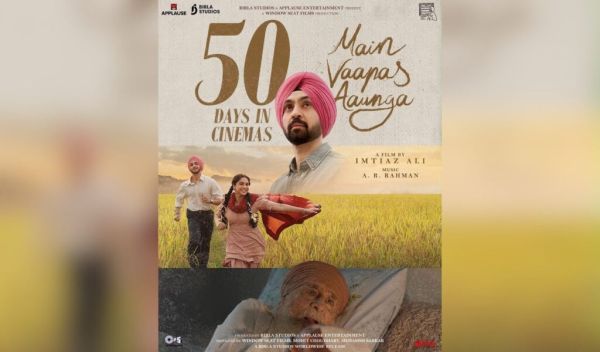
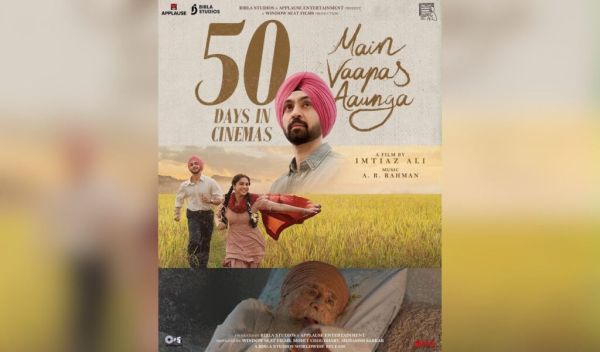
Author Nayanika Mahtani says Main Vaapas Aaunga, co-written with Imtiaz Ali, was inspired by her family’s Partition experiences and an unfinished conversation with her grandfather. Ahead of its Netflix release, she hopes the film’s universal themes of home, identity and belonging resonate worldwide
Updated On – 2 August 2026, 04:15 PM
London: An unfinished conversation with her grandfather is what drew London-based author Nayanika Mahtani to “Main Vaapas Aaunga”, the word-of-mouth box-office success she co-wrote with director Imtiaz Ali.
The Partition-era romance starring Naseeruddin Shah, Diljit Dosanjh, Vedang Raina and Sharvari is set for the streaming premiere on Netflix next week after making waves in cinemas worldwide. For Mahtani, the film’s journey remains deeply personal and emotional, from its setting in Sargodha in modern-day Pakistan where her familial roots lie to the real-life anecdotes that have been weaved through the narrative.
“I really believe that stories choose us, and this story, I believe, is because of an unfinished conversation with my grandfather,” Mahtani told PTI.
Her novel “Across The Line”, honoured with the South Asia Book Award in 2020, was set within a similar timeframe of August 1947 when many thousands were rendered homeless overnight on either side of a hurriedly drawn border to carve out Pakistan from a newly Independent India.
“I think that was part of a conversation which I hadn’t yet finished, and I was chosen for this conversation, and I’m so fortunate and this film happened. We all are so overwhelmed by the amazing word of mouth and audience response that it has got, because this is my tribute to my grandparents,” she said.
A chance conversation between Mahtani and Ali during a literature festival in Dehradun came full circle when the filmmaker said their pairing was an ideal “match of sensibilities” to create a script that encompasses nostalgia, memories and bonds that transcend borders.
“It was never about a message. I was doing it for my grandparents; I had seen that despite having lost so much, there was strikingly never any rancour against the other.
“I wanted to pay tribute to the stories they could not tell. They did not have the luxury of grief. They were refugees. They did not have the words a lot of times. I felt that unspoken story of a generation had to be told. As much as I love words, I feel drawn to silences,” she shares.
Her maternal grandmother grew up in Sargodha before settling in India after marriage. When the Partition riots broke out, her parents and the rest of her family didn’t want to leave their home.
“Their lives were saved by their Muslim neighbours. But for the rest of her life, my nani was separated from her birth family,” recounts Mahtani.
Never having visited Sargodha, she felt compelled to intertwine the threads of some of her grandmother’s childhood tales about open-air tandoors and sprawling orchards of keenu (oranges) across a region known as the “Mediterranean of the East” into “Main Vaapas Aaunga”. “They were always just fragments of stories. So, it was so special to be able to set the film there and incredibly moving to see my grandmother’s home recreated on set,” she said.
Despite writers usually being “first in, first out” on many film projects, Mahtani was overjoyed to be welcomed on to the sets to watch her words come alive during the film’s shoot across different parts of Punjab.
“When you’re writing a book, it’s like your baby. With a screenplay, it’s like you give that baby up for adoption. But here it was beautiful because Imtiaz was also writing it with me, so the vision from the beginning stayed the same.
“It was overwhelming to see those performances and so, in this case, I’m so happy that this child was raised by such an incredible cast and crew,” shares the writer.
As an investment banker who was always drawn to storytelling, Mahtani took the plunge into the world of prose after a successful audition to work on the American live-action sketch comedy “Sesame Street”. From there germinated her children’s books such as ‘Ambushed’, a story of man versus nature, and “The Gory Story of Ghenghis Khan”, which highlights how history depends on who is telling the story.
After a course over the COVID pandemic lockdown period, her foray into screenwriting came with Vidya Balan starrer biopic “Shakuntala Devi” – on the life of the mathematical genius whose swishing sari remained embedded in Mahtani’s mind’s eye from a visit to her school many years ago.
“There are remnants of different memories that come into different aspects of things one writes along the way,” she explains.
Based in the UK and travelling to India regularly to visit family, the writer is currently tackling a number of projects on the go – two films and a web series – but has firmly stepped out of the Partition era, feeling like she has finally wrapped her conversation with her grandfather.
With “Main Vaapas Aaunga” set to find an even wider audience with its streaming release, Mahtani is excited to see the universality of its message resonate across all artificial man-made divides.
“There are so many layers to this story – searching for home, for identity, for belonging, for love. These are so universal. It’s so beautiful how this story has spoken to so many people around the world and now with the streaming platform, hopefully the reach will be even more,” she said.
-
From Erling Haaland’s raccoon to dreaming of Vinicius Jr at Arsenal: five ways to become a proper football nerd after the 2026 World Cup

-
NEET PG 2026: New Regulations Enhance Exam Security and Convenience

-
AP NEET UG 2026 State Rank List Released by Dr. NTR University

-
India Concludes Commonwealth Games 2026 with Impressive Medal Haul

-
India Secures Fourth Place at 2026 Commonwealth Games with 39 Medals