The second day of the bright fortnight of the month of Ashadha (the bright fortnight of the moon). On this day, the entire country celebrates the celebration of Lord Jagannath’s Rath Yatra. While the Lord’s chariot moves forward on the shoulders of millions of devotees in Puri, Odisha, Manora, a small village in the Vidisha district of Madhya Pradesh, waits with bated breath for a miracle. Here, the Rath Yatra does not begin until the wheels of Lord Jagannath’s chariot stop in Puri. This tradition, which has been going on for nearly 200 years, sets Manora apart from other holy places in the country. It is said that even in the absence of communication, our ancestors knew that the chariot had stopped in Puri and the Lord was now arriving in Manora.
Swayambhu Deity and the Bond of Promise
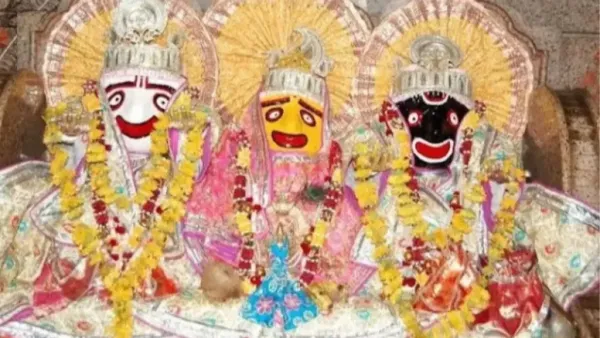
Lord Jagannath is called Jagdish in Manora. There is a 200-year-old temple of Lord Jagannath, Balabhadra, and Goddess Subhadra here. These three idols, made of sandalwood, are self-manifested and are believed to have appeared on their own. Here, like in Puri, sweet rice is offered as an offering, and the same rituals are followed. Behind this unique tradition lies the story of a devotee’s unwavering faith. Years ago, Manikchand Raghuvanshi, the patron of Manora, and his wife, Padmavati, were childless. They had deep faith in Jagannath.
Desiring a child, the couple resolved to undertake a prostration journey from Manora to Puri. As their bodies bled from walking through the treacherous forests and thorny paths, Lord Jagannath himself appeared. He promised his devotees to return to Manora and appear before them every year on Ashadha Dussehra. At that very moment, the three idols also appeared in Manora. Since then, it is believed that the Lord comes to Manora from Puri to fulfill his promise.
When the Doors Open Automatically
The temple doors are closed on the eve of the Rath Yatra, but on the morning of the Rath Yatra, the doors open automatically. As soon as the Lord is seated on the chariot, the chariot vibrates slightly or begins to roll on its own. At that very moment, the priests in Puri announce, “The Lord has arrived at Manora.” Every year, millions of devotees gather in Manora to witness this divine moment. A single voice echoes throughout, “Jai Jagdish.” Guests are also greeted with “Jai Jagdish.”
Devotee Soaked in Mud
On the day of the Rath Yatra, a special offering of Atka, or sweet rice, is made at the temple. Devotees from far and wide offer this offering after their wishes are fulfilled. The most amazing sight is when people from hundreds of surrounding villages reach Manora, walking barefoot or prostrating themselves on paths filled with mud, stones, and pebbles. They are neither concerned about hunger nor fatigue. Their eyes have only one desire: to see Lord Jagdish. This Rath Yatra, which begins in Manora after Puri, is not just a celebration. It is the continuation of a promise, a testimony to the belief that both time and distance pale before faith. As long as the chariot stops in Puri, Jagdish’s chariot will continue to move in Manaura.
-Anjani Saxena
-
Bihar has a Cockroach Cafe, and yes, it’s real!
-
What Is CJP Planning Next After Its Jantar Mantar Protest? Here's Big Update
-
Deepika Padukone's Hilarious Take on Pregnancy: A Relatable Journey for Moms!

-
Dubai residents to get regulated gardening services on Careem from September

-
Shravan Rains Revive Ratlam's Kharif Crops, Ease Re-Sowing Fears Despite Rainfall Deficit