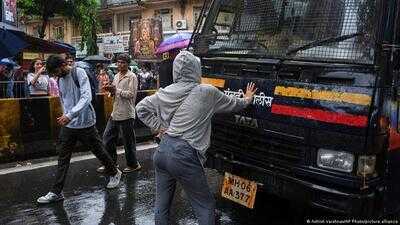
From imperial China to present-day India, student movements have repeatedly adapted the tools and symbols of their age to challenge authority.It was a clip destined to go viral. On July 22, 2026, in rainy Mumbai, India, a casually dressed young woman stepped in front of a slow-moving police van carrying detained students. She placed her palm on the hood, forcing the vehicle to stop. Mobile phones captured the moment from every angle. She too, raised her own phone and recorded the encounter. Within hours, the clip spread across India and beyond. It became one of the defining visuals of the Cockroach Janta Party protests, a movement in which students demanded transparency and accountability, following leaks in India's medical entrance exams. But the power of the moment lay not only in what she did, but in how quickly it was seen. A single gesture, a young woman confronting authority, became a symbol shared across millions of screens. While the clip belongs to a generation raised on social media, the impulse behind it is much older. From court petitions and revolutionary posters to photographs, umbrellas and memes, student movements have repeatedly adapted the tools and symbols available to them, turning them into vehicles for dissent. Communicating dissent at court Long before television or social media carried dissent across borders, students still found ways to make their grievances heard. In Eastern Han China, for instance, scholars at the Imperial Academy (Taixue) aligned with reform-minded officials in opposing powerful eunuchs at court, whom many viewed as corrupt and politically overbearing. They voiced their objections through public criticism, political networks and petitions. In an era when political communication moved through official channels, petitions were among the established ways of bringing grievances before the throne. Written in formal language and delivered through the bureaucracy, they carried student concerns directly into the state's communication system. Multiplying dissent through posters Centuries later, communication and protest mechanisms evolved. In Paris in 1968, students challenged university authorities and a conservative postwar social order. As demonstrations spread across the French capital and drew in workers, one of the movement's most enduring contributions emerged from a basement workshop at the Ecole des Beaux-Arts. The Atelier Populaire ("People's Workshop") printed thousands of posters during the protests, many of them overnight. Their bold graphics, silhouettes and slogans became the visual language of the movement. Produced collectively, many carried no individual author's name, helping transform protest into a shared public voice. The posters and their messages could appear in dozens of places overnight, giving the protest a wide local visual presence. When a photograph became global witness Protests also became more impactful when images could be transmitted across borders. In Soweto in June 1976, Black South African students marched against the apartheid system's education policies, rejecting Afrikaans as a compulsory medium of instruction in Black schools. Many saw it as the language of an oppressive state and a barrier to equal education. As thousands of students took to the streets, police opened fire. Amid the chaos, South African photographer Sam Nzima captured the image that would travel the world: 13-year-old Hector Pieterson being carried away from the scene after he was fatally shot. The photograph became one of the defining images of apartheid. For many outside South Africa, it served as the lens through which the students' protest was seen and understood, helping build international awareness of and opposition to apartheid. When images become iconic In the spring of 1989, students gathered in Beijing's Tiananmen Square demanding democratic reforms, freedom of expression and an end to corruption. As the protests grew, so did the need for symbols that could communicate their message beyond the square. In the final weeks of the occupation of Tiananmen Square, students built the Goddess of Democracy. Facing Mao Zedong's portrait, the 10-meter statue became a powerful symbol of the movement. But while the students created one icon, history would produce another. After the brutal military crackdown on the protesters, a photograph of a lone man, later known as "Tank Man," standing facing a column of tanks traveled around the world. Global media did not create these symbols, but amplified them. Cameras, newspapers and broadcasters transformed these local acts of defiance into enduring images of resistance. From organizers to participants Over time, protest communication no longer flowed only from organizers outward. Crowds and bystanders increasingly helped shape it. In Chile in 2011, students demanding education reform used flash mobs, performances and public spectacle to draw attention to their cause. Protest was no longer just something people watched. It became something they could join. In Hong Kong in 2014, students protesting Beijing's plans for electoral reform transformed everyday objects into political symbols. And what began as a practical response to pepper spray and tear gas soon became the defining image of the Umbrella Movement. Modeled on Prague's original John Lennon Wall that was created after his murder in 1988 and went on to provide a space for people to express irritation with the communist regime, Lennon Walls in Hong Kong also became hubs of public expression, attracting thousands of people who left messages of support and protest on sticky notes attached to walls around the city. From slur to symbol And then there are the political platforms that shape which symbols become widely seen, as is the case in India recently. Students protesting exam irregularities took an insult aimed at them and made it their own: "Cockroach" quickly became one of the movement's most recognizable symbols online. Memes and reels often spread faster than official statements, with students using them to respond to criticism, mock their opponents and rally support. Like posters in Paris or umbrellas in Hong Kong, this particular instance shows how memes can transform a disparaging label into a powerful protest symbol. Edited by: Elizabeth Grenier
-
Indian cyclists finish at the back in men's 4000m individual pursuit

-
UP: HC restores appointments of principals finalised in 2022, sets aside single-judge bench order

-
Odisha govt panel to probe into circulation of photos of medical PG exam paper on social media

-
Even my late mother was abused at Jantar Mantar, but we must forgive 'our misguided children': PM

-
In Nicaragua, President Ortega bans elections – a new page in the authoritarian playbook