Gianni Infantino’s grip on the FIFA presidency is becoming increasingly fragile as regional governing bodies continue to formally oppose his proposal to sell stakes in the World Cup to private investors.
UEFA’s 55 member associations have made it clear they will not take part in any FIFA competition unless plans for the FIFA Forward Enterprise (FFE) are scrapped, and they have even confirmed they would boycott the next World Cup if the proposal is pushed through. Football Supporters Europe reacted by posting “#InfantinOUT”.
Concacaf, the governing body for North America and the Caribbean, repeated its concerns over the absence of proper consultation and rejected the plan. The Asian Football Confederation (AFC) did the same, calling for an “urgent review of its governance” at FIFA, adding to the pressure on Infantino.
FIFA, however, has so far shown no sign of retreating, maintaining that “nobody is selling football” while also claiming that its consultation process was “disrupted by incorrect media reports”, in a response that appeared to echo Donald Trump-style messaging.
But with previously dependable bases of support now beginning to turn against him less than a year before the next FIFA presidential election in March 2027, the question is whether this could mark the beginning of the end for Infantino.
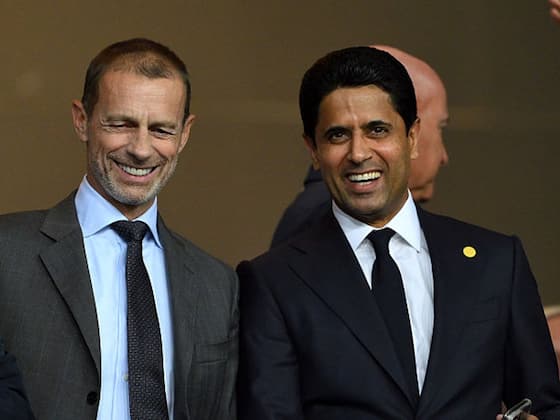
UEFA president Aleksander Ceferin has long been at odds with Gianni Infantino on several major issues.
There are growing calls from UEFA member associations to unite behind a candidate to run against Infantino, and Ceferin appears to be one of the strongest-qualified options.
A long-time rival of Infantino, Ceferin most recently did not attend the World Cup 2026 final after the tournament was overshadowed by controversy, particularly the suspension of Folarin Balogun’s red-card ban following a “review” request from Trump, which UEFA said “crossed a red line”.
The Slovenian lawyer has held office since 2016 but is reportedly keen to remain in his current role. He had originally ruled out seeking a third term next spring, at least until 3031, but is now prepared to stand for re-election if no alternative candidates emerge.
As matters stand, though, he does not appear keen to challenge Infantino for the FIFA presidency, which has prompted UEFA members to consider other names.
Paris Saint-Germain president Nasser Al-Khelaifi is understood to be among those being discussed as a possible challenger to Infantino.
Al-Khelaifi, whose main position is chairman of Qatar Sports Investment, occupies several senior roles in football. After the collapse of the failed European Super League project, he was elevated to the top of the game’s main club body, European Football Clubs, which voiced “serious concern” over Infantino’s sell-off proposal.
It has been reported that several UEFA federations, including Belgium and Poland, would support Al-Khelaifi, seeing him as the candidate with the best chance of unseating Infantino in next year’s presidential election.
Even so, Al-Khelaifi would need considerable persuasion to enter the race, as he currently has no ambition to stand for the post.
A representative for Al-Khelaifi said: “Nasser has absolutely no ambition, no intention, no interest in the FIFA role, and he will continue to discreetly support all the institutions of world and European football.”
UEFA members are also examining the possibility of backing Legia Warsaw owner Mioduski.
The Polish lawyer has reportedly been suggested by senior federation officials in Bosnia and Herzegovina, Norway, Sweden, Germany and Spain.
But at present, he would not be the leading choice in his own country, with the Polish FA more interested in backing Al-Khelaifi.
Outside UEFA, Concacaf president Victor Montagliani has also been mentioned as a possible successor to Infantino, with his desire to one day become FIFA president widely known.
The Canadian was unanimously re-elected to lead the confederation in 2023, and his current term runs until 2027. Up to now, his main priority has been securing another re-election next year.
Montagliani’s Concacaf followed UEFA’s lead in firmly rejecting FIFA’s proposal, although it stopped short of threatening a boycott.
The AFC has likewise publicly opposed Infantino’s plans, dealing a major blow to the incumbent FIFA president by withdrawing support from what had once been a loyal base for the Swiss-Italian official.
AFC president Sheikh Salman bin Ibrahim Al Khalifa, the Bahraini football administrator who also serves as senior vice-president of the FIFA Council, described FIFA’s failure to properly consult its members as “totally unacceptable” in a letter sent on Thursday to the regional body’s 47 member federations, one day before the confederation collectively rejected the proposal.
That later statement notably demanded “an urgent review of its governance”, intensifying the pressure on Infantino. That naturally raises the question of whether Sheikh Salman himself could emerge as a challenger.
His term as AFC president is due to end in 2027.
Then there is another possibility, admittedly a more distant one, but still worth keeping an eye on.
Legendary former Arsenal manager Arsene Wenger has become increasingly involved in football politics through his role as FIFA’s Chief of Global Football Development.
He has never been afraid to push for radical reform, with his “daylight offside rule” having gone on trial in Canada earlier this year.
And with some supporters now voicing frustration at his close association with Infantino, and by extension this World Cup proposal, there is an open question over whether Wenger could choose to stand against the FIFA president in order to protect his own reputation from being damaged.
-
Circus to concert: 6 big events happening in Hyderabad on Aug 1, 2

-
MP: Namaz offered at site near Bhojshala complex in Dhar

-
Man dies in parents’ arms after ambulance runs out of oxygen

-
139 Indian nationals released from Russian Army: MEA

-
SC orders status quo on demolition of 25 houses in MP’s Khandwa