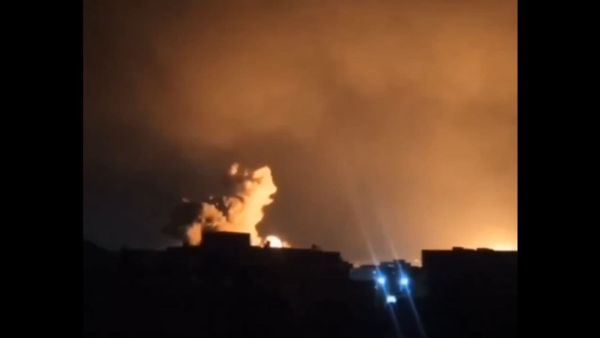
Washington: American and Saudi forces struck sites used by Iran-backed militias in Iraq to carry out attacks in recent days, the US military said on Tuesday, July 28.
“US and Saudi fighter aircraft struck multiple terrorist logistics and weapons sites across eastern Iraq in a strong response to over 30 IRGC-directed aerial drone attacks in the last 72 hours,” US Central Command said in a statement, using an acronym for Iran’s paramilitary Revolutionary Guard.
It said the Revolutionary Guard “and its terrorist proxies must cease these attacks to avoid further US military response.”

Saudi Arabia said earlier Tuesday that it for a second day shot down drones fired by Iran-backed militias in Iraq, which had attempted to target petroleum facilities in the nation’s eastern region. Iraqi Prime Minister Ali al-Zaidi ordered security agencies to investigate after the Saudis alleged a similar attack on Monday.
Trump says Iran badly wants nuclear deal
US President Donald Trump said Iran wants an agreement with Washington “so badly” and has essentially accepted that it cannot possess a nuclear weapon, but warned that American forces could resume attacks if negotiations fail.
Trump made the remarks during a virtual campaign rally for Republican Congressman Andy Ogles and in a separate interview with Fox News.
“They will never have a nuclear weapon, and they understand it,” Trump told voters in Tennessee. “We’ve taken them, we’ve hit them very hard and they wanna make a deal so badly.”
In the Fox interview, Trump said the United States and Iran had held “some very good talks”. He rejected Iranian statements suggesting that nuclear matters were not being discussed.
“For some reason, we can be in the midst of a beautiful discussion, and they’ll come out and say, we’re not talking or we didn’t discuss nuclear,” he said. “Well, that’s all we discussed because they’ll never have a nuclear weapon, they understand that.”
Trump said Iran had essentially agreed to the US demand but had not yet formalised its commitment.
“I just want very simply — they cannot have a nuclear weapon, very simple,” he said. “And they’ve agreed to that essentially, we have to get them to make it formal, but they’ve agreed to it.”
The president said he would prefer an agreement to further military action. But he threatened extensive strikes against Iran’s bridges, power stations and other infrastructure if Tehran rejected a deal.
“If they don’t make a deal, then I go back and I finish the job,” Trump said.
He also warned that the United States could attack Pickax Mountain, where Iran was reportedly undertaking construction and fortification work.
“We took out their nuclear sites, and we’ll have to take out Pickax if we don’t make a deal,” Trump said. “If we don’t make a deal, we’ll take it out very easily.”
Trump said the US military controlled access through the Strait of Hormuz and was allowing passage only to selected ships. He said Washington had eased its blockade after reaching the outlines of an agreement but restored it after Iran broke the arrangement.
“The only ones that get through are the ones that we want to get through,” he said. “We have a blockade that’s so powerful that nobody can get through.”
Iran and six world powers concluded a nuclear agreement in 2015 that restricted Tehran’s nuclear programme in exchange for sanctions relief. Trump withdrew the United States from that agreement in 2018 during his first presidential term.
US says it’s thwarted an Iranian missile attack on American troops
Iran launched multiple ballistic missiles at American forces in the Middle East on Tuesday, shattering a brief pause in fighting as mediators tried to get both sides back to negotiations and toward a ceasefire, the US military said.
All Iranian missiles were successfully intercepted, US Central Command said in a statement, adding that US forces “remain vigilant and at a high state of readiness.”
The United States and Iran had experienced a period of calm, during which neither announced attacks for days following weeks of escalation over the strategic Strait of Hormuz, the Persian Gulf waterway and narrow chokepoint through which 20 per cent of the world’s oil normally flows.
Iran effectively closed the strait when the war began by firing at freighters and tankers off its coast or threatening, too. Following the signing of an interim ceasefire deal in June, a battle for control over the strait has erupted.
Iran demanded that ships use a route near its coastline and said it can potentially charge fees. Ships were increasingly navigating a southern route along the coast of Oman under a US overwatch operation when Iran attacked some vessels.
Saudi Arabia says it intercepted drone attacks
Saudi Arabia said earlier on Tuesday that it shot down drones fired by Iran-backed militias in Iraq for a second day, while Iran-backed Houthi rebels in Yemen claimed to have forced a Saudi oil tanker to turn around as part of their self-styled blockade of the kingdom.
The kingdom’s Defence Ministry said in a statement that air defences intercepted and destroyed several drones that had attempted to target petroleum facilities in the nation’s eastern region. It said the attacks were “once again launched from Iraqi territory and carried out by Iran-affiliated terrorist militias.”
Iraqi Prime Minister Ali al-Zaidi ordered security agencies to investigate after the Saudis alleged a similar attack on Monday. The Iraqi military said in a statement that Iraq is committed to “preventing Iraqi territory from being used as a route or launching point for any attack targeting brotherly or friendly countries.”
The Iraqi militias have denied any role in the drone attacks. The Islamic Resistance in Iraq, an umbrella group of Iran-backed armed groups, called the Saudi claims “fabrications” and implied that Monday’s attacks were carried out by the Houthis, who had themselves claimed to have attacked Saudi oil facilities.
A Saudi oil tanker is targeted
Meanwhile, the Houthis claim to have fired missiles at the Saudi oil tanker NCC Ghazal, forcing it to turn back. Last week, they announced a blockade of Saudi shipping, putting another key Middle Eastern waterway — through the Bab el-Mandeb strait leading to the Red Sea — at risk.
The United Kingdom Maritime Trade Operations Centre said a tanker reported hearing explosions while travelling in the southern Red Sea. It did not name the tanker but said the crew and vessel were safe.
The rebels fired on at least one Saudi tanker in the Red Sea last week.
Iran and the US paused their fighting over the weekend, though tensions remain high even as officials said mediators achieved progress in getting the two sides back to negotiations.
Iran said Tuesday that US strikes during an earlier period of escalation destroyed an airport and a marine control tower, and caused damage to 12 bridges and two tunnels, among other infrastructure.
The US military said at the time that it had struck numerous military targets in response to Iranian attacks on ships in the Strait of Hormuz. Iran retaliated with missile and drone attacks on Arab countries hosting US forces.
Trump welcomes Netanyahu
Iran’s surprise strikes came as Israeli President Benjamin Netanyahu visited Washington and US President Donald Trump. The US and Israel had launched the war against Iran on Feb. 28. But Israel has been notably absent from the recent fighting with the Islamic Republic. Netanyahu said he had an “excellent” meeting with Trump at the White House on Tuesday, their first sitdown since launching the war, which offered Netanyahu a chance to smooth out strains in their relationship.
The closed-door meeting lasted nearly an hour and a half and was “positive and productive,” White House press secretary Karoline Leavitt said. The White House did not immediately offer more details. It comes as both leaders face growing pressures at home. Netanyahu is up for reelection and is embattled in part because of his deteriorating relationship with Trump. Trump is under pressure to end an unpopular war that has wreaked economic havoc and driven prices higher ahead of midterm elections this November.
With inputs from agencies
-
Arjantin, İsviçre'yi Uzatmalarda 3-1 Geçerek Yarı Finale Yükseldi

-
Sagittarius Horoscope Today, July 29, 2026: Will Receive Proper Contract Improvements, Financial Gains Will Remain Better

-
Financial Horoscope Today, July 29, 2026: Scorpio Signs Show Signs of Increasing Gains, Know the Status of Other Signs

-
Scorpio Tarot Horoscope Today, July 29, 2026: Outline of new tasks will be formed, will consider spending time at home

-
Harjinder, Gulveer clinch memorable silvers as India shines at CWG