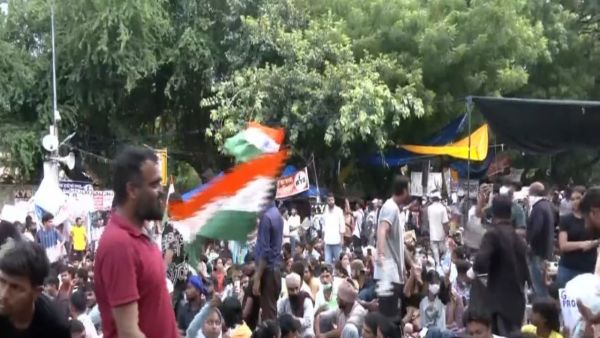
The Delhi HC heard a PIL challenging protester surveillance at Jantar Mantar. The petitioner argued it violates the right to privacy, while the Centre defended videography and facial recognition as a necessary measure for maintaining law and order.
The Delhi High Court on Friday heard detailed arguments on a public interest litigation (PIL) challenging the alleged surveillance of protesters at Jantar Mantar, with the petitioner contending that the use of videography and facial recognition technology violates the fundamental right to privacy. However, the Central government defended the videography as a lawful measure to maintain public order.
A Division Bench of Chief Justice Devendra Kumar Upadhyaya and Justice Tejas Karia heard submissions from both sides before posting the matter for further hearing on Monday.
Petitioner: Surveillance Violates Right to Privacy
Senior Advocate Nandita Rao, appearing for the petitioner, sought issuance of notice and argued that the petition raises issues distinct from other pending matters concerning the July 20 protests. Relying on the Supreme Court's judgment in Justice KS Puttaswamy vs Union of India, Rao submitted that citizens retain a right to privacy even while participating in public protests and that any restriction on this right must satisfy the constitutional requirements of legality, legitimate State purpose and proportionality.
"The law in Puttaswamy is very clear. In a democratic polity, there is a right to privacy at a public place, even during a protest. It can be restrained only if the State satisfies the triple test," Rao submitted.
Rao maintained that the present petition specifically concerns police surveillance and had been filed even before the police action of July 20. She submitted that the petition relates to the alleged surveillance of young protesters, including students aged between 16 and 20 years, and referred to a newspaper report claiming that police vans were conducting live facial recognition.
According to Rao, the alleged use of facial recognition without adequate safeguards risks criminalising peaceful democratic participation. She argued that while the State may record protests for legitimate purposes, there is no legal framework governing the collection, storage and use of the data.
"What are we asking? Have a structure of law. Protect us from misuse. Even for telephone tapping there is a protocol," Rao submitted, adding that there was no data protection mechanism governing such recordings.
Senior Advocate Gopal Sankaranarayanan, appearing in one of the connected matters, supported Rao's submissions and contended that the earlier petitions did not raise the same issues relating to surveillance and privacy.
Centre's Defense: Videography a Lawful Measure
Solicitor General Tushar Mehta, appearing for the Centre, raised a preliminary objection and opposed issuance of notice. He submitted that videography at protest sites is a routine law-and-order measure carried out in accordance with standing orders issued pursuant to Supreme Court directions regulating public protests.
"This is not with regard to this particular protest. Every protest is videographed. When you are doing something in a public place, the claim of privacy is ironical," Mehta submitted.
The Solicitor General argued that protest organisers themselves undertake to comply with the standing order governing demonstrations and that participants routinely record and circulate videos of protests on social media. He further submitted that although privacy is a fundamental right, it is subject to reasonable restrictions where there is a legitimate State interest, including maintaining law and order.
Mehta said videography enables authorities to identify persons responsible if any untoward incident occurs during a protest and stressed that the practice is followed at all demonstrations held at Jantar Mantar, not just the present one.
Rebuttal and Adjournment
Responding, Rao distinguished recordings made by journalists or private individuals from surveillance conducted by the State. She argued that while private parties may face legal consequences for misuse of recordings, there are no comparable safeguards governing official recordings. She urged the Court to direct the authorities to file a detailed affidavit explaining the protocols governing the collection, storage and use of footage recorded during protests.
Towards the conclusion of the hearing, Mehta requested that the matter be taken up on Monday, stating that the issue should be addressed without unnecessarily escalating the controversy. Accepting the request, the Bench posted the matter for further hearing on Monday.
Background of the PIL
The PIL filed by CPI(M) leader Aishe Ghosh alleges unlawful surveillance of protesters at Jantar Mantar, including participants in demonstrations led by climate activist Sonam Wangchuk. At an earlier hearing, the High Court had asked the Delhi Police whether it had framed a Standard Operating Procedure (SOP) or standing order for handling protests in compliance with the Supreme Court's decision in the Mazdoor Kisan Shakti Sangathan (MKSS) case. The Centre had then maintained that videography at protest sites is undertaken solely to ensure law and order and public safety and denied allegations of snooping or surveillance. (ANI)
(Except for the headline, this story has not been edited by Asianet Newsable English staff and is published from a syndicated feed.)-
Enzo Maresca confirms Rodri surgery details amid Manchester City exit speculation

-
Al-Ittihad-style nightmare and injury curse: another defeat worries Al-Ahli ahead of the new season

-
‘Unbelievable Jeff!’: Chris Kamara on his iconic catchphrase and how it became part of university drinking culture
-
Germany job ka pehla din aur Jurgen Klopp already quit karne ki dhamki de rahe hain

-
Kylian Mbappe at Arsenal? Former France international Mikael Silvestre says Premier League move cannot be ruled out as ‘best platform’ claim is made