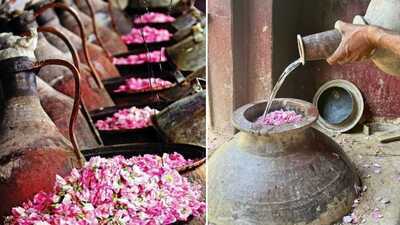
New Delhi: Most travellers pass through Uttar Pradesh chasing famous landmarks, rarely stopping at Kannauj. Yet this historic town on the banks of the Ganga has quietly preserved one of India’s oldest living crafts for centuries. Known as the country’s perfume capital, Kannauj continues to produce traditional attar using methods that have barely changed over generations. Long before modern perfumes filled store shelves, artisans here were extracting fragrances from roses, jasmine, vetiver and even rain-soaked earth.
The city’s legacy is shaped by its fertile Gangetic plains, Mughal patronage and skilled craftsmen who continue to distil natural botanical oils using copper stills and wood-fired furnaces. If you enjoy heritage, craftsmanship and unique travel experiences, Kannauj offers a side of India that remains wonderfully untouched by mass tourism.
Why Kannauj became India’s perfume capitalThe reputation of Kannauj as India’s fragrance capital is closely linked to the fertile alluvial plains of the Ganga. The region provides ideal conditions for growing aromatic flowers such as Damask roses, jasmine and vetiver. These botanicals have supplied local perfumers for centuries, making the city one of India’s oldest perfume-producing centres. Although perfume-making in Kannauj predates the Mughal Empire, the craft flourished under Mughal rule.
Ancient Deg-Bhapka method still survivesOne of Kannauj’s biggest attractions is that its centuries-old perfume-making process continues almost unchanged.
Known as the Deg-Bhapka method, the traditional hydro-distillation technique uses large copper stills called degs, which are heated slowly over wood-fired furnaces. Steam carrying the fragrance of flowers travels through bamboo pipes into a receiving vessel known as a bhapka, where the aromatic vapours are absorbed into pure sandalwood oil.
Unlike many commercial perfumes, traditional Kannauj attars are alcohol-free, relying on sandalwood oil to preserve their natural fragrance and make it long-lasting.
Process of creating famous Mitti Attar in KannaujAmong Kannauj’s most fascinating creations is Mitti Attar, often described as the fragrance of the first rain on dry earth.
- The process begins with collecting clean clay from dried riverbeds or ponds.
- The clay is shaped into small discs and baked before being placed inside copper stills with water.
- Once heated, the steam captures the earthy aroma of the baked clay and travels into a vessel containing pure sandalwood oil.
- The oil gradually absorbs the fragrance over repeated distillation cycles carried out for several weeks.
The result is a unique natural perfume that recreates the unmistakable scent of rain falling on parched soil, making Mitti Attar one of Kannauj’s most distinctive fragrances.
Places to explore in Kannauj 1. Traditional attar distilleriesA visit to Kannauj is incomplete without stepping inside one of its traditional perfume distilleries. Many family-run establishments continue to use the centuries-old Deg-Bhapka technique.
Among the city’s best-known names, ML Ramnarain Perfumers is one of the oldest and remains a popular stop for travellers interested in Kannauj’s perfume heritage.
2. Bara BazaarBara Bazaar is the heart of Kannauj’s perfume trade. The narrow lanes are lined with shops displaying shelves of colourful glass bottles filled with rose, jasmine, khus and other traditional attars.
3. Kannauj FortAlthough much of the historic fort now lies in ruins, it still reflects Kannauj’s importance as one of northern India’s ancient cities. Walking through the remains offers a glimpse into the region’s long political and cultural history, making it a worthwhile stop for history enthusiasts.
4. Annapurna Devi and Gaurishankar templesThese two temples are closely associated with the reign of King Jaichand, one of Kannauj’s most well-known rulers.
5. Gola Gokaran Nath TemplePopularly known as Chota Kashi, this Shiva temple attracts devotees from across Uttar Pradesh throughout the year.
6. Ganga ghatsKannauj’s ghats offer a quieter experience than many of India’s better-known riverside destinations. Early mornings are especially peaceful, with mist rising above the Ganga as the city gradually comes to life.
7. Damask rose fieldsTravellers visiting between February and April can explore the Damask rose fields located on the outskirts of Kannauj.
How to reach KannaujKannauj is well connected by road and rail, making it an easy addition to a Uttar Pradesh itinerary.
The nearest airport is Chaudhary Charan Singh International Airport in Lucknow, around 100 km away. The airport has regular flights from Delhi, Mumbai, Bengaluru and several other major Indian cities. From Lucknow, Kannauj can be reached by road in under two hours.
If travelling from Delhi, the journey takes around five to six hours via the Agra-Lucknow Expressway. Kannauj also has its own railway station with regular train services connecting it to Lucknow, Kanpur and nearby cities.
Travel tipsExploring Kannauj is easiest by auto-rickshaw or cycle rickshaw, especially within the old city.
If you wish to visit a traditional perfume distillery, contact it in advance, as many accept visitors only through prior appointments.
Kannauj also pairs well with nearby destinations such as Lucknow and Agra, making it a convenient stop on a longer Uttar Pradesh itinerary.
Kannauj may not feature on every traveller’s bucket list, but it leaves a lasting impression on those who visit. With its centuries-old perfume tradition, rich history and slower pace of life, the city offers an experience that feels both authentic and uniquely Indian.
-
Nandan Nilekani to prepare roadmap for exam reforms: Modi
-
Gen Z protests: The Cockroach chose to approach, not encroach

-
Top 10 | ABP LIVE Evening Bulletin: Top News Headlines from 26 July 2026 - Evening

-
Fashion quote of the day by Iris Apfel: 'Jewellery is the most transformative thing you can wear'

-
Devoleena Bhattacharjee calls for Punjab education minister to resign following Dharmendra Pradhan resignation