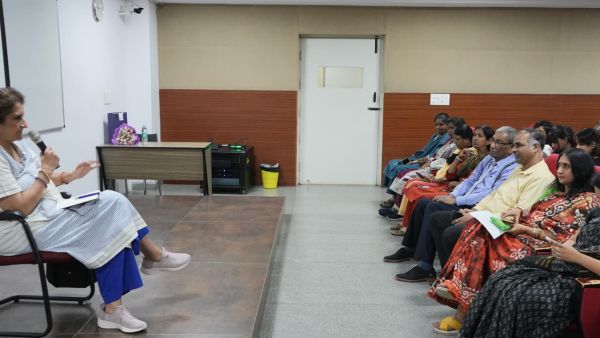
JAIN (Deemed-to-be University), one of India's leading private universities, hosted the Media Lecture Series featuring Chitra Subramaniam Duella, award-winning investigative journalist and Co-Founder of The News Minute.
Bengaluru, 20 July, 2026: JAIN (Deemed-to-be University), one of India's leading private universities, hosted the Media Lecture Series featuring Chitra Subramaniam Duella, award-winning investigative journalist and Co-Founder of The News Minute, who shared her insights on the evolving role of journalism in safeguarding democracy, strengthening public discourse, and upholding truth and accountability in society, while speaking on the topic
"Journalism as a Public Good in Democratic Society," organised by the Department of Journalism and Mass Communication, School of Humanities and Social Sciences.
Chitra Subramaniam Reveals How the Bofors Investigation Unfolded
Reflecting on the Bofors investigation, Chitra Subramaniam Duella recounted how one of India's most significant investigative stories began with a report broadcast by Swedish Radio, alleging that illegal commissions had been paid during the Bofors defence deal. “This is 38–39 years ago. There was no WhatsApp, no internet, not even fax machines in the way we know them today. We had telex machines. Swedish Radio broke the story saying that Bofors had paid money to Indian centres.” She recalled that what immediately drew her attention was not the allegation itself, but the then Prime Minister Rajiv Gandhi's statement in Parliament. “He went down to the floor of the House and said, 'I didn't make money. My family didn't make money.' Nobody had accused him of anything. That, was the first sign that something needed to be investigated.”
Following her instincts, she began tracing the story across Europe, studying bank accounts, financial records, and confidential documents. “I didn't know what many of those financial terms meant. I went to libraries, pulled out books and read. You have to keep reading because you never know when that knowledge will become useful.” She explained that the investigation required immense patience and persistence. “I was given nearly 400 documents.
Individually, they meant very little. But when I laid them all out together, they began to reveal a pattern. That is how investigative journalism works—you build and build until the truth begins to emerge.” One of the most memorable moments of her investigation involved her meetings with an international arms dealer who eventually became one of her most valuable sources. “I had never met an arms dealer before. I was frightened. I walked into his office and all I heard was 'Buy, sell, buy, sell.' I thought he was talking about ordinary business until I realised he was dealing in commodities and the international arms trade.” She shared an unexpected lesson she learnt from him. “He pointed to different photographs and said, 'It doesn't matter what the colour of your skin is—everyone's blood is red.' Coming from an arms dealer, I found that deeply ironic."
Building trust with sources, she noted, was just as important as gathering documents.
“Investigative journalism is not only about documents. It is also about relationships, patience and earning the confidence of people who eventually trust you with information.” Her investigation had consequences beyond India. ”My reporting exposed loopholes in Switzerland's laws relating to criminal investigations and the exchange of documents between countries. Those loopholes were later plugged, and the laws were changed.”
Speaking about ethics in journalism, Chitra reflected on how Amitabh Bachchan's name became associated with the Bofors controversy. "Amitabh Bachchan's name was planted. I examined all the documents and found absolutely nothing connecting him to the payments. I defended him because I had no evidence against him." She stressed that journalism must always be guided by evidence rather than rumours. "You have to get your own evidence—at least two independent sources. Once you write a story, a person's life can change forever."
Chitra concluded by reminding students that journalism demands patience, integrity, and humility. "Leave your ego outside. You don't matter. Your story matters. The day you become more important than your story, you're dead as a journalist." Ending on a note that captured the essence of her career, she reaffirmed her belief that journalism exists to serve society.
"Journalism is not about going after people. Journalism is about going after the truth—however difficult it is, however long it takes."
Dr. Bhargavi D. Hemmige, Head of the Department of Journalism and Mass Communication, JAIN (Deemed-to-be University), highlighted the significance of academic engagement with distinguished media professionals through the Department's newly launched Media Lecture Series, “The goal is to inspire our students to embrace the spirit of true journalism- truth, ethics, public responsibility and courage. In a media environment often shaped by public relations, advertising branding and promotion, this series meant to remind us the deeper purpose of journalism: to question, to investigate, to inform and to serve our society.” Further, she added, “interactions with accomplished journalists provide students with invaluable exposure to real-world media practices and reinforce the University's commitment to nurturing responsible, ethical, and socially conscious media professionals.”
The lecture witnessed enthusiastic participation from students of the Bachelor of Arts in Journalism and Mass Communication (BAJ) and Master of Arts in Journalism (MAJ) programmes. The interactive session concluded with a lively question-and-answer segment, where students engaged with the speaker on issues relating to investigative journalism, press freedom, media ethics, digital journalism, and the role of journalists in addressing contemporary societal challenges.
The Media Lecture Series reflects the Department's continued endeavour to bridge academiclearning with industry expertise by creating platforms for dialogue between students and eminent media practitioners. The initiative seeks to inspire future journalists to uphold the values of integrity, accountability, and public service while adapting to the evolving demands of the global media landscape.
About JAIN (Deemed-to-be University)
JAIN (Deemed-to-be University) is ranked among the top universities in India and is considered a cerebral destination for students across the world, Bengaluru in particular, for its illustrious history of developing talent. JAIN (Deemed-to-be University) is accredited A++ with a CGPA of 3.71 by India's National Assessment and Accreditation Council (NAAC) leading to being graded autonomy Category-1 by the University Grants Commission (UGC), Government of India. Jain (Deemed-to-be University) is a member of the Association of Universities of Asia and the Pacific. It has been awarded five stars in the Young University Category in Karnataka by KSURF ICARE Ratings.
The University holds the 62nd position in the National Institutional Ranking Framework (NIRF) by the Government of India as of 2025 and ranks 8th among India's leading private universities according to India Today’s July 2025 report. Jain (Deemed-to-be University) has achieved the No. 1 position among private universities for the highest number of patents published and filed over the past three years. With 2933 patents filed and 2335 published, this accomplishment highlights our unwavering dedication to innovation and research excellence. Jain (Deemed-to-be University) has been conferred the prestigious Rashtriya Khel Protsahan Puraskar 2023 by the Ministry of Youth Affairs and Sports in the category of “Identification and Nurturing of Budding and Young talents” for the year 2023. The university also proudly hosted and won the over championship Khelo India 2021.
In Khelo India 2022, held in Uttar Pradesh, JAIN (Deemed-to-be University) secured the 2nd position. Additionally, the institution maintains ISO 21001:2018 certification for Quality Management from TUV Nord. The Department of Journalism and Mass Communication is an integral part of the School of Humanities and Social Sciences, JAIN (Deemed-to-be University) that offers entry into the ever-evolving world of global media and a dream university experience that merges the best of both worlds- academics and media. In the year 2025, the department has secured 7th overall position in India Today’s Top 10 emerging colleges ranking. The department provides opportunities for interdisciplinary learning, with workshops, guest lectures, and media-centric events that allow students to network, experiment, and grow as well-rounded professionals.
(This is a press release)
-
Periods Health Tips: Does drinking cold water increase pain during periods? Know the expert’s opinion

-
Symptoms of gallstones, frequent abdominal pain, bloating and indigestion can be troublesome to ignore.
-
Top 5 Sedans Under Rs 15 Lakh in India: Check on Style, Comfort and Performance

-
Samsung Foldables: Samsung explodes in the Indian market; Entry of Galaxy Z Fold8 Ultra, Fold8 and Flip8 for the new generation

-
During testing, OpenAI’s AI agent went out of the security circle, reached other AI platforms, increased cyber security concerns.