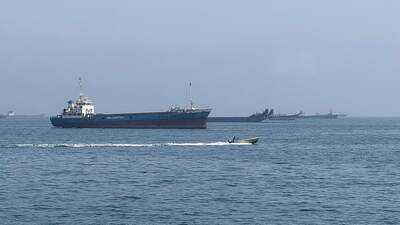
Iran dramatically raised the stakes in the Gulf on Thursday as the Islamic Revolutionary Guard Corps (IRGC) claimed it had stopped three oil tankers attempting to transit the Strait of Hormuz, alleging that one of the vessels exploded and caught fire while the remaining two hastily turned back.
The claim, carried by Iranian state media, comes amid intensifying hostilities with the United States and underscores Tehran's determination to assert control over one of the world's most strategically important maritime chokepoints.
In a sharply worded statement, the IRGC alleged that the three tankers were attempting to pass through what it described as a "mine-laid route" south of the Strait of Hormuz after being "provoked and tempted by the child-killing American army".
According to the elite military force, one of the vessels exploded and burst into flames, forcing the other two to immediately abandon their passage and retreat. The IRGC did not identify the vessels or provide further details, and the claim could not be independently verified.
Iran under relentless US fire for 10th straight night as conflict widensThe Guard Corps coupled its announcement with a stern warning, declaring that any commercial vessel "deceived" by the United States into attempting passage without Iran's consent would "suffer the same fate" — a message widely seen as Tehran's latest attempt to project its ability to influence maritime traffic through the narrow waterway.
The warning comes as Iran and the United States remain locked in an increasingly dangerous military confrontation.
For the 12th consecutive night, US forces launched strikes across Iran late Wednesday (Washington time). Iranian state media reported that missiles hit areas near the western cities of Ahvaz, Ramshir and Andimeshk, while another strike targeted a power station near the Bushehr nuclear power plant in southern Iran. Two people were also reported killed in the border town of Shalamcheh near Iraq.
Despite the sustained bombardment, Iranian officials have signalled that Tehran has no intention of backing down.
Iranian foreign minister Seyed Abbas Araghchi declared on X that the Islamic Republic would adopt an "eye for an eye" doctrine, warning that any attack on Iranian territory or infrastructure would be met with a "powerful and decisive response."
The statement followed a fresh warning from US President Donald Trump, who threatened to target Iranian infrastructure if Tehran attacks vessels navigating the Strait of Hormuz.
"From this point forward, any time the Islamic Republic of Iran shoots at a ship in the Strait of Hormuz, whether it be by Missile, Rocket, Drone, or any other device or weapon, the United States will bomb and destroy one bridge or power plant, including those located next to, or in, the Capital City of Tehran," Trump wrote on Truth Social.
Meanwhile, the US Central Command (CENTCOM) said its latest strikes were aimed at "further degrading Iran's ability to threaten civilian mariners and commercial vessels transiting regional waters."
The rapidly escalating exchange of military action and increasingly uncompromising rhetoric has fuelled concerns that the Strait of Hormuz — through which nearly one-fifth of global seaborne oil supplies pass — could become the next flashpoint in the conflict. Any disruption to shipping through the narrow passage is expected to reverberate across global energy markets and further destabilise an already volatile West Asia.
With IANS inputs
-
Lord's Will Not Host ICC WTC 2027 Final! New Venue Revealed: Details Inside
-
CWG 2026: Lovlina Borgohain Secures India's First Medal Even Before Opening Ceremony

-
'Kashmir Will Always Remain An Integral Part': India Blasts Pakistan At UNSC, Calls Out Terror Policy

-
Liverpool’s £34 Million Offer for Maghnes Akliouche Turned Down Amid PSG Rivalry: Report

-
FIFA World Cup 2026 Final Pitch Goes On Sale! Fans Can Now Own A Piece Of Football History For Up To ₹2.89 Lakh