
The capybara has earned a special place in the hearts of animal lovers around the world. From viral videos showing it relaxing with ducks and monkeys to photographs of birds perched on its back - this giant rodent has become famous for its calm and friendly nature. Native to South America, the capybara is the largest rodent on Earth and is known for its remarkable ability to peacefully coexist with a wide variety of animals. While social media has amplified its reputation, experts say its gentle behaviour is rooted in its biology, social lifestyle and habitat. Here's what makes the capybara such a unique animal and where you can spot it in the wild.
The world's largest rodent
The capybara (Hydrochoerus hydrochaeris) is the world’s largest rodent, growing up to more than one meter in length and weighing as much as 80 kilograms or more. Even with its large size, the capybara is a pure herbivore that eats grasses, aquatic plants, fruit, and the bark of trees. The capybara is a relative of guinea pigs and rock cavies.
Capybaras are semi-aquatic mammals and spend much of their time in rivers, lakes, marshes and wetlands. Their partially webbed feet make them excellent swimmers while their eyes, ears and nostrils sit high on their heads, allowing them to stay mostly submerged while watching for danger. They can even remain underwater for several minutes to escape predators such as jaguars, pumas and anacondas.
These animals are extremely social and live in groups of around 10 to 20 members, though sometimes larger congregations form during the dry season when water sources shrink. Living in groups makes them more cautious of predators.
Why capybaras seem to be friends with everyone
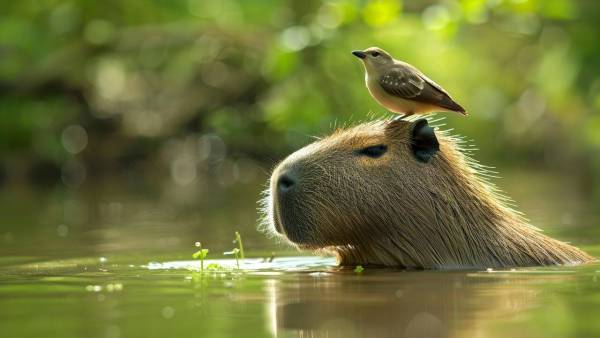
One of the biggest reasons capybaras appear so friendly is that they pose little threat to other animals. Since they eat only plants - they do not compete with carnivores for food or prey on smaller species. Their calm temperament and relaxed behaviour make it easy for many animals to remain close to them without fear.
In the wild, birds such as cattle egrets and caracaras are often seen sitting on capybaras while feeding on insects or removing parasites from their fur. This creates a mutually beneficial relationship, giving the birds an easy meal while helping keep the capybaras clean. Turtles, ducks and other wetland animals also frequently share the same resting areas.
Images of capybaras peacefully sitting beside caimans have become particularly popular online. Although these reptiles are capable of hunting young capybaras, they are not constantly on the hunt. When well-fed or resting, caimans may simply ignore nearby capybaras leading to surprisingly peaceful scenes. However, these interactions should not be mistaken for true friendships as predators remain a natural threat.
Their easy-going personality also extends to humans in areas where they have become accustomed to people. In many parks and protected wetlands across South America, capybaras often remain calm around visitors, provided they are not disturbed.
Where to find capybaras in the wild
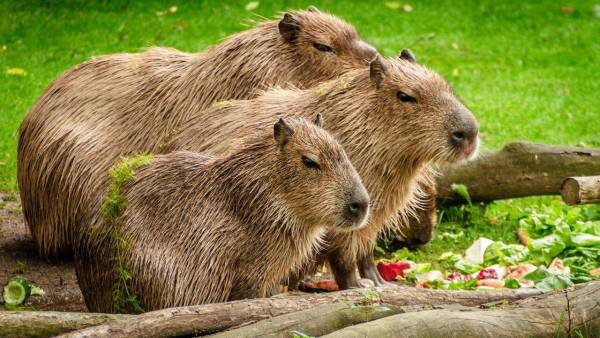
Capybaras are found throughout much of South America, particularly east of the Andes Mountains. Their range includes Brazil, Venezuela, Colombia, Argentina, Uruguay, Paraguay, Peru, Bolivia, Ecuador and the Guianas. They thrive wherever freshwater is abundant and vegetation is dense. The Pantanal in Brazil, the largest tropical wetland on Earth, is known as one of the best locations to see the capybara in its natural environment. The capybaras usually live in family groups that feed close to rivers and relax in shallow waters together with birds and caimans. One more great location is the Llanos grasslands in Venezuela. It's particularly good to visit there in the dry season when all animals congregate near the remaining pools of water.
The Argentinean Ibera Wetlands also harbour thriving colonies of capybaras and are now attracting many tourists because of their wildlife viewing opportunities. Capybaras have recently become more adapted to the urban setting in some areas of Brazil and Argentina, whereby they may sometimes be found around lakes, golf courses, and parks.
According to the International Union for Conservation of Nature (IUCN), the species is currently classified as Least Concern because of its wide distribution and stable overall population. However, habitat destruction, wetland loss and illegal hunting continue to threaten some local populations.
Whether peacefully browsing along the banks of a river or living alongside other animals like birds, the capybara will always be among nature’s most peaceful mammals. Indeed, its peaceful temperament, highly social nature and remarkable adaptability have earned it a reputation as one of the animal kingdom's most easy-going mammals.
-
Telangana student declared brain dead after accident in US

-
Congress, BJP battle on streets as student agitation spirals

-
Samsung Galaxy Z Fold 8 Ultra Price Can Go Up To Rs 2.6 Lakh! Galaxy Z Fold 8, Flip 8 India Prices Revealed

-
Is CNG The New Diesel? Maruti Suzuki Explores More Demand Amongst Rising Fuel Prices

-
Aamir Khan's '3 Idiots' Not Releasing In September, Say Makers