Quote of the day by Plato: "Art is a lie that tells the truth—or at least, it should."
ETimes | July 22, 2026 1:39 PM CST
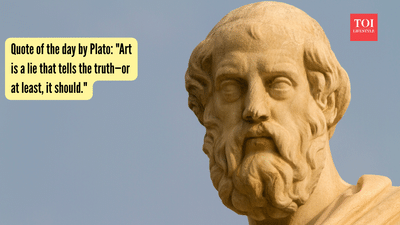
We usually expect truth to look just as we see it at face value, exact, and easy to verify. On the contrary, art works differently. It can bend facts, influence emotions, and create scenes that never happened, yet still leave us with stronger and more intense feelings of grief, love, fear, hope, or injustice.
That is why a painting, a poem, or a film has a longer impact on us, even long after facts are forgotten.
Plato weighed in on this thought years ago, and his words remain as relevant as ever.
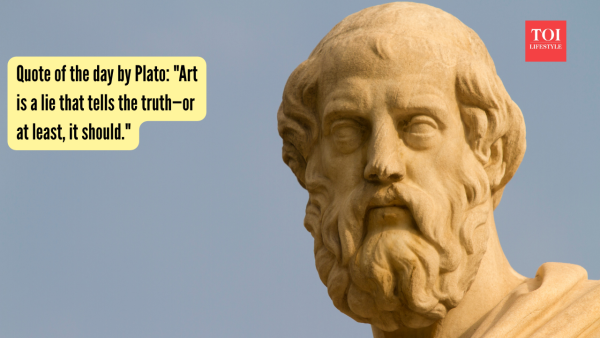
Quote of the day
What does the quote mean?
Plato’s philosophy saw art as mimesis , or imitation, meaning art copies the world instead of directly knowing truth. In that belief, art is “a lie” because it is not the thing itself, but it can “tell the truth” when the imitation reveals something essential about human nature, character, or society.
Which is why a fictional story can feel more truthful than a report. A novel about a broken family may help us understand loneliness better than a list of statistics ever could. A film may invent characters, but their choices can still tell about the real patterns of power, cruelty, kindness, or shame. The “lie” is the invented form; the “truth” is the information that it gives.
How is it important now?
Plato’s words hold relevance even today because life is filled with polished images, edited videos, and quick opinions. People often ask whether something is factually accurate, but they should also ask whether it conveys anything meaningful. Art helps us do that. It gives shape to emotions and social realities that are hard to express in direct language.
As even a perfectly produced image can still mislead, but a carefully made work of art can also expose truth in a way raw data cannot. In times of noise, art can slow us down and make us notice what matters.
That is why a painting, a poem, or a film has a longer impact on us, even long after facts are forgotten.
Plato weighed in on this thought years ago, and his words remain as relevant as ever.
Quote of the day
What does the quote mean?
Plato’s philosophy saw art as mimesis , or imitation, meaning art copies the world instead of directly knowing truth. In that belief, art is “a lie” because it is not the thing itself, but it can “tell the truth” when the imitation reveals something essential about human nature, character, or society.
Which is why a fictional story can feel more truthful than a report. A novel about a broken family may help us understand loneliness better than a list of statistics ever could. A film may invent characters, but their choices can still tell about the real patterns of power, cruelty, kindness, or shame. The “lie” is the invented form; the “truth” is the information that it gives.
How is it important now?
Plato’s words hold relevance even today because life is filled with polished images, edited videos, and quick opinions. People often ask whether something is factually accurate, but they should also ask whether it conveys anything meaningful. Art helps us do that. It gives shape to emotions and social realities that are hard to express in direct language.
As even a perfectly produced image can still mislead, but a carefully made work of art can also expose truth in a way raw data cannot. In times of noise, art can slow us down and make us notice what matters.
READ NEXT
-
Nashik: AIMA Commits To Resolving Entrepreneurs' Issues In Igatpuri, Says Rajendra Pansare

-
CFI reports strongest quarter and first half on record, $3.03 trillion in Q2 and $5.34 trillion in H1 2026

-
Can Jamun Really Help Control Blood Sugar? Experts Reveal the Truth Behind the Popular Diabetes Belief

-
David Warner Pleads Guilty in Drink-Driving Case, Captaincy Future Faces Uncertainty

-
Divyenndu Sharma Voices Support for Student Protesters, Shares Powerful Poem on Social Media