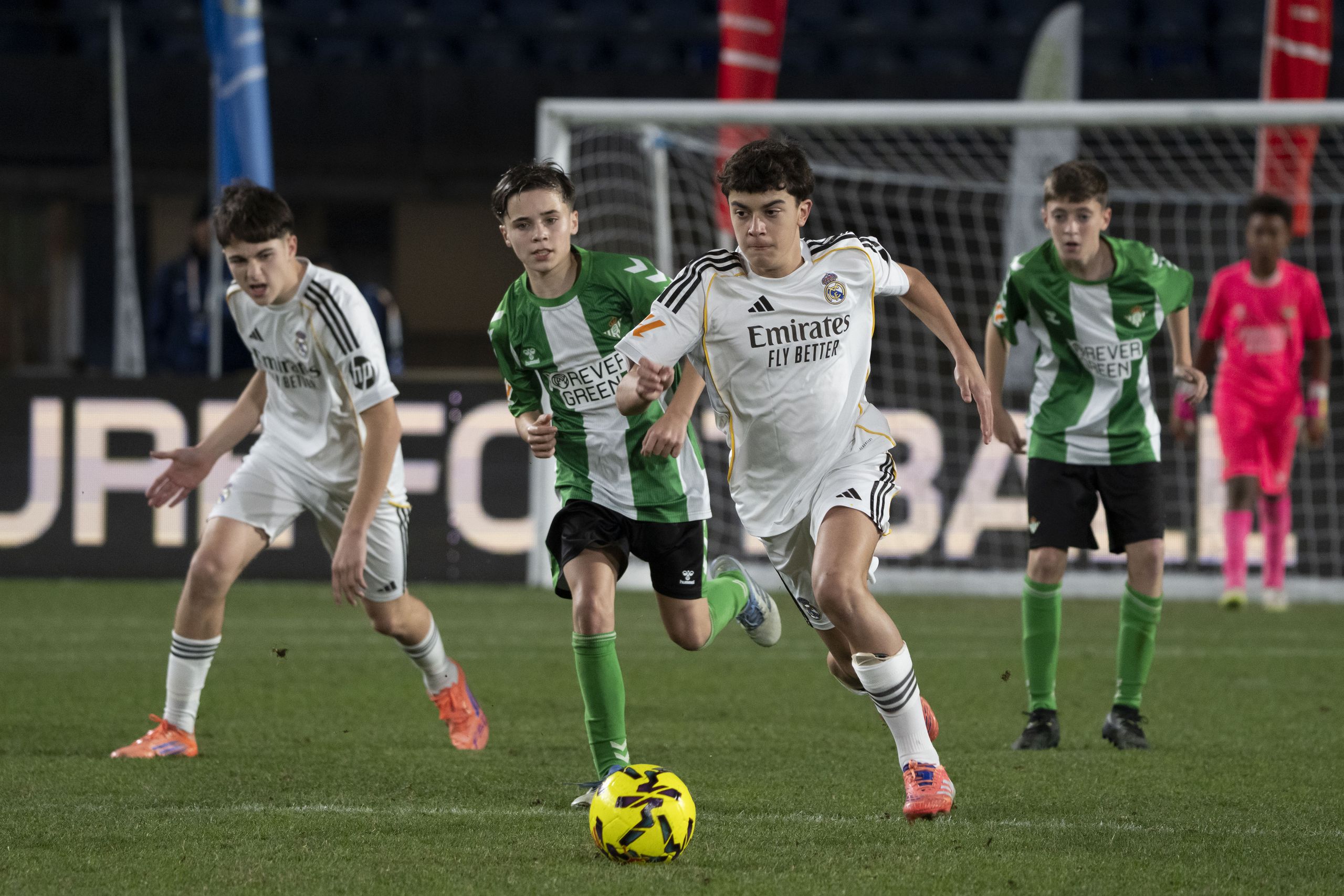
Xavi, Andres Iniesta, Iker Casillas, Fernando Torres, Gerard Pique and Lamine Yamal are just a few of the legendary names who once graced the Futures FC tournament. We travelled to see its latest edition to understand how Spain continues to nurture such extraordinary talent.
If qualification for the World Cup were based on population, Spain would barely have made it over the past seven editions. Ranked 31st by that measure, the nation sits behind Myanmar, Sudan and Colombia – and, notably, England.
Yet, both the Spanish men’s and women’s teams currently top the FIFA rankings, having collectively secured three World Cups and three European Championships. No other country has been as consistent in producing generational footballers.
To discover what makes Spain’s youth system so effective, FourFourTwo flew to the Canary Islands to meet the latest batch of wonderkids and identify who might be leading La Roja to glory in a decade’s time.
We’re in Las Palmas for La Liga’s latest Futures FC tournament – one of several staged each year, though this one holds particular prestige. Every winter, it gathers Spain’s elite clubs and several top European sides on the island of Gran Canaria. Although it’s an under-13 competition, all three match days are broadcast live by RTVE’s sports channel – Spain’s equivalent of the BBC – as well as DAZN and other platforms. This year, the event has moved to UD Las Palmas’ 32,000-seat stadium, a venue earmarked to host matches at the 2030 World Cup. It’s difficult to imagine a youth tournament being given such prominence elsewhere, including the UK.
Its prestige is largely due to its alumni list – Xavi, Andres Iniesta, Iker Casillas, Fernando Torres, Gerard Pique and Lamine Yamal all began their journeys here. For anyone looking to spot Spain’s next superstar, this is the place.
That’s a source of immense pride for Jose Ramon de la Morena, a former journalist who founded the tournament in 1992 on the outskirts of Madrid. Over the years, he’s watched it evolve beyond his wildest expectations, aided by La Liga’s involvement. Many of the tournament’s graduates later lifted the 2010 World Cup, something De la Morena still finds deeply emotional.
“I still feel it,” he tells FFT. “Those players who became champions in South Africa all played in this tournament. I still remember Iniesta at nine years old – we named him best player of the event. A friendship began then; I followed him at 10, 12, 14, and at 16, when he began training with Barcelona’s first team. Then I saw him become a world champion, and we’re still friends today. It fills me with great pride.”
Starting the tournament wasn’t easy. “We had no money, so I had to invest my own,” he recalls. “We prepared the field ourselves – no sponsors, no publicity. The first few years were tough, but once we started broadcasting, things took off. Canal Plus came on board and handled everything.”
“It was right after the 1992 Barcelona Olympics, so the country had new sports facilities and a strong sporting spirit. We wanted a tournament where kids could feel like professionals for a few days – because they were on television, in newspapers – and it just kept growing.”
Not every young star’s early experience was smooth. “Iker Casillas was brilliant, but one year he didn’t play,” De la Morena remembers. “Real Madrid were training at our ground and spotted a local petrol station worker’s son playing goalkeeper. They asked to try him out, so he played instead of Casillas. Later, Casillas’s mother came to me furious, saying I’d blocked her son’s opportunity.”
These days, Casillas laughs about it. “I had nothing to do with it,” De la Morena chuckles. “But he still jokes that I robbed him of his chance to play that year.”
He also remembers young Lamine Yamal vividly. “He was top scorer at a tournament in Villarreal five years ago, then played in New York and Abu Dhabi,” says De la Morena, now 69. “I remember walking with the teams along the Hudson River when Lamine asked if I’d take him to see rap music – his father had told him New York had great rap! I said, ‘Rap? No, you’re here to play football!’ I met him again a few months ago for an interview and showed him his old goals – it was wonderful seeing him again.”
De la Morena’s phone rings mid-conversation – it’s David Villa, whose son Luca is playing for Atletico Madrid in the tournament. The former striker accepts an invitation to present the prizes at the closing ceremony.
Asked who we should keep an eye on, De la Morena lists several names: “For Atletico Madrid, there’s Toro and Mario; for Real Madrid, number 10 Hugo Fernandez; for Barcelona, number 11 Mounirou; and for Inter, number nine Leonardo Bolzoni.”
Inter are among six non-Spanish teams in the 16-club tournament, alongside Juventus, Dortmund, Benfica, Sporting and Paris Saint-Germain. PSG face Real Betis in our first match. Despite PSG’s reputation for developing young talent, they’re outclassed by Betis, who race to a 5-0 lead within eight minutes – thanks to two goals each from Ivan Calderon and Eric Villalba – and eventually win 6-0. The seven-a-side matches, played on a smaller pitch, last 12 minutes per half. Betis are cheered on by an enthusiastic group of mothers singing the club’s anthem from start to finish. The atmosphere is remarkable.
“This experience is invaluable for our players,” says Betis coach Edgar Agudo. “They’ve competed in tournaments for years, but maybe not with this level of exposure or opposition. Our academy plays a huge role in feeding the first team, and it’s great that these events show young players the path to follow.”
Juventus captain Andrea Ortoncelli shines against Benfica, scoring a goal and celebrating with a Dybala-style gesture. Some players are performing on live TV for the first time, complete with rehearsed goal celebrations – as seen when Valencia’s Luca Sanchez scores in a 3-0 win over Inter.
Atletico Madrid face hosts Las Palmas, whose fans bring drums, flags, and nonstop chants – a surreal scene for an under-13s game. Even referee decisions are met with whistles. Despite it being winter, temperatures hover around 20°C, drawing over 1,000 spectators, including David Villa, who watches proudly among the Atletico parents.
Barcelona defeat Espanyol despite their players being notably smaller than many rivals. The technical ability of their shorter players impresses most – defenders like Claudio Ruiz stand out for their composure and skill, suggesting a bright future once they grow physically.
Real Madrid captain Hugo Fernandez also catches the eye against Athletic Bilbao. Idolising Luka Modric, he sports a similar flowing hairstyle and technical flair – but as a left-footer. He scores once and assists another, while winger Nacho dazzles with his dribbling and flamboyant orange boots.
Of the six international teams, only Juventus reach the quarter-finals, underlining the dominance of Spanish academies. “Year after year, Spain’s teams prove they’re the best,” says La Liga representative Cristina Sanchez. Dortmund coach Jannik Pleschke agrees: “You can see Spanish teams live football differently. Their understanding of the game and creativity with the ball is exceptional. Competing at this level is invaluable for us.”
In the quarter-finals, Villarreal’s right winger Aly Nestor Fofana impresses as they beat Espanyol. “It’s been amazing,” says Espanyol defender Max Novas. “My first time in the Canary Islands – I was so excited to play here.” Midfielder Issa Sigue adds, “It’s been a great experience.”
Villarreal midfielder Raul Perez says, “My dream is to become a professional and win this tournament.” Atletico Madrid join them in the semis after defeating Juventus, with dribbler Viti scoring a stunning long-range goal and goalkeeper Inigo netting from a long punt. Barcelona lose on penalties to Valencia, while Betis bow out after a 1-0 loss to Real Madrid – Fernandez, the young Modric lookalike, scoring the decisive goal. “That kid has an aura,” remarks a journalist, praising Real keeper Andres Estaire’s earlier saves.
In the semis, Villarreal’s Raul Perez calmly chips in a panenka penalty to beat Valencia, while David Villa’s son Luca scores as Atletico knock out Real Madrid, delighting his father in the stands.
True to Atleti’s style, they win the final 1-0 courtesy of Jaime’s goal. Villa presents the awards, handing the MVP prize to Viti, while Real Madrid’s Fernandez earns the top scorer honour and Valencia’s Ibai Garcia is named best goalkeeper. Villarreal settle for runners-up medals, but coach Paco Peris is optimistic: “We recruit players young to develop them within our model. When they’re ready, we trust them and give them chances.”
De la Morena believes Spain’s talent conveyor belt will keep rolling. “We might have the worst generation of politicians in years,” he jokes, “but the best generation of footballers – and for a long time to come.”
The players on show in Gran Canaria won’t be ready for the 2030 World Cup on home soil, but don’t be surprised if several of them wear La Roja’s shirt by 2034. With its year-round climate and unmatched youth development system, Spain continues to set the global benchmark. In 10 years, the combined value of these players could be astronomical.
-
Unai Simón: The Record-Breaking Golden Glove Winner Who Redefined Spain's Goalkeeping
-
Taurus Horoscope Today, July 21, 2026: Stay Focused and Avoid Overconfidence

-
Aquarius Horoscope Today, July 21, 2026: Faith Will Strengthen, Bonds with Friends Will Deepen

-
Virgo Horoscope Today, July 21, 2026: Active saving efforts and promising offers ahead

-
Scorpio Horoscope Today, July 21, 2026: Be Generous and Stay Balanced in Health