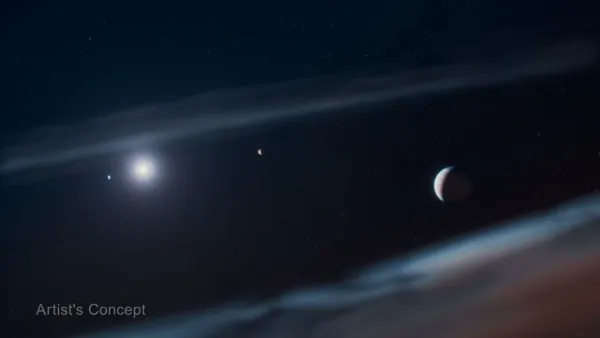
Some discoveries push our growing list of places in the sky, and some pretty much push the process itself. NASA’s James Webb Space Telescope just delivered that second kind, by confirming Beta Painter da huge exoplanet that apparently sat there for more than a decade, tucked inside one of the most intensely observed planetary systems we can point at. It shows a new way to uncover worlds that even our best observatories had trouble teasing out.
Beta Pictoris: Our Hidden Planet
Beta Pictoris is roughly 63 light-years away down in the southern constellation Pictor. It’s not your everyday star. The system is believed to be only about 20 to 23 million years old, which makes it kind of a space teenager compared to our Sun’s 4.6 billion-year age. Since planets are still figuring out stable orbits, and the surrounding debris disk keeps churning, astronomers have treated Beta Pictoris as a natural workshop for watching planetary systems mature after they form.
Before this new planet was confirmed, Beta Pictoris was already well known for two directly imaged gas giants, Beta Pictoris b and Beta Pictoris c. Adding Beta Pictoris d now makes it only the second planetary system known to be directly imaged with more than two confirmed planets. That’s a rare setup, because it gives scientists a chance to study a kind of gravitational dance between multiple young giant worlds, all in one relatively nearby neighborhood.
How the James Webb Space Telescope (JWST) found it
Classic direct imaging starts usually with coronagraphs, where we block the star’s overwhelming glare, then look for the faint glow of a planet sitting off to the side. Webb worked more sideways, sort of, by using the Near-Infrared Spectrograph’s Integral Field Unit (NIRSpec IFU). Instead of capturing only a visual snapshot, the team captured spatial and spectral information simultaneously.
Hunting for a tiny point of light would be grueling, so, they traced the planet’s distinctive infrared spectrum, i.e., they looked for molecular tells that do not blend neatly into the stellar background. Then, the second set of NIRSpec observations, paired with matching constraints from the Mid-Infrared Instrument (MIRI), helped confirm that this was actually a planet, not an observational hiccup.
That difference might seem small, but small things matter a lot in astronomy. A conventional picture mostly tells you where the light comes from. Spectroscopy tells you what the light is made of. Planet atmospheres (and other materials) leave absorption marks in the spectrum (like a chemical signature, or a fingerprint). Webb leveraged that property to pull a dim planet out from the star’s overwhelming brightness, even when the planet itself was hard to separate visually.
According to the Astrophysical Journal Letters, Beta Pictoris d is slightly larger than Jupiter, and it takes about 91 years to make a full orbit around Beta Pictoris. It’s also around one hundred times dimmer than the brighter giant planets already known there. That faintness explains why it slipped past earlier detections, despite years of monitoring by both ground-based telescopes and space instruments. It wasn’t necessarily missing from the system’s earlier data, it was more like concealed, by viewing geometry and star glare, until improved observing approaches finally brought the signal into view.
This find also points to a broader shift in modern astronomy. More and more, progress comes because astronomers get better at extracting meaning from the photons we already collect. Here, the key move was treating every pixel as a slice of spectrum, packed with physical information, instead of, you know, a pixel.
For planetary scientists, Beta Pictoris keeps looking like a close analogue to our own Solar System’s early days, shortly after Jupiter and Saturn were taking shape. The star’s broad debris disk, reshaped by gravitational nudges from its planets, still evolves through collisions between countless rocky fragments and icy leftovers. Each newly confirmed planet helps refine the models that describe how disks take shape, how giant planets drift and migrate, and how young systems eventually calm down into longer-term stability.

The bigger implication beyond Beta Pictoris
The fact that Webb can recover a giant planet that remained hidden for more than a decade in one of the most scrutinized stellar systems around, then it suggests something pretty fascinating. Plenty of nearby planetary systems might already host unseen worlds, just sitting there in the data, waiting for better analysis by us, and not a bigger mirror. As spectroscopy and computational techniques keep improving together, astronomers may find that the next exoplanets we are so on the lookout for, were present in our archives, all along.
One of my favourite people to walk this planet, Carl Sagan, often said that science isn’t just a set of facts or collected knowledge but a careful way of listening to the universe as we have it presented to us. Beta Pictoris d kinda fits that idea, don’t you think?
Considering that the Webb aimed toward it and the planet did not simply show up. It was there the whole time, sure, orbiting a young star, but in silence. What changed was our capacity to notice. How can you not love it! In astronomy, discovery is often less about inventing something new, and more about learning how to see what was hidden in plain sight.
-
How To Make Perfect Mutton Biryani At Home With These Simple Tips

-
‘I don’t care…’ Rohit Sharma breaks silence on retirement rumors

-
Kriti-Jiva’s bonding at Lord’s became more famous than cricket, heart-winning pictures went viral

-
When and where will Vaibhav Suryavanshi play the next match for India? See full schedule here

-
Surprising: Husband and wife infected with Covid-19 in Bhagalpur, panic in the district