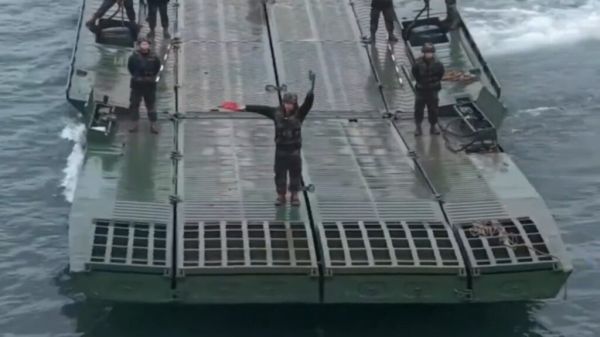
As wildfires rage on in Canada and Iran’s Anzali Wetland faces various environmental difficulties, major flooding has affected parts of China. The Guangxi Zhuang Autonomous Region has flooded due to several rounds of extreme rainfall, resulting in numerous deaths in short order. Fortunately, efforts are being made to rescue those left stranded by the rising water levels, as evidenced by the emergency response agency China Anneng Construction Group and its innovative rescue technology. It is utilizing what can only be described as transforming pontoon raft tech to collect those trapped by the flooding and float them to safety.
Thus far, the unfolding pontoon rafts have proven a major success. As reported by @shanghaidaily on X, tens of thousands of people were stranded in Guangxi’s Guigang education park thanks to the dangerous levels of flooding. China Anneng arrived on the scene with the rapidly unfolding flotation devices to get them out, moving hundreds of people at a time to safety. Not only does the Chinese military have multiple things the United States’ doesn’t, but its emergency response teams have some unique tools in their own right.
This is a remarkable invention that has proven more than capable of saving countless lives in disaster scenarios. Surprisingly, the technology to make these rafts work doesn’t even seem all that complicated, hence its implementation for over half a decade.
How China Anneng’s transforming rafts work
So, how do these rescue pontoon rafts come together in times of crisis? As shown off in a video on X by the Chinese Embassy in the United States, the rafts are divided into portions, which travel via truck to flooded areas. These sections are deployed into the water where they unfold, allowing emergency personnel to join them together to form a larger raft or even a full-length bridge to cross a major waterway. Alternatively, they can go off on rescue missions individually. These emergency personnel man the motorized crafts, navigating them to disaster sites to locate and pull out those in need of assistance.
These pontoon rafts have seen use in emergency circumstances since around 2020, proving a valuable emergency rescue tool thanks to their quick, minutes-long deployment and assembly process, self-propulsion system, and ability to move hundreds of people out of harm’s way without issue. With that said, as effective as these pontoon rafts are, they haven’t handled the current flood rescue mission alone. In the spirit of the many intriguing military helicopters used for rescue missions, SAR and standard helicopters have helped rescue stranded survivors and deliver vital supplies as necessary. Heavy-duty drones have been employed, too, engaging in similar tasks to great effect.
Sometimes in the world of engineering, less is more. These relatively simple, easy-to-assemble rafts are getting the job done amid extreme flooding, saving numerous lives from rising water levels alongside other forms of rescue technology.