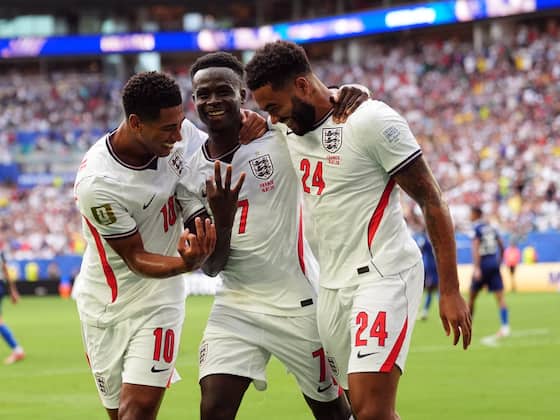
When England finally looked like world champions, the title had already slipped away. In a wild and bewildering contest, instead of chasing gold, they settled for bronze. For one half, England were unstoppable; for the other, they looked vulnerable even from a 4-0 lead. By the final whistle, Bukayo Saka had become only the fourth Englishman to score a World Cup hat-trick, joining Geoff Hurst, Gary Lineker and Harry Kane, while Jude Bellingham made England the first side ever to put six past France in a World Cup match. Yet, what would have been a joyous result in any other setting carried an undertone of regret: given how inconsistent they had been, where was this version of England against Argentina? Or even against Norway, DR Congo, Panama and Ghana?
England’s 6-4 victory over France in Miami was as exhilarating as it was exasperating. It hinted that such brilliance might actually be part of their makeup, despite Thomas Tuchel’s earlier denials. Tuchel, still haunted by the semi-final collapse, could not escape the boos from English fans. Yet his side, so timid and defensive in that dreary 36-minute spell against Argentina, were four goals up by half-time against a disorganised and disheartened French team. The same manager who failed to hold a 1-0 lead in the semi-final nearly contrived to lose a four-goal advantage here, though at least he resisted the temptation to revert to a back five.
As both teams made seven changes, England’s depth was on full display — and that only heightened the frustration that some of the players who dismantled France were denied the chance to influence the Argentina match. Saka was the prime example: overlooked when Tuchel opted for a conservative setup on Wednesday, he reminded everyone of what England had been missing. Marcus Rashford, introduced only in stoppage time in that semi-final, showed again how his pace and directness could have changed things. If Tuchel’s plan was to play with quick wingers, this was the proof of their potential impact.
Tuchel’s assistant Anthony Barry said England were playing “with broken hearts,” yet the emphatic response in Miami was both an endorsement and an indictment of the manager. There was irony in the scorer of England’s second goal: Ezri Konsa, the same player Tuchel had controversially brought on for Anthony Gordon against Argentina. That substitution had backfired spectacularly. This time, positioned in a back four, Konsa surged forward to head in from a corner.
Tuchel did have reason to take some comfort from the return to form of Declan Rice, who has struggled recently with injury and illness. Rice was commanding, scoring the first goal and assisting the second, in a performance that owed much to Arsenal’s influence. The Gunners contingent in Tuchel’s XI produced four goals and two assists between them.
Rice captained the side in place of the rested Harry Kane, whom Tuchel had said was carrying too many “kilometres in the legs.” Perhaps Saka and Rashford had too few. Ivan Toney was the surprise inclusion, having previously been limited to late cameos. Kobbie Mainoo’s World Cup ended without a single minute due to injury, while Morgan Rogers started — just as Chelsea were reportedly preparing a £117 million bid for him — though his display suggested he remains a step below Saka and Rice.
Rice set the tone early, intercepting Desire Doue’s pass, driving forward, and firing a 25-yard shot past a static Mike Maignan. His corner was then headed home by Konsa. From there, Saka took control. Combining with Rashford in a breathtaking counter-attack, he was first denied by Maxence Lacroix on the line before Rashford set him up for England’s third. Saka added a fourth after a clever through-ball by Eberechi Eze, then completed his hat-trick from the penalty spot after Djed Spence was fouled by Malo Gusto. Bellingham came off the bench to cap the win with a stunning solo goal.
France, however, mounted a spirited fightback. After Didier Deschamps made four substitutions, his team struck four times in a stirring response led by the irrepressible Kylian Mbappe. His brace saw him overtake Lionel Messi — at least temporarily — as the World Cup’s all-time leading scorer, with 22 goals to Messi’s 21. Mbappe also became the first player since Gerd Muller to reach double figures in a single World Cup, putting him in pole position for the Golden Boot. Bradley Barcola, one of the substitutes, scored from Mbappe’s assist, while Michael Olise, who twice came close to levelling at 4-4, created both of Mbappe’s goals to take his tournament assist tally to seven — another record. Ousmane Dembele, also introduced at half-time, made it 5-4 before Bellingham’s late strike sealed it.
The game was historic not only for its scoreline. It also marked Deschamps’ 187th and final match in charge — and his 290th appearance for France including his playing career. The comeback mirrored the 2022 final in spirit, though this time a defeat was an unfitting farewell for the long-serving coach.
Tuchel, who has expressed a desire to remain in charge, can point out that this is officially England’s best World Cup campaign since 1966 — six victories and, unlike in 1990 or 2018, a win in the third-place play-off. Yet, the triumph only underscored the lingering question: what might have been.
-
Manchester United Suffer Setback as Lisandro Martinez Injured During World Cup Final
-
Lionel Messi and Lamine Yamal Create Historic Moment with World Cup Final Starts
-
Passenger Bus Hits Parked Car, Auto And Two-Wheeler In Indore; Driver Detained

-
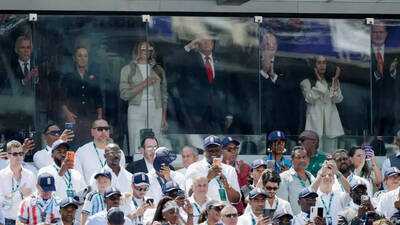
Donald Trump Attends 2026 World Cup Final: A Historic Moment
-
BBC viewers erupt at 'desperate' TV licence World Cup ad - 'made me want to cancel'