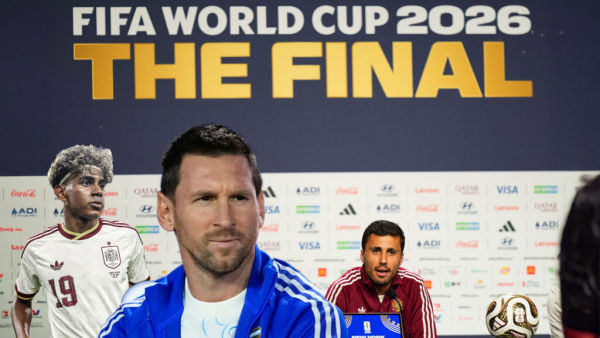
Unlike Argentina’s bruising, physical semi-final against England, Sunday’s World Cup final against Spain offers something different entirely and yet compelling: a clash of contrasting footballing philosophies, generations, and eras—Lionel Messi’s ageing brilliance against Lamine Yamal’s emerging genius, defending champions against Europe’s reigning kings.
Also read: Messi fires back at World Cup favouritism allegations: ‘Nothing was handed to us’
Long before the first whistle goes at the MetLife Stadium in New Jersey, USA, the conversation has settled around one image. It is not about a goal, a trophy celebration or a moment from the training ground. It is a photograph taken nearly two decades ago.
Epic Messi-Yamal photo goes viral
A 20-year-old Lionel Messi, then an emerging Barcelona star, gently bathes an infant as part of a UNICEF charity calendar organised by the club. That baby was Yamal, not yet a year old.
Few could have imagined that the infant in Messi’s arms would one day stand across from him in a World Cup final. Social media has christened it destiny. Football romantics call it the perfect passing-of-the-baton moment. Whether or not that proves true on the pitch, the symbolism is impossible to ignore.
How Argentina and Spain made World Cup 2026 finals
ARGENTINA
● Beat Algeria 3-0 in group stage
● Beat Austria 2-0 in group stage
● Beat Jordan 3-1 in group stage
● Beat Cape Verde 3-2 in Round of 32
● Beat Egypt 3-2 in Round of 16
● Beat Switzerland 3-1 in Round of 8
● Beat England 2-1 in semifinal
SPAIN
● Drew Cape Verde 0-0 in group stage
● Beat Saudi Arabia 4-0 in group stage
● Beat Uruguay 1-0 in group stage
● Beat Austria 3-0 in Round of 32
● Beat Portugal 1-0 in Round of 16
● Beat Belgium 2-1 in Round of 8
● Beat France 2-0 in semifinal
At 39, Messi is chasing what could be the final great prize of an extraordinary international career. Yamal, still only a teenager, is expected to dominate world football for the next decade. Sunday’s final is not simply about the present. It is also about football’s future.
Yet, reducing the contest to Messi versus Yamal would do a disservice to what promises to be one of the most fascinating tactical battles in recent World Cup history.
Tactical comparisons: Spain against Argentina
Spain arrive as arguably the most aesthetically pleasing side in international football today. Coach Luis de la Fuente has retained the foundations of Spain’s possession-based identity while adding greater verticality, pace and directness. This is no longer the endless sideways passing associated with the peak Tiki-taka years. The current Spanish side controls possession with purpose, pressing aggressively when they lose the ball and attacking spaces with remarkable speed.
Their semi-final victory over France was perhaps the best performance by any team in the tournament. Spain dominated the midfield, denied France any rhythm and forced one of the world’s strongest attacking sides into prolonged periods without meaningful possession. The game showcased not just technical superiority but also tactical discipline. Spain have conceded just one goal in the tournament so far.
Argentina have made final seven times. In their previous three appearances, they have won the trophy three times (1978, 1986 and 2022) and lost as many times (1930, 1990, 2014)
Yamal may not yet have produced the individual brilliance many expected during this World Cup, but Spain have hardly depended on one player. Their strength lies in collective movement and intelligent positioning. Every player understands his role, allowing the team to function as a cohesive unit rather than a collection of stars.
Also read: From plastic tub to FIFA final hub: Epic Messi-Yamal 2007 image goes viral again
There is another emotional layer to Spain’s story. Many of their leading players emerged from Barcelona’s famed La Masia academy. Yamal, Pau Cubarsí, Gavi, Dani Olmo and goalkeeper Joan Garcia all grew up idolising Messi. Childhood photographs of several of them with the Argentina captain have resurfaced in recent days, reminders of the influence he has had on an entire generation of Spanish footballers. The man they once admired from the stands is now the final obstacle between them and World Cup glory.
For Messi and Argentina coach Lionel Scaloni, Spain represent more than just an opponent. It is, in many ways, a second home. Messi spent the defining years of his club career in Spain, becoming Barcelona’s greatest player and one of La Liga’s greatest icons. Scaloni, meanwhile, is a Spanish resident and citizen who has built much of his post-playing life in the country.
Sunday’s title clash is, therefore, also a meeting between homeland and adopted homeland.
If Spain are favourites in the eyes of many pundits, Argentina have grown a habit of defying predictions in this tournament. Scaloni’s boys have become synonymous with comeback victories. Their knockout journey has been anything but comfortable. They edged past Cape Verde, recovered dramatically to beat Egypt after trailing by two goals, overcame Switzerland in another tense contest and then came from behind once again to eliminate England in the semi-finals.
None of those victories was straightforward and reflected Argentina’s remarkable resilience, which has become the defining feature of the Scaloni era.
His greatest strength is not simply tactical knowledge but his ability to adapt during matches.
Argentina rarely approach two opponents in exactly the same way. Scaloni studies opposition strengths, identifies weaknesses and is prepared to abandon familiar patterns if circumstances demand it.
That flexibility has transformed Argentina into one of the hardest teams in international football to beat. Messi remains central to everything they do. La Albiceleste have scored a minimum of two goals in each game that they have played so far.
The Messi factor
Despite approaching 40, he continues to dictate matches through intelligence rather than speed. His movement between the lines, his vision and his decision-making remain unmatched. He enters the final leading discussions not only for another World Cup title but also for both the Golden Ball and the Golden Boot, achievements that would further enhance a legacy already regarded by many as unparalleled.
Also read: FIFA WC: How Scalonismo turned Argentina into the masters of comebacks
His influence extends beyond statistics. Younger players seem to grow in confidence around him, while opponents often reshape entire defensive plans simply to contain him. That could once again be Spain’s biggest challenge.
Equally intriguing will be how Argentina deal with Spain’s midfield dominance. De la Fuente’s side thrives on controlling possession, forcing opponents to chase shadows before creating openings through relentless passing combinations. Against Argentina, La Furia Roja are expected to suffocate space rather than simply mark Messi.
With Rodri anchoring midfield in his trademark deep lying playmaking role, Spain will look to cut off passing lanes into Argentina’s talismanic captain, deny him time between the lines and force Argentina to build through less dangerous areas.
The world champions on the other hand, are unlikely to allow Spain to dictate the rhythm so easily. One of Scaloni’s defining characteristics has been his ability to slow games when necessary, disrupt opposition momentum and turn contests into battles fought on his own terms. Rather than engage Spain in an open exchange of possession, Argentina are expected to press selectively and attack quickly once possession changes hands.
The contest may therefore be decided less by spectacular individual moments than by which coach succeeds in imposing his preferred tempo.
Both teams have high-end skills
For neutrals, it is an irresistible final. Spain bring perhaps the world’s finest collective football. Argentina bring experience, adaptability and an almost unmatched competitive spirit. One team seeks to control through possession, the other through game management and tactical flexibility.
Also read: World Cup 2026: How Argentina coach Lionel Scaloni saw a 100-game evolution
Hovering above it all is the image of Messi and Yamal, separated by nearly two decades but united by one unforgettable photograph.
Whether it proves to be the symbolic handover from one generation to the next or the final glorious chapter of football’s greatest career will only be known after 90 minutes, or perhaps even longer.
Either way, this World Cup final has already secured its place as one of the sport’s most compelling storylines before a ball has even been kicked.
-
WAFCON 2026: What you need to know

-
SA20 2027 FIXTURES ANNOUNCED, DEFENDING CHAMPIONS SUNRISERS TAKE ON GANGULY'S PRETORIA CAPITALS IN OPENER

-
F1® Sim Racing India Open to Commence Delhi Time Trials
-
The Silky Elephant Brings Immersive Vegetarian Fine Dining to J.P. Nagar

-
Thalapathy Vijay's Jana Nayagan Hits Theatres Amid Political Aspirations