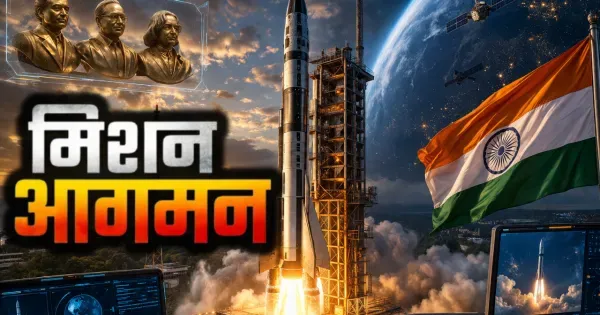
Digital Desk: Today, 18th July, is a very special day for India’s private space sector. Hyderabad-based space startup Skyroot Aerospace is going to launch its first orbital rocket Vikram-1 from the Satish Dhawan Space Center (SDSC-SHAR), Sriharikota. This mission has been named ‘Aagman’. If this launch is successful, then for the first time a rocket developed by an Indian private company will place the satellite in the Earth’s orbit.
This mission is being considered a major milestone not only for Skyroot but for the entire private space sector of India. This will be one of the biggest achievements after the government opens the space sector to private companies in the year 2020.
First orbital mission now after 2022
Skyroot Aerospace had successfully launched a sub-orbital rocket named Vikram-S in the year 2022. However that mission was only a test flight. This time the aim of Vikram-1 is to place small satellites of many customers in Low-Earth Orbit (LEO) about 450 kilometers high from the Earth. This will be the first of three developmental orbital missions of the company.
Vikram-1 is made with carbon composite technology
The biggest technical feature of Vikram-1 is that it is completely made of carbon-composite structure. According to Skyroot CEO Pawan Kumar Chandana, this is the world’s first orbital rocket made entirely of carbon composite. This material is about five times lighter than steel, allowing the rocket to weigh less and perform better.
The rocket is fitted with three solid-fuel stages and a liquid orbital adjustment module. It has the capacity to deliver payload of up to 350 kg to a 450 km high orbit.
Not just satellite, will also pay tribute to three great scientists of India
There is also a unique initiative that makes Vikram-1 mission special. Along with this rocket, micro statues of three great scientists of India will also be sent to space.
These include-
-
Dr. C.V. Raman – India’s first science Nobel laureate.
-
Dr. Vikram Sarabhai – Father of the Indian space programme.
-
Dr. A.P.J. Abdul Kalam – Missile Man and former President of India.
The size of these statues is only 800 microns (0.8 mm), that is, they are smaller than a grain of rice and it is not possible to see them with normal eyes.
Micro artist from Telangana created a unique collection
These micro sculptures have been prepared by Ajay Kumar Mattewada, a resident of Warangal, Telangana and international level micro artist. He told that work on this project started in 2023 and it took more than 140 hours to prepare the three statues.
Stainless steel, pure silver, 24 carat gold, ceramic powder and carbon fiber were used in their manufacturing. These were later installed within a small rocket model made of 18 carat gold.
Calling it the biggest honor of his 40 years of art life, Ajay said that his artwork is now going to be a part of the history of space.
Four Stage Advanced Launch Vehicle
Vikram-1 is a four-stage launch vehicle. Solid fuel has been used in its first three stages, while a restartable liquid engine has been installed in the fourth stage. This technology helps in placing the satellite in its designated orbit more accurately.
How did Skyroot Aerospace start?
Skyroot Aerospace was founded in 2018 by former ISRO engineers Pawan Kumar Chandana and Naga Bharat Daka. After getting permission for the private space sector in the year 2020, the company worked rapidly towards developing orbital rockets and now Vikram-1 is the biggest result of that effort.
Launch preparations completed
According to the company, the rocket has been fully integrated on the launch pad. All ground systems, telemetry, tracking radar and technical tests have been successfully completed.
Naga Bharat Daka, co-founder and COO of the company, said that the hard work of almost eight years has now reached its most important point. Their goal is to provide reliable and affordable launch services from India to the world.