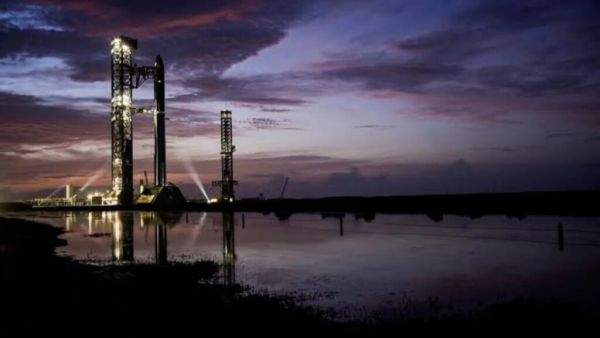
SpaceX called off the launch of its Starship Flight 13 test mission just seconds before liftoff on Thursday, after an issue occurred during the ignition sequence of the rocket’s first-stage engines.
The launch attempt from the company’s Starbase facility in South Texas was scheduled for 6.45 pm EDT (04.15 am IST Friday) at the start of a 90-minute launch window. However, the countdown halted moments before launch as the vehicle’s 33 Raptor engines began firing up.
During the live webcast, SpaceX spokesperson Dan Huot said the company would investigate the cause of the last-second abort before deciding on the next launch attempt.
“We’ll take some time, dig into what triggered that abort once the booster was igniting to launch, and then we’ll figure out what our path forward is going to be,” Huot added.
A few hours later, SpaceX CEO Elon Musk shared an update on X, saying engineers had identified the likely issue.
“To be confident of a good flight, two Raptors will be removed and replaced. Most probable launch timing is early next week,” Musk posted.
Flight 13 is the second mission using Starship Version 3 (V3), an upgraded configuration designed to move the fully reusable rocket closer to operational readinesss.
The previous Flight 12 test, conducted on May 22, achieved several objectives but also encountered technical issues. While the upper-stage Ship successfully completed its planned splashdown near Western Australia, the Super Heavy booster failed to execute its planned controlled splashdown in the Gulf of Mexico. In addition, one of the Ship’s Raptor engines did not successfully restart in space.
Many of those objectives were scheduled to be repeated during Flight 13. SpaceX planned to demonstrate a controlled booster splashdown while sending the upper stage on a near-complete orbit before another controlled descent into waters off Western Australia.
The mission was also expected to carry a major new payload, 20 next-generation Starlink V3 satellites, marking the first time the upgraded spacecraft were flown aboard Starship. The satellites were to be deployed on a suborbital trajectory before re-entering Earth’s atmosphere roughly 20 minutes later, allowing SpaceX to test deployment procedures without placing them into operational orbit.
Six of those satellites were equipped with cameras designed to capture close-up views of Starship’s heat shield during re-entry, continuing a similar experiment conducted during Flight 12 using modified Starlink V2 satellites.
-
Motorola Edge 50 Ultra: Price of Motorola’s premium flagship phone slashed on Amazon, getting a flat discount of ₹ 24,000

-
JWT Authentication Explained: Tokens, Sessions, and Backend Security

-
Sachin Tendulkar’s emotional tribute to ‘One and Only’ Sir Garry Sobers

-
What happened on day 21? See in 10 pictures how the police took away Sonam Wangchuk from Jantar Mantar. Sonam Wangchuk Hunger Strike Day 21 Delhi Police Jantar Mantar Safdarjung Hospital Protest Photoslide

-
Vikram-1: India’s first private orbital rocket set for historic launch