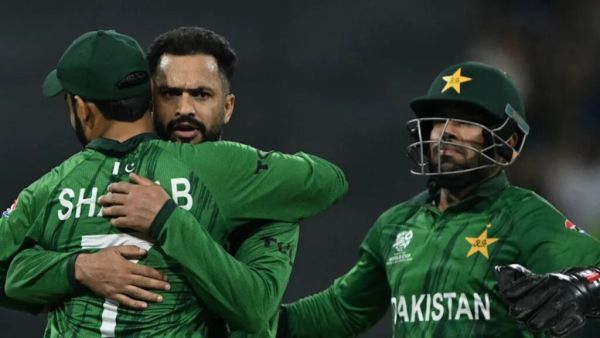
Pakistan all-rounder Mohammad Nawaz is cleared to resume his cricket career after agreeing to an ICC anti-doping penalty, but the player’s case highlighted yet again Pakistan’s troubled past with banned performance-enhancing substances.
The 32-year-old left-handed spinner was found to have used Carboxy-THC, which is a Substance of Abuse, after playing for Pakistan against the Netherlands in Colombo on February 7 in the ICC Men’s T20 World Cup 2026 Qualifier.
Nawaz, who has been banned from all forms of the game for five years, will serve only one year as he accepted the sanction. However, the latest controversy involving banned drugs casts a shadow over Pakistan’s rich cricketing history, which has had its share of doping problems in the last two decades.
Mohammad Nawaz’s Positive Test During the T20 World Cup
Nawaz’s sample, which was taken following Pakistan’s World Cup encounter against the Dutch, tested positive for Carboxy-THC.
The spinner then admitted to the commission that he had taken the banned substance, but not during competition. Under ICC rules, players who can demonstrate that they have used a Substance of Abuse outside of competition have their suspensions shortened by half if they agree to a substance abuse program.
Mohammad Nawaz’s three-month suspension was reduced to one month because he agreed to a treatment program to the ICC’s satisfaction.
Nawaz’s suspension was backdated to May 1, 2026, the day he accepted the provisional ban on himself. This means he has actually been suspended for one month and will be free to play club cricket again from June 1, 2026.
Although Nawaz is free to play, the anti-doping ruling has serious implications.
As per the ICC rulebook, all of Nawaz’s results from Feb 7 till the start of his provisional suspension have been annulled, including his knockout win against the Netherlands and any subsequent results during that period.
His own half-century and the team’s victory over the Netherlands, along with any individual accolades and records Nawaz may have equaled or bettered during the same period, were also erased.
The Pakistan Cricket Board has yet to formally respond to the news. Nawaz was under the radar of the PCB as well during this year’s Pakistan Super League, but it’s unclear what the outcome of their internal inquiry was. With the ICC punishment out of the way, the veteran all-rounder is now free to be retained if he features in Pakistan’s plans.
Pakistan’s Long History of Doping Cases
Nawaz’s doping ban is far from the first instance of its kind. Over the last two decades, Pakistan’s cricketers have repeatedly faced sanctions that charge them with violating anti-doping rules. Ahmed Shehzad, Yasir Shah, Raza Hasan, and Abdur Rehman were all banned at different points in time for similar reasons. Perhaps, Nawaz’s case will become another reminder of the ongoing problem that Pakistani cricket faces with performance-enhancing drugs.
Ahmed Shehzad was suspended for four months in 2018 after testing positive for metandienone. The controversial opener received the penalty after the Pakistan Cup matches. In 2015, leg-spinner Yasir Shah got a three-month ban from ICC after chlortalidone was found in his system.
According to Shah, the banned substance came from his wife’s blood pressure medicine. In the same year, Raza Hasan was suspended for two years after testing positive for cocaine. The left-arm spinner said he got the banned substance from a local tournament.
In 2012, Abdur Rehman was banned for 12 weeks after failing a drug test for cannabis. Shoaib Akhtar and Mohammad Asif were both banned in 2006 for using nandrolone. Before the Champions Trophy, the fast bowlers underwent a doping test that showed positive results. Shoaib’s ban was revoked, but
Mohammad Asif faced multiple doping violations throughout his career. Another example of why the Pakistan team faces criticism is the ICC’s anti-doping code. It states that there are reduced sanctions for admitting to the use of prohibited substances outside of competitions and finishing a treatment program. However, the authorities still take action to ensure players’ results and records are adjusted. Even though Nawaz got a break for being honest about the violation, his ban still serves as a severe punishment.
Perhaps for Nawaz, the difficulties of his 12-week ban are over. However, for Pakistan’s cricket fans, this is another blow to the sport they love. It seems that the country struggles to keep its cricketers clean and educated on the consequences of doping.
-
First Glimpse of the Range Rover GT – The Brand's Most Sedan-Like Model Yet

-
Why Mercedes-Benz Has Yet to Reveal Its V-8 C63 and E63 AMG Models
-
Kia EV3 GT Review: 288bhp, 4WD Hot Hatch Priced at £49,000

-
The taste of plain rice will increase! Make Sour Spicy Prawns Curry for lunch, note down the recipe

-
World Brain Day: The habit of reading just 30 minutes every day can make the brain sharp, know 5 ways to keep the brain healthy.