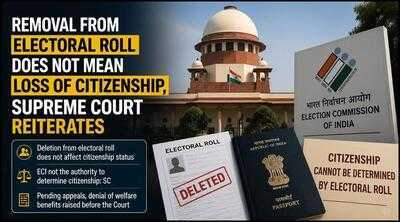

The Supreme Court on Friday orally reiterated that the removal of a person's name from the electoral roll following the Special Intensive Revision (SIR) exercise does not automatically result in the loss of citizenship.
The court emphasised that it had already clarified in its Bihar SIR judgment that the Election Commission of India (ECI) is not the authority to determine citizenship. It observed that deletion from the electoral rolls, by itself, cannot deprive a person of their citizenship status, Live Law reports.
Citizenship Cannot Hinge On Voter List
A Bench comprising Chief Justice of India Surya Kant, Justice Joymalya Bagchi and Justice V Mohana was hearing a petition filed by Prasenjit Bose seeking directions to streamline the functioning of the Appellate Tribunals constituted to hear appeals filed by persons excluded from the electoral rolls during the SIR exercise.Appearing for the petitioner, Senior Advocate Gopal Sankaranarayanan told the court that around 34 lakh appeals are still pending before 19 Appellate Tribunals, while two judges have resigned. He said only around 38,000 appeals have been decided so far and nearly 70% of those have been allowed, indicating that a significant number of exclusions may eventually be overturned.
The senior counsel further submitted that while appeals remain pending, the West Bengal government has issued notifications denying benefits under the Public Distribution System (PDS) and welfare schemes such as Annapurna Yojana to people whose names were deleted from the electoral rolls. He also informed the court that caste certificates were being denied to such persons.
Responding to the submissions, Justice Bagchi referred to the Supreme Court's Bihar SIR judgment and said the ECI is not a constitutional authority to determine citizenship under Articles 9, 10, 11 and 12 of the Constitution.
He observed that once a person's name is removed from the electoral roll on the ground of doubtful citizenship, the ECI has a corresponding duty to refer the matter to the Central Government for adjudication under the Citizenship Act. Until such a determination is made, the person's citizenship status continues.
"We are conscious of this. In our Bihar SIR judgment, we made it clear that the ECI has a corresponding duty that as soon as there is a decision, it has to refer the matter to the Ministry for adjudication under the Citizenship Act. Unless that is done, the status must continue," Justice Bagchi said.

Welfare Benefits Under Scrutiny
Sankaranarayanan argued that neither the petitioners nor the court had anticipated that the deletion of names from electoral rolls would lead to the withdrawal of welfare benefits.
He submitted that with nearly 33.5 lakh appeals still pending, those affected continue to lose access to welfare schemes despite the fact that 70% of the appeals decided so far have been allowed. He urged the court to put in place mechanisms to ensure transparency and accountability in the appellate process.
The senior counsel also argued that possession of a valid passport should be treated as clear evidence of citizenship.
After hearing the submissions, the Bench re-listed the matter along with the petitions challenging the West Bengal SIR exercise.
Petition Seeks Wider Reforms
The petition seeks several directions to simplify and improve the appellate process for electors whose names have been deleted during the SIR exercise. It also seeks greater transparency by asking for the disclosure of constituency-wise data and publication of the Standard Operating Procedure (SOP) governing the exercise.
Filed through Advocate-on-Record Neha Rathi on July 8, the petition seeks directions allowing appellants and their authorised representatives to appear before Appellate Tribunals through video conferencing. It also seeks mandatory service of hearing notices at least seven days in advance through both electronic means and physical delivery by Booth Level Officers (BLOs).
The plea further seeks a time-bound schedule for disposing of all appeals before the next election, with appeals arising from Municipal Corporation and Municipality areas to be given priority. It also asks for a simplified guide to the appellate process in Bangla, Hindi and English to improve accessibility and public awareness.
The petitioner has also sought permission for electors whose names were deleted at any stage of the SIR process, including enumeration, claims and objections, and adjudication of logical discrepancy cases, to file appeals before the Appellate Tribunals for the restoration of their names.
Seeking greater transparency, the petition urges the authorities to publish Assemblyconstituency-wise data on Form 6 applications for inclusion of names and Form 7 applications for objections or deletion. It seeks details of applications filed, admitted and rejected during the claims and objections stage and subsequent stages.
The plea also seeks disclosure of the number of pending cases before Appellate Tribunals in every Assembly constituency, the number of appeals filed both by deleted electors seeking restoration and by the ECI seeking exclusion, and the publication of data required under Formats 1 to 8 of the ECI Manual on Electoral Roll, 2024.
Additionally, the petitioner has sought directions to the Union government and the ECI to place in the public domain the Standard Operating Procedure framed on April 7, 2026, by a three-member judicial committee, which was referred to in the Supreme Court's order dated April 13, 2026, in W.P. (C) No. 1089 of 2025.
The petition also seeks regular public bulletins indicating the number of appeals heard and decided by the Appellate Tribunals.
-
Air Quality Alert Issued in New York Ahead of the World Cup Final

-
‘I’ll Give It My All’: How Lionel Messi and Argentina’s Unbreakable Faith Drove Them Through Challenges to the World Cup Final Against Spain

-
Wrong blood transfusion at Jodhpur hospital leaves new mother battling for life

-
Faridabad: Two minor brothers booked for sexual assault of nine-year-old girl

-
Meet Jimothy: The Raccoon Captivating Seattle's Residents