Sonam Wangchuk’s indefinite fast has entered its 19th day. He remains steadfast in his demand for the resignation of Union education minister Dharmendra Pradhan following the leak of the National Eligibility-cum-Entrance Test (NEET) — the examination that determines admission to medical colleges across India. While the protest targets the government, the questions it raises are for all Indians. This is the profound moral quagmire confronting the nation: how should a democracy respond when a 59-year-old peaceful activist sits on an indefinite hunger strike, growing weaker by the day and now unable to sit up without support?
Yet, simultaneously, Sonam Wangchuk demonstrates that the path of peaceful protest is vibrantly alive. His fast stands up to a regime that appears to operate on the belief that power, force, or merely looking away will make civic dissent disappear. In Wangchuk's protest, the nation is called to revisit and reclaim the path set by Mahatma Gandhi. It is a road that has not been used for a long time but remains available to those who wish to explore its possibilities. It is a road that forces a conversation where power would prefer to run, hide and scheme behind closed doors.
There will inevitably be questions and debates on whether a fast for this specific crisis in education is the ideal tool, whether it was impulsive or came with adequate preparation, or if it aligns with the strict Gandhian prescription of a fast as an exercise in self-purification. These are hard questions for a purist Gandhian. They stand out sharply in light of the unprecedented developments that led to the dramatic rise of the youth-led Cockroach Janata Party (CJP), redefining the grammar of civil protest in the age of social media. The CJP is a two-month-old phenomenon with an expanding base of online support that sits in stark contrast to limited boots on the ground, raising critical questions about online backing and activism versus a disciplined grassroots movement.
Every life is precious says Delhi HC, orders regular monitoring of Sonam Wangchuk's healthMahatma Gandhi would argue that a fast — one of the most potent tools against injustice — is suffering for the self without intending or causing harm to the wrongdoer. In this view, fasting aims to reform the wrongdoer, forcing them to see the situation objectively and realign with justice. Yet, the exercise cannot be reduced to a mechanical manual of 'dos' and 'don'ts'. It demands tapasya and deep practice. In Gandhi’s words: “Fasting then is crucifixion of the flesh with a corresponding freedom of the spirit and prayer is a definite conscious longing of the soul to the utterly pure.”
Wangchuk’s protest forcefully resurrects this discussion. Despite the polarised rhetoric directed against Gandhi and his ideals in recent years, the moral force of the Mahatma’s message today stares the country directly in the face. If more Indians can relook at what Gandhi taught and left us with, that in itself serves democracy and marks a victory for the protest.
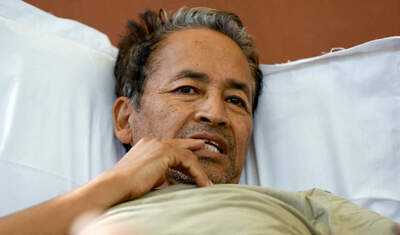
Right now, however, it is not about fasting or methods of protest. Right now, India faces the urgent task of saving Sonam Wangchuk. His vital parameters are a cause for immediate medical concern. The government must be encouraged to initiate a dialogue and find a way out so that the fast can end without further loss of time. However there has been no such inclination so far, prompting a wide range of citizens to call on Wangchuk to withdraw his fast.
Jammu and Kashmir Chief Minister Omar Abdullah is the latest political leader to have voiced concern over the health of Wangchuk, saying that the Centre should have appealed to him to end his fast. Abdullah said there should be some room for humanity and compassion even in politics. Among others who have voiced their concern and appealed to Wangchuk to end his fast are Akhilesh Yadav, Mamata Banerjee, Uddhav Thackeray, Arvind Kejriwal, Kanimozhi, Shashi Tharoor, Mahua Moitra, Kapil Sibal and Atishi.
Day 17: amid rising health concerns, Opposition leaders urge Sonam Wangchuk to end fastThis provides a broad political spectrum from the Opposition standing for Wangchuk. There is little doubt at this stage that all sides must come together to build pressure on him to yield. The matter is already moving through the courts, and the judiciary may yet offer a path forward. The Delhi High Court has now asked the Central government to ensure that Wangchuk’s health is monitored on a regular basis and to provide medical intervention if his condition deteriorates. The court observed that all medical efforts must be made to protect his life.
At this stage, we cannot predict how this standoff will play out. But there is no denying that Wangchuk's protest will remain imprinted on the collective memory of India for a long time. It will sit heavy on the conscience of the government, marking a distinct milestone in the journey of peaceful struggle against an insensitive officialdom. While the government remains preoccupied with strategic silence, Wangchuk carries moral force. He invites the State, and all citizens of India, to look within themselves and take a stand.
While the CJP agitation and Wangchuk’s fast are targeted at a government that appears to not hear voices of protest, the sharp moral question posed by the hunger strike must also hit a new generation of Indians who have signed up or felt drawn to the CJP. In a world of instant gratification, speed and seamless connectivity, what does it mean to stand up for a cause? What will have to be sacrificed in return for voicing dissent, raising a banner of protest and forcing a change in policy? And eventually, what does it take to move from social media to the physical arena of the hot and sultry Jantar Mantar, where Wangchuk fasts in protest? Gandhi can offer the direction, but the youth of India will have a lot of work to do to find their own answers.
(Lekha Rattanani is the Managing Editor of The Billion Press) (Syndicate: The Billion Press) (email: editor@thebillionpress.org)
-
Fact check: Do statins cause dementia?
-
WeWork India Sinks 10% As Q1 Net Loss Weighs On Investor Sentiment

-
DPDP Is Coming Fast But Indian Startups Are Moving At Different Speeds

-
Climate Activist Sonam Wangchuk's Hunger Strike Enters Critical Phase
-
High-Level NDA Meeting Prepares for Upcoming Monsoon Session in Parliament