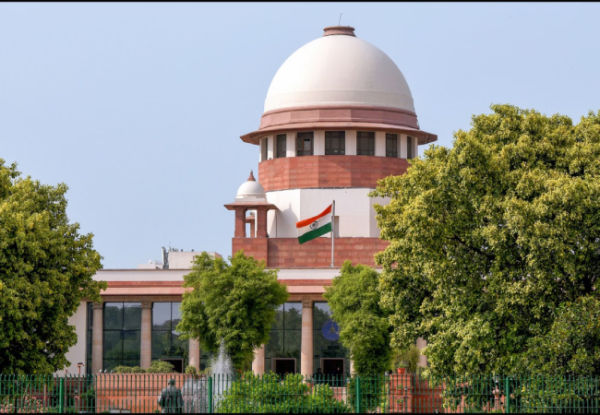
New Delhi. The Supreme Court on Thursday said that 9th class is already difficult, so what is the need to include a third language. The court said that this may increase the mental stress of the students. Tell the central government not to do this. Justice BV Nagarathna and Justice R. Mahadevan’s bench said that the third language should be introduced in Class 5 or 6 itself, so that students can cope with it more effectively.
Read :- Politics intensifies on delimitation, Kharge writes letter to PM Modi: Demand to call all-party meeting
Actually, the bench was hearing the petition of Tamil Nadu Government, in which the order of Madras High Court to create Jawahar Navodaya Vidyalaya (JNV) in every district of the state was challenged. Tamil Nadu government is not in favor of the three-language policy implemented in JNV.
Study of third language should be stopped in 9th: Court
Justice Nagarathna said that teaching of the third language should start in class 6 and stop in class 9. He said that the pressure of Class 10 board exams starts from Class 8 itself. Further talking about her school days, she said that when I was in school, 8th class children were taught 10th class things. If the situation was like this at that time, you can understand how much burden there will be on the children today.
What is the whole matter?
Read:- Congress wrote a letter to PM Modi demanding an all-party meeting, said – will raise the issue of theft of offerings in the monsoon session, will oppose the amendment bill.
This comment came in the Supreme Court during the hearing on the appeal of the Tamil Nadu Government, which has been filed against a decision of the Madras High Court. The Madras High Court had directed the Tamil Nadu government to allow the establishment of central government ‘Jawahar Navodaya Vidyalayas’ (JNVs) in every district of the state. The Government of Tamil Nadu has always opposed the establishment of Navodaya Vidyalayas because the three-language formula applies in these schools, whereas the state of Tamil Nadu follows its statutory two-language policy (Tamil and English only).
Main debate took place in the court room during the hearing
Confusion of mandatory Hindi removed: During the hearing, when Tamil Nadu’s counsel raised objections to the three-language policy, Justice Nagarathna clarified that nowhere in the policy does Hindi have to be imposed as a compulsory third language. He said that in this the state language has to be taught, English has to be taught and any third language has to be chosen. Nowhere does it say that that language should be Hindi only.
Question on Sanskrit: The Central Government’s lawyer also clarified in the court that no language will be imposed on any state under the National Education Policy (NEP). On this the court asked Tamil Nadu that if you do not want Hindi, but if it is Sanskrit, then what is the problem? On this, the state counsel said that the problem is that this third language becomes compulsory from class 9th, after which Justice Nagarathna said that imposing the language in class 9th was wrong.
Advice to Tamil Nadu government: The court also told the Tamil Nadu Government that just because a scheme is of the Central Government, it should not adopt an attitude of rejecting it. The court said that you can have your own education system, but do not stop central government schools (from coming to the state).
Read :- When will BJP demolish the illegal buildings of its unregistered colleagues? Akhilesh Yadav speaks on Johar University controversy
Change of power in Tamil Nadu and court’s stance
The Supreme Court noted that talks are still going on between the Center and the state government to establish Jawahar Navodaya Vidyalaya in Tamil Nadu. The court said that until these talks do not reach a final result, the verdict on merits will not be given. Since Tamil Nadu has recently held assembly elections and there has been a change in power (TVK replaced DMK), Justice Nagarathna remarked that it now remains to be seen what policy stance the new government takes on this issue. The state government has sought 6 weeks’ time to take instructions in the matter.
The case is pending since 2017
Madras High Court had ruled that stopping Navodaya Vidyalayas violates the right to education of children. In December 2017, the Supreme Court had put a stay on this order of the High Court.
Centre’s argument: According to the Central Government, 689 JNVs are sanctioned in 666 districts of the country to provide free and quality residential education to talented children of rural areas, but Tamil Nadu has not accepted this scheme.
Tamil Nadu’s argument: The Tamil Nadu government says that under the Assembly resolution of 1968 and the Tamil Nadu Teaching Act, 2006, only Tamil and English are compulsory in the state. The third language can only be optional. The state also pointed out that it was running ‘model residential schools’ in every district at its own expense, hence there was no need for JNV. Along with this, the state also raised the issue of funds worth Rs 3,548 crore withheld by the Center under the ‘Samagra Shiksha Yojana’.
Read :- Swami Prasad Maurya’s appeal to Sonam Wangchuk, said – break your fast in the national interest, this government believes in suppressing the voice instead of listening to it.
The Supreme Court will now hear the matter next on August 11, 2026. This case is different from other petitions pending before the bench of Chief Justice Surya Kant of the Supreme Court, where the three-language policy of CBSE has been challenged.
-
Ex-England Midfielder Nicky Butt Blasts Thomas Tuchel After World Cup Exit, Calls for His Sacking and Suggests Two Successors

-
‘Missing the final piece again’ – Harry Kane speaks of ‘empty feeling’ after England’s World Cup semi-final heartbreak against Argentina

-
'World-class ability and leadership' - USWNT skipper Lindsey Heaps cleared for much-awaited Denver Summit debut in NWSL clash with Portland Thorns on Saturday

-
Luis Suarez Praises Ronaldo as the Greatest Striker of All Time

-
Trump tightens US visa rules for students, journalists, exchange visitors