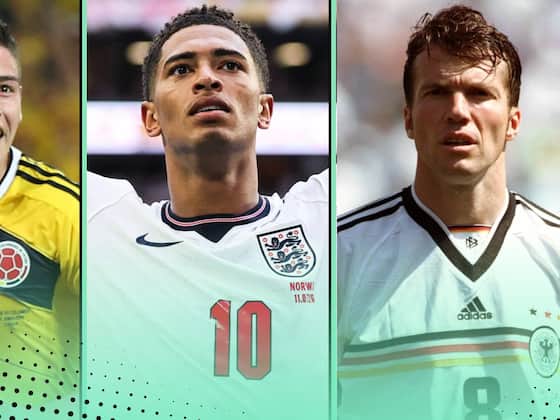
The FIFA World Cup has always been illuminated by the brilliance of legendary strikers, yet midfielders have often played a decisive role in shaping its greatest moments.
Jude Bellingham is currently enjoying one of the most remarkable goal-scoring World Cup campaigns ever recorded by a midfielder.
We take an in-depth look at the midfielders who have scored the most goals in World Cup history.
The definition of a midfielder can be quite flexible, so this list includes several attacking midfielders who some might classify as forwards. We’ll leave it to you to decide who truly counts as a midfielder.
Peru have netted 21 goals across their World Cup history, with nearly half of those coming from Teófilo Cubillas.
An attacking midfielder by trade, Cubillas featured in the 1970, 1978, and 1982 World Cups. In his debut tournament, he scored in every match he played, including Peru’s quarter-final loss to eventual champions Brazil.
His hat-trick against Iran in 1978 marked the final time he would score at a World Cup, bringing his career total in the competition to 10 goals.
At that stage, only West Germany’s Gerd Müller and Helmut Rahn, France’s Just Fontaine, Brazil’s Pelé, and Hungary’s Sándor Kocsis had also reached double figures in World Cup goals, alongside Cubillas.
One of the most iconic players in World Cup history, Diego Maradona reached the pinnacle of his career when he lifted the trophy with Argentina in 1986.
He scored eight goals across his World Cup appearances – one of them, of course, controversially with his hand, and another, in the same match, considered by many as the finest goal in tournament history.
The Argentine number 10 also featured in the 1982, 1990, and 1994 editions of the tournament.
Was he a midfielder? Perhaps not in the traditional sense, but he certainly wasn’t a classic centre-forward either. What everyone can agree on is that he was a genius on the field.
Another attack-minded midfielder, Rivaldo was part of Brazil’s squad that reached the 1998 World Cup final, often operating as a winger.
However, it was when he played in a more central role during the 2002 World Cup that he truly flourished in front of goal and showcased his fiery competitive nature.
Wearing Brazil’s number 10 shirt, Rivaldo scored in each of Brazil’s first five matches during their 2002 title-winning run, having also netted three times in the 1998 tournament.
Hans Schäfer, meanwhile, scored on his World Cup debut for West Germany in 1954 and finished that tournament with four goals – and a winner’s medal.
Initially more of a winger, he played a more central role during West Germany’s title defence in 1958, adding another three goals as they finished fourth.
If Bellingham is looking for something to boast about, he might already claim to be the highest-scoring pure midfielder in World Cup history.
Yes, he often plays as a number 10 for England, but if he were to be moved, it would likely be into a deeper rather than a more advanced role.
Bellingham scored on his World Cup debut in 2022, but it is in the 2026 edition that he has truly excelled.
His match-winning braces against Mexico in the Round of 16 and Norway in the quarter-final have underlined his importance to England, following his strong performances in the group stage against Croatia and Panama.
Before Lionel Messi and Cristiano Ronaldo came along, Lothar Matthäus held the record for the most World Cup appearances in history, playing in five consecutive tournaments between 1982 and 1998.
Four of his six World Cup goals came during West Germany’s triumphant 1990 campaign, with one each in the tournaments before and after.
Matthäus was a true midfielder, even transitioning into a deeper sweeper role later in his career.
Wesley Sneijder shone as an attacking midfielder during the 2010 World Cup, leading the Netherlands to the final. He scored once in the group stage, once in the Round of 16, twice in the quarter-final, and once in the semi-final.
However, neither Sneijder nor his Dutch teammates could find the net against Spain in the final.
Four years later, his sixth and final World Cup goal came against Mexico in the Round of 16 at the 2014 tournament.
Polish attacking midfielder Zbigniew Boniek featured in three World Cups, scoring twice in 1978 and four times in 1982.
He achieved a memorable hat-trick against Belgium in 1982, helping Poland to a third-place finish.
Rivellino also made his mark, scoring on his World Cup debut against Czechoslovakia in 1970 and adding two more as Brazil went on to win the title.
He often operated as a winger during that campaign but played in a more traditional attacking midfield role in 1974, again scoring three goals.
James Rodríguez’s dazzling performances for Colombia at the 2014 World Cup earned him the Golden Boot and a transfer from AS Monaco to Real Madrid.
The attacking midfielder scored in every match he played in that tournament, including a brace in the Round of 16 against Uruguay before Colombia’s quarter-final exit to Brazil.
Rodríguez also represented Colombia at the 2018 and 2026 World Cups, though he did not add to his goal tally.
-
Galatasaray prepare bold move for Phil Foden as Manchester City star reportedly open to summer departure
-
IAS Transfer: 19 IAS officers transferred from one place to another in the state, transfer order issued, see full list

-
Steve Yzerman steps down as detroit red wings general manager after seven-year tenure

-
Hard Times Come To An End For 3 Zodiac Signs On July 16, 2026

-
Are you planning to buy gold? Wait! Please read this news first