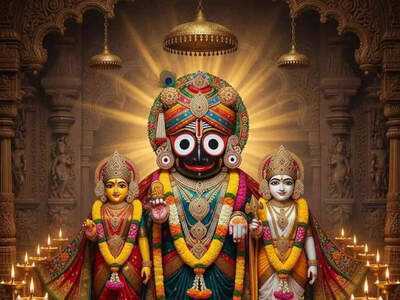
It is widely recognized that the Vedas reference the chariots associated with Goddess Usha and God Agni, detailing various types of chariot constructions. Numerous temples across India are designed in the form of chariots; for example, a small chariot-shaped temple is located adjacent to both the Konark and Simhachalam Temples, both of which were established by Langula Narasimha Deva. These structures can be aptly termed as 'stone chariots.' The chariot tradition is also prevalent in South India, with temples such as Tyagaraja in Thiruvananthapuram, Suchindram, Meenakshi, Srirangam, and Narasimha in Simhachalam celebrating the *Ratha Yatra* (chariot festival). Notably, the chariot at Simhachalam Temple is accessible to devotees year-round. In Odisha, ancient chariot traditions are linked to Sri Lingaraj and Goddess Biraja of Jajpur, representing both Shaiva and Shakta traditions.
Insights from the Skanda Purana
**Unique Ratha Yatra of Jagannath**
Among the various festivals in India, the Jagannath Ratha Yatra in Odisha stands out as a globally recognized event. Although the chariot festival for Sri Jagannath has been celebrated in Sri Purushottama Kshetra for centuries, the precise year of its origin remains uncertain. Scriptures suggest that it may have started in the first century BCE, when King Indradyumna is said to have transported the *Chaturdha Vigraha* (the four deities) in a chariot from *Adampandam* to the *Simhadwara* (Lion's Gate), as narrated in the Skanda Purana. Recent studies by German scholars indicate that this Purana might predate the first century BCE, while traditional beliefs assert that the Ratha Yatra has been celebrated since the inception of the Lord.
Historical Perspectives on the Festival
**Yayati's Legacy**
Various historical accounts provide insights into the origins of this festival. Pandit Sadashiv Rathsharma traced the festival's timeline through a manuscript named ‘Rathachakra,’ preserved in the Bada-Odia Matha of Puri, as noted in *Darubrahma ki Sanskriti aur Yug-Yug ki Ghosh-Yatra: Shri Gundicha*, edited by Shri Paramananda Adhikari in 1981. Authored by Bhikhari Pattnaik, this manuscript indicates that the Rath Yatra occurred during Maharaja Yayati's reign in the 9th century. Additionally, Pandit Murari Mishra’s play *Anargharaghava*, also from the 9th century, interprets the term ‘Yatra’ in relation to Purushottama as a figurative reference to the Rath Yatra, suggesting that the festival was indeed celebrated during that era.
The Tradition of Seven Chariots
**Chariot Specifications**
The manuscript describes the Shrimandir's height as 48 *haths* (cubits), while the *Madala Panji* refers to it as ‘Patol’ with a height of 38 *haths*. Due to the smaller temple size, the deities were also smaller, and the chariot height was recorded at 18 *haths*. Initially, seven chariots were constructed, with the deities traveling from the Singhadwara (Lion’s Gate) to Balgandi on three of them. A smaller chariot, drawn by horses rather than devotees, would lead the procession, accompanied by devotees playing musical instruments. All four chariots would pause at the banks of the Balgandi-Malini River before proceeding to the Shri Gundicha Temple. The three chariots used on the opposite bank were built at Indradyumna-Patana, a site that is yet to be precisely identified.
Construction of Chariots
**Indradyumna Workshop**
Historical records indicate that a river flowed northwest of Indradyumna Tirtha, serving as a vital transportation route. Settlements along the riverbanks were referred to as ‘Patna,’ a name still found in various regions today. Four-wheeled chariots were constructed at Indradyumna Patna. Dr. Harekrushna Mahtab, in his *History of Odisha*, notes that during Maharaja Bhanudeva I's reign (1264–1278), the number of chariots for the deities was reduced from six to three, although the exact date when horse-drawn chariot construction ceased remains unclear.
Mahaprabhu’s Grand Kitchen
**The Sacred Kitchen of Jagannath**
The kitchen of Mahaprabhu Shri Jagannath is renowned as the largest and most sacred kitchen in Sanatan culture, where *Mahaprasad* (also known as *Abhada*) is prepared daily for thousands of devotees. Situated in the southeastern courtyard of the Jagannath Temple, this expansive kitchen features around two hundred and forty active hearths, with numerous Brahmin cooks and their assistants working diligently to maintain purity in their service.
Within this kitchen, all food is prepared exclusively in fresh earthen pots. The traditional cooking method employed here is remarkable, even by modern thermal science standards. Seven earthen pots are stacked vertically over the sacred fire, with the food in the topmost pot—furthest from the heat—cooking first, while the food in the bottom pot—closest to the fire—takes the longest to cook.
Conclusion
PC Social Media
-
FCI rejected the claim of rice embezzlement of Rs 1160 crore, called it misleading, investigation continues
-
Diabetes Prevention Tips: Have you stopped eating fruits due to fear of sweets? New research reveals shocking facts about type 2 diabetes

-
A five-year-old prediction is suddenly the talk of football Twitter

-
5 Zodiac Signs Have Great Horoscopes On Thursday, July 16, 2026

-
Seeing bargain offers on Facebook? One mistake can make your bank account empty, big alert from police