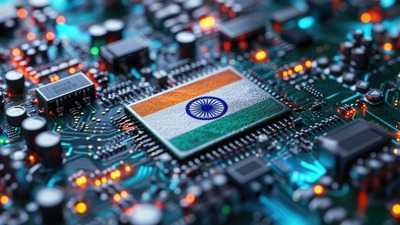
Centre approves ₹1.27 lakh crore India Semiconductor Mission 2.0
15 Jul 2026
The Indian government has approved the second phase of the India Semiconductor Mission (ISM 2.0), with a budget allocation of ₹1.275 lakh crore. This is significantly higher than the first phase's allocation of ₹76,000 crore.
The initiative aims to strengthen India's position in the global semiconductor supply chain and boost domestic electronics manufacturing.
The government expects ISM 2.0 to attract investments worth ₹4 lakh crore, generate production worth ₹2 lakh crore, and boost exports by ₹1 lakh crore.
ISM 2.0 aims to localize entire semiconductor value chain
Strategic plan
The ISM 2.0 is a long-term strategy to strengthen India's semiconductor ecosystem by building capabilities across the entire value chain.
It aims to localize the entire semiconductor value chain, including sand, silicon ingot wafer, fabricated wafers, and integrated circuits.
The government will provide incentives of up to 40% for silicon fabs and up to 35% for other fabs under this initiative.
Six pillars of ISM 2.0
Pillars of progress
The ISM 2.0 is based on six pillars, each targeting a specific aspect of semiconductor manufacturing.
The first pillar focuses on chip design, with an aim to deepen the domestic design ecosystem after 105 start-ups started designing chips under Semicon 1.0.
The second pillar incentivizes companies involved in manufacturing and R&D of semiconductor equipment and materials essential for chip production.
Pillars 3 and 4 focus on fabrication and packaging
Unit attraction
The third pillar of ISM 2.0 aims to attract more semiconductor fabrication units to India.
With the country's first fab expected to be operational by 2028, the government plans to promote investments across silicon fabs, compound semiconductor fabs, discrete component fabs, and display fabs.
The fourth pillar seeks to strengthen the Assembly, Testing, Marking and Packaging (ATMP) and Outsourced Semiconductor Assembly and Test (OSAT) industry by promoting advanced packaging technologies as companies increasingly see India as an alternative manufacturing destination.
R&D, talent development also key focus areas
Skill enhancement
The fifth pillar of ISM 2.0 focuses on research and development, with plans to move beyond current technology nodes toward more advanced semiconductor technologies through collaboration with leading R&D centers within and outside India.
The sixth pillar focuses on talent development, with 315 universities already training students in complex chip design using industry-standard Electronic Design Automation (EDA) tools. Around 68,000 students have been trained so far.
-
Leeds United confirm Karl Darlow’s departure after contract offer; joins Manchester United

-
Indian Athletes Gear Up for Competitive Commonwealth Games Ahead of Asian Games

-
India's Junior Pickleball Team Set for Asian Championship

-
Central Cabinet Approves Major Initiatives for Infrastructure and Semiconductor Development
-
Anuradha Paudwal Addresses Controversy Over Ram Mandir Remarks and India's Global Aspirations