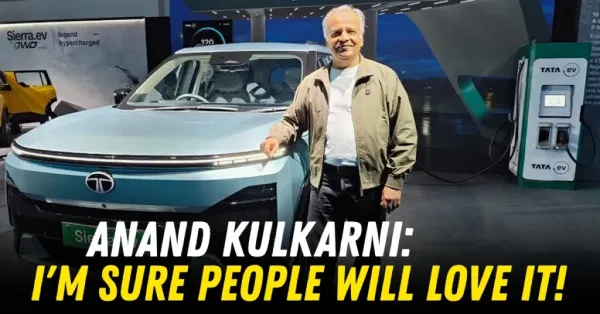
In the run up to the Tata Sierra.EV’s launch at Mumbai, CarToq’s Jayaprashanth Mohanram sat down with Anand Kulkarni – Chief Product Officer – Tata Electric Passenger Mobility – for a quick chat about the electric version of the Sierra. Here’s what transpired.
Jayaprashanth Mohanram: By the way, first of all, sir, I just saw that Tal Mureeb video where you put the Sierra up 50 degrees, inclined. So is the Sierra going to be Tata Motors’ most powerful EV ever? I have the numbers now, but it’s, I think, 340 PS and 504 Nm. But my question is, in terms of power to weight, is it going to be Tata Motors’ most powerful EV ever?
Anand Kulkarni: So thank you for that: Tal Mureeb video and the feedback. I think it’s really drawing in a lot of good reviews and adulation, I would say, from a lot of people. Look, JP, the entire technology stack that we have, we are trying to do this as a common stack. And therefore, if you see the Shaeffler unit in the rear and the induction motor – TACO unit – in the front, that shares a lineage with the Harrier EV. And therefore, you would say that the power and torque of these units are similar. But because the car is different, because the car is a little lighter, that same unit will have a higher outcome. And therefore, you are right. It is an incredibly capable car. It is a fast car as well.
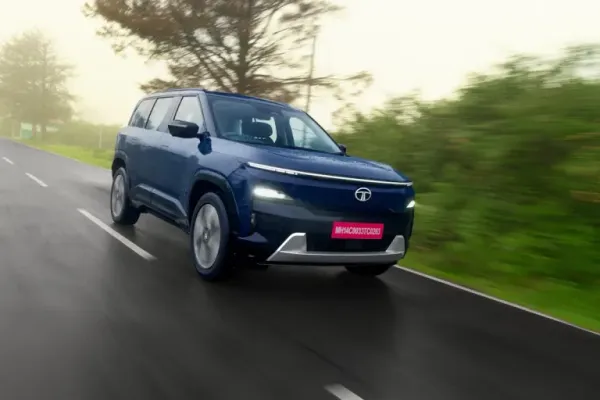
Jayaprashanth Mohanram: Yeah, because see, I think you’re going to hit the 0-100 in 6 seconds, which is incredible. Because for this kind of performance, one had to buy, say, a BMW or something like that, which is like 50-60 lakh rupees.
Anand Kulkarni: Less than 6 seconds. Less than 6 seconds, boss.
Jayaprashanth Mohanram: So it will be faster than the (Mahindra) BE6 also, right?
Anand Kulkarni: I don’t know that. I’m a poor guy when it comes to measuring data.
Jayaprashanth Mohanram: 6.7 is the (Mahindra) BE6, sir. So this, I think, will be the fastest made in India EV ever.
Anand Kulkarni: Yes, yes.
Jayaprashanth Mohanram: Okay, now moving to the next question. I remember you talked about all-wheel drive first during the Curvv launch, Curve.EV. That is when I actually spoke to you and you said the all-wheel drive is something much more easier to implement in an EV rather than ICE. So given the fact that the Sierra EV will have all-wheel drive, what does it have that the Harrier.EV doesn’t have? Does it actually surpass the Harrier also in terms of off-road performance?
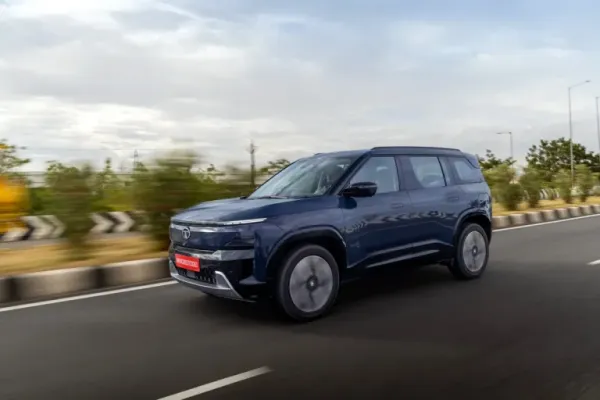
Anand Kulkarni: So, again, this is a response that I said just now. That, you know, it’s about a stack. It’s about a stack of technology. It’s about a stack of software. It is about a stack of hardware that you implement in various vehicles and tune it and deliver it as per the requirements of the vehicle. Now, when you deploy that inside of a Sierra, obviously from a weight perspective and from a power-to-weight, power-to-torque perspective, it’s going to be different, isn’t it? Then what do we do? We essentially make sure that it does not become a tearing performance which surprises a first-time user, nor does it become a dull performance that people like you and I who want to experience it cannot extract out of it. So, the hardware, the software stack remains the same. The way that we have enabled it remains the same. However, with every delivery of newer vehicles on the same stack, the technology evolves. So, the technology, and we spoke about it at the time of the Punch EV. If you took note of that, we said we are going to taper down on the throttle response. We are going to make it more easy for people to pick it up and becomes more intuitive, becomes more natural to how we want our cars to behave. So, that kind of feel has now been built into this car. And going forward, because technology has evolved, we will want to build it more and more into cars that exist today on the road as well. So, the Harrier EV will also get it. But yes, from today’s perspective, the hardware is the same, but the feel on the car is different. And as soon as you drive the car, you will feel that difference.
Jayaprashanth Mohanram: Okay. Alright. Great, sir. And one more thing, now you have given the Harrier 2 battery pack, 63 kWh for the rear-wheel drive and 75 kWh for the all-wheel drive. I assume that it’s going to be same for the Sierra because I just went through the product note that Tata Motors shared with me. So, since the Sierra has a lower weight, is it going to give it extra range because of the same size battery pack and the lower weight?
Anand Kulkarni: So, we keep on working on the range enhancements. And I’ve said at various times in previous presentations also that it’s not about adding more range, but it’s about extracting the maximum out of every watt of energy. We’ve done a similar thing here. So, along with whatever we have on the battery pack and the usual stuff like low rolling resistance tyres and the optimisation roadmaps and the algorithms and so on and so forth, we have a BLDC fan running the thermal management system. We have E-TXV. E-TXV we had shown at the time of Punch EV, which is an electronic thermostatic expansion valve for the air conditioning, which optimises the flow of refrigerant between the battery and the cabin.
And we also have something which is called an intermediate expansion tube, an IHX as they call it technically, for the air conditioning system, which makes it further better. Along with this, we also have a few other smaller aspects within the battery and within the algorithms that we have done to improve the efficiency of the car. As a result of that, and the fact that the car sits at 200 kilos lighter, the range on the cars is going to be higher. The real life achieved range will be higher. Also note that this car is of a smaller format as compared to the Harrier EV. One is weight, but the other one is the size and the aerodynamic drag, etc, etc. So all of these things put together and you are going to get a more efficient package as compared to what you have on some other cars.
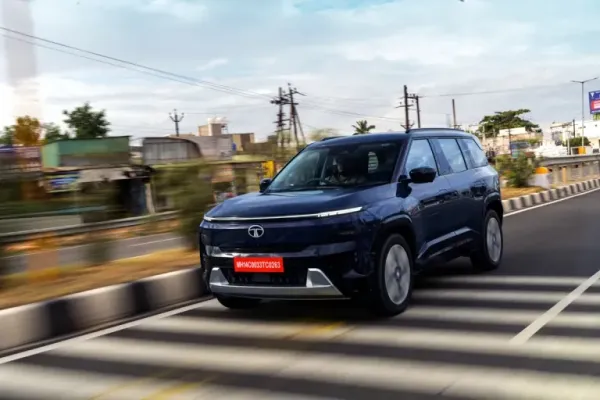
Jayaprashanth Mohanram: Yes. All right. So, sir, last time when I spoke to you, you said that packing in a large battery in a small car is an engineering challenge that you can manage. It’s not a big deal. You can do it. But in case of the Sierra, did the massive 27-0 mm wheelbase help? I’m asking this specifically because in most EVs what happens is when the battery pack becomes large, it becomes a problem for under-thigh support because, you know, the floor has to be raised, etc. But did this additional room, the longer wheelbase that you have on this Sierra, did it really help you package all that and make it a comfortable experience?
Anand Kulkarni: Certainly. Certainly it did because the Sierra EV is based on the Acti.EV Plus architecture, which means we have tried to maximise the space and make it very, very orthogonal in between the two wheels and or rather the four wheels. And as a result of that, plus the way that we have packaged the battery, JP, we’ve hit an energy density of 141 watt-hour per kilogramme, which is exceedingly high. Yeah, that is really good. And as a result of that, we’ve really been able to optimise not only the vertical stack, which is what you’re speaking about, because if you have more battery, you end up losing on ground clearance. But here we’ve not lost out on ground clearance, nor have we lost out on the seating space inside the car. In fact, you will find that the seating with respect to the floor is extremely comfortable and it offers very generous thigh support, very generous seating space, shoulder room, all of that has been optimised. So certainly the architecture and the way that we’ve been able to do it has helped this particular cause. The batteries themselves, because we have a cell to pack now, as compared to a regular module construction earlier, we are able to pack this extra density and that’s very helpful.
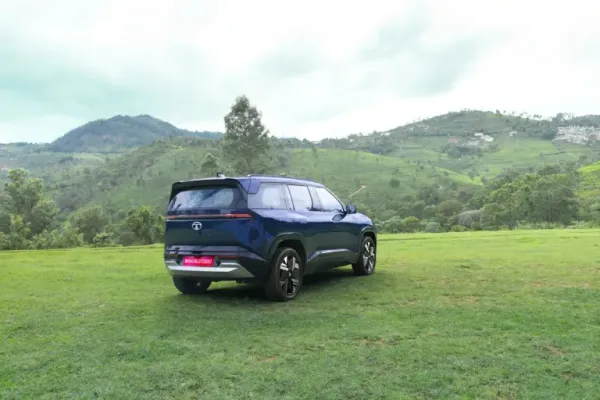
Jayaprashanth Mohanram: All right. So what platform does the Sierra EV sit on, sir? Active EV Plus or the Argos?
Anand Kulkarni: No, no, it is the Acti.EV Plus. I mean, all our EVs will always sit on the Acti EV Plus.
Jayaprashanth Mohanram: Okay. So do you want to share anything specifically about the Sierra EV’s platform, especially the ground clearance, because you just said that, you know, because you’re using cell to pack, you’re not having to actually have a very tall battery. So is it actually helping with the ground clearance?
Anand Kulkarni: Yeah. So, look, the ground clearance is one aspect of it. I mean, the ground clearance is still segment leading for this category of a vehicle. It’s an absolutely flat battery at the bottom. And, you know, one of the things I just recalled, you’re going to be here tomorrow, right? I’m showing you tomorrow exhibit, which you will really, really be happy to walk around the car and see how it is. It’s in an exploded fashion. And there you will realise that it again, when you do platforms of this sort, you look at these three dimensionalities of the X, Y and Z. And the Z space is what you essentially look at for creating enough ground clearance plus enough space for the battery and then the step in height and the headroom for the passenger as well. So while we have a great ground clearance, we also have the car set up in a height where it is not going to be cumbersome to get inside the car or exit the car. So it’s a beautiful package and you will be able to see that tomorrow.
Jayaprashanth Mohanram: All right. Thank you, sir. And now, OK, now let’s talk about charging speeds, because charging speeds is something a lot of, especially EV buyers who are buying a large battery pack want. OK, what is the maximum charging speed on the Sierra EV, sir? Will this be a new benchmark if, you know, if it’s the fastest ever, you know, in terms of charging speed for a Tata Motors car? And yeah, that’s basically it, sir, in terms of charging speeds.
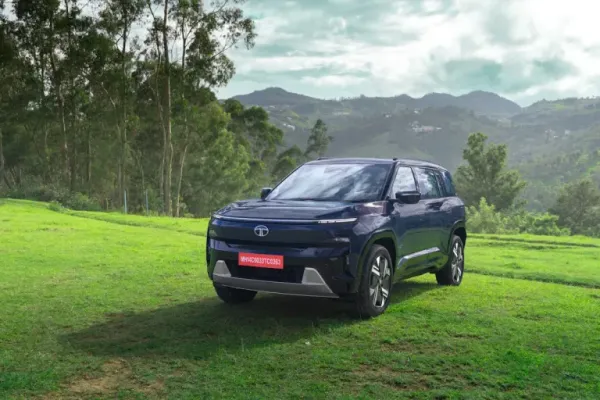
Anand Kulkarni: So the charging speed is going to be at 1.6 C and that is in line with what we have done on the Harrier EV and some of our other recently launched cars like the Punch EV as well. And the only reason why we have kept it at 1.6 C is not because we don’t have the capability to go beyond, but because, you know, it’s a balance between the charging infrastructure and what we can do on the car. So with a 75 kilowatt hour battery at 1.6 C, you can see that it easily goes up to 120 kilowatt. So with 120 kilowatt chargers, you will be able to easily or above, you will be easily able to get to 1.6 C. What does 1.6 C do for you? It gives you a 10% to 80% charge in about 25-26 minutes, which is probably what most people stop. In fact, it’s lesser than what most people stop for a break or something and that immediately replenishes you by almost equal to 350 plus real life kilometres on the car. And that we think is absolutely a sweet spot in terms of what people have on the road, what people need and how the car can support this flexibility.
Jayaprashanth Mohanram: So in future, if you want to actually, you know, increase the charging speed like Hyundai has been doing for the Creta, etc. Would the existing electrical architecture on the Acti.EV Plus of the Sierra support it?
Anand Kulkarni: You don’t need to go to peak speeds or max speeds at 1.6 beyond 1.6 C. But let us say for if it were to be for short durations and because it is JP, you need to understand that increasing the 1.6 C or increasing the charging rate will mean one thing. It will mean more current passing into the car and more current will always mean more heat. So how does the and which is why all electric cars, they don’t give you a complete full enablement at 1.6 C or whatever that max charging speeds might be. Because you need to look at connections. You need to look at wiring harnesses. You need to look at all these things. So some of it is hardware enabled. Whatever is hardware enabled, you can’t change on the car. But whatever is software enabled, you can certainly do that.
Jayaprashanth Mohanram: Okay. So because to be honest, in my BE6, what happens is when we go to the 180 kilowatt charger that Mahindra has put up called Charge-In. So what happens is, sir, on a hot day, it goes into limp mode. So only if you cool the car for 30 minutes, then it comes back.
Anand Kulkarni: Precisely my point.
Jayaprashanth Mohanram: So we didn’t face that when we had our Tata Tiago. So I have experienced it with the real world, sir.
Anand Kulkarni: You have to look at it from a holistic perspective because you are in Bangalore, which is probably a paradise for climate. But there are people who have to charge it in Jaisalmer and Bikaner. And we have to look at all of these, right?
Jayaprashanth Mohanram: Yes, absolutely. Because this happened in a place called Chittoor, which is quite hot near Andhra Pradesh. We were returning from a trip and it was very hot and it happened. So that is why I actually asked you this question. All right. Now, Mr. Chandra sir, Mr. Shailesh Chandra, on multiple occasions, he’s leaned heavily towards EVs over hybrids. He’s always been, and even Mahindra executives I actually talked to, about range extender hybrids for the born electrics, etc. So will the Sierra EVs platform, okay, if it’s the Acti.EV or whichever platform it uses, or say the Argos, will it actually support a range extender in future? It’s just a hypothetical question.
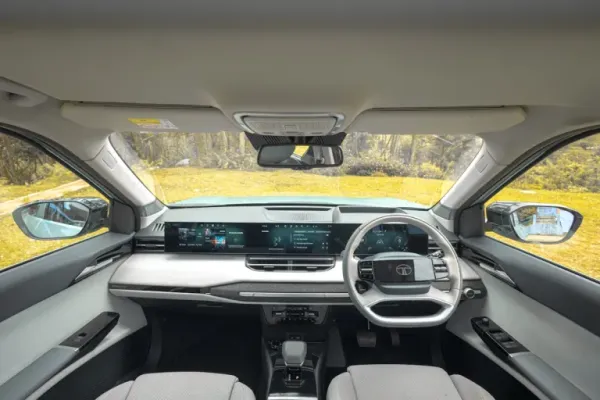
Anand Kulkarni: So I want to again repeat, it is not Argos, it is Acti EV plus. So, you know, we’ve always worked right from our day one and we’ve been very clear about it that we have worked on a multi-powertrain strategy. And we think that as electrification makes in roads, it’s not going to be a switch. It’s not going to be a binary thing that one day you are suddenly going to transit into electrification. It’s going to be a transition. And until that transition takes place, from a customer perspective, OE perspective, ecosystem perspective, you need to have a multi-powertrain supporting strategy. So we completely endorse that because it’s been our way of looking at things. Now, what does that mean? From a technical perspective, it’s always possible. It’s always possible. How do you make it happen is a matter of engineering and doing it in the future. So the short answer to your question is, is it possible of supporting that? The answer is yes. But does it mean that it can be done tomorrow? It’s a matter of further elaboration and further feasibility checks, etc.
Jayaprashanth Mohanram: Tata Motors has actually democratised safety in India. So what challenge did the Sierra’s glass-heavy design pose with respect to safety? I’m asking this again because one, you have glass. And the second thing, you also have a heavier car because of the battery. I understand that. So did it pose a big challenge for engineers? And if so, how did you surmount it?
Anand Kulkarni: So this was known right in the beginning. This was not a surprise that came on later. So we engineered the car to that perspective, knowing fully well that the glass house on the Sierra was going to be higher than what most other cars of its category have. And therefore, when we look at the crash impulse, we make sure that the crash impulse forces are passed on partially to the underbody, partially to the upper body, and partially into the side. And therefore, there’s a very careful evaluation of this. I think your question is also relating to if the platform is similar or close enough to each other on the ice and this thing, how do you cater for the 200 kilogrammes of extra weight? I think the answer to that is purely depending upon how you provide strengthening, what kind of materials you use, and what kind of sections you use. And that’s where the ice and EV platforms, while coming off a similar family of parts, is actually not the same. And you’ve actually asked me the same question, which I struggle trying to get people to understand too. But therefore, the platforms are different. The way they were engineered are different. The material selection, the engineering choices, the section choices, the strength choices that we had to make were different. And that’s what has helped us realise this performance, even though the glass house is pretty high.
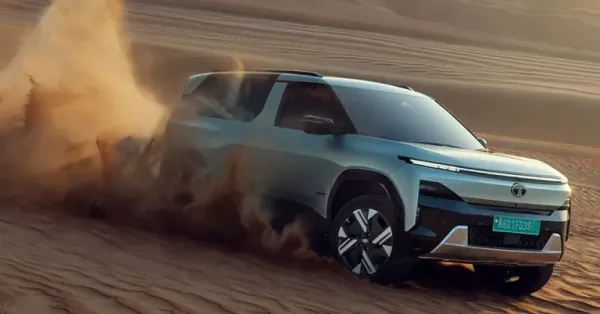
Jayaprashanth Mohanram: Now, let’s talk about the frunk. Will we see one on the Sierra.EV, sir?
Anand Kulkarni: Yes, from a perspective of flexibility and because the Sierra celebrates possibilities, the Frunk is there. We have a very, very large Frunk. Obviously, there is a larger Frunk when it is a rear wheel drive only. It’s 55 litres. And with all-wheel drive, quad-wheel drive, the front falls down to a slightly lower value. It’s still about 25-30 litres. So frunk is certainly a part of the package.
Jayaprashanth Mohanram: Yeah, it’s very helpful to keep the charger, sir. Otherwise, we have to keep it behind.
Anand Kulkarni: Some of my friends in the northern part of the country also keep some beer cans and beer bottles.
Jayaprashanth Mohanram: Yeah, yeah, yeah. So final question, sir, we’ve come to the end. Okay. Is there something that you feel really passionate about the Sierra.EV? What do you want to share with people who are going to read this interview? And what would you want a prospective owner of the Sierra.EV to experience?
Anand Kulkarni: You know, what I feel great about the car is the feeling that it gives you in the first 30 seconds that you get in the car. It’s a feeling of endless possibilities. Okay. It’s more of an emotional connect, JP, rather than parts or a subsystem or a system-level connect. It’s just the freedom, the expanse, the openness, the transparency of the car and the great intuitive feel that the car gives to you. That to me is what speaks about the Sierra.EV. And I hope that like me, many other people would get to enjoy it. This is an icon coming back, an icon coming back in a hypercharged mode. And I’m sure people will enjoy this.
Jayaprashanth Mohanram: Sir, over 300 horsepower. Who would have thought that it will become so accessible? It’s something unbelievable, in fact, as an enthusiast. So unbelievable. Thank you very much, sir. Thank you so much for your time.
Anand Kulkarni: I look forward to seeing you tomorrow. Thank you and see you tomorrow. Bye.
Jayaprashanth Mohanram: Bye. Thank you, sir. Bye. Thanks, Abhishek. Bye-bye. Thank you.
Interview ends
-
Leeds United confirm Karl Darlow’s departure after contract offer; joins Manchester United

-
Indian Athletes Gear Up for Competitive Commonwealth Games Ahead of Asian Games
-
India's Junior Pickleball Team Set for Asian Championship

-
Central Cabinet Approves Major Initiatives for Infrastructure and Semiconductor Development
-
Anuradha Paudwal Addresses Controversy Over Ram Mandir Remarks and India's Global Aspirations