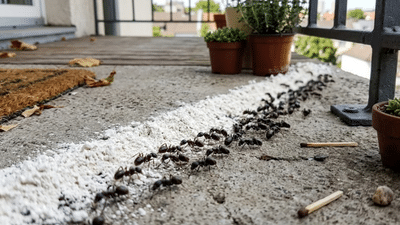
If the arrival of warmer weather has resulted in unwanted ants following behind you in your patio area, garden pathways, or seating area outdoors, you are not alone. With summer upon us, ant infestations tend to become more prevalent as colonies grow and ants begin looking for food and water.
While many people have turned to white vinegar to disrupt ant trails, there is a new buzz going around in the world of gardening about the use of DE (diatomaceous earth), which many gardeners are now recommending instead. In a recent article for, gardening writer Cynthia Lawrence said she swapped white vinegar for diatomaceous earth and found it far more effective at getting rid of ants in her garden within a week. But does the science support the claims? Here’s what experts say.
What is diatomaceous earth?
Despite its name, diatomaceous earth is not ordinary soil. This natural powder is made from the fossilised remains of microscopic algae called diatoms, which have hard silica shells. According to the (AHDB), diatomaceous earth causes damage to the protective outer layer of insects. Once the protective barrier is affected, the bugs eventually lose water and die of dehydration rather than toxicity.
This indicates that diatomaceous earth works physically rather than chemically. Unlike other insecticides, diatomaceous earth does not contain artificial pesticides, making it a lower-toxicity option for gardeners.
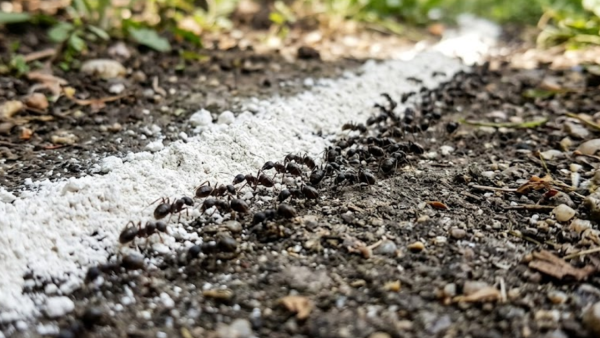 Does it actually work against ants?
There is some evidence that it can work, although expectations shouldn’t be too high. Consumer organisation, which independently tested ant control products, found that an organic insect powder containing diatomaceous earth killed nearly 90 percent of black ants over a 20-day trial. Nevertheless, this method was ineffective in the case of yellow meadow ants and worked well in dry weather.
Laboratory research has also shown that dry forms of diatomaceous earth are generally more effective than wet ones, because insects must contact the dry powder directly to be affected. Research published in the
Journal of Stored Products Research, available through
, reached similar conclusions when evaluating different diatomaceous earth products against insect pests.
This suggests that claims about ants disappearing within minutes may be based mainly on individual experiences rather than controlled testing. The effectiveness of the treatment is influenced by the size of the colony, the weather, and whether ants keep coming through the treated area.
Why do some people find it more effective than vinegar?
White vinegar may disrupt ant trails for a while, but since it evaporates, it has very little lasting effect unless the source of the problem is addressed. Unlike white vinegar, which can temporarily disrupt scent trails, diatomaceous earth affects insects physically when they come into contact with the powder. Since it is a physical rather than a chemical pesticide, there is also little risk of developing resistance, as you could with certain pesticides.
How should it be applied?
Experts recommend spreading a light layer of the powder along ant paths, near their nests, in cracks between paving stones, or wherever ants travel. It must be dry. The powder tends to clump when moistened; its effectiveness decreases because insects are less likely to come into contact with the abrasive particles. If heavy rain falls or the treated area gets wet, reapply the powder after the surface dries.
Even though food-grade diatomaceous earth is a low-toxicity substance, it should never be breathed in. The substance consists mainly of silica and can irritate the mucous membranes when inhaled as dust. When using it, make sure not to create any dust clouds and perhaps wear a mask if working with large amounts. Gardeners should choose a product labeled for garden use. Some forms of diatomaceous earth are not suitable for garden use.
It is not a permanent solution
Although diatomaceous earth may remove ants temporarily, long-term results require eliminating the factors attracting them in the first place, according to experts. Food debris, sticky messes, overfilled trash containers, leftover pet food outside, and water sources can attract ants and bring them back. Sealing gaps near patios and removing potential nests can also help prevent future infestations.
If you experience persistent or numerous infestations, and especially if some ants have already found their way into your house, professional pest control can remain your best choice. White vinegar can still temporarily disrupt ant trails, but research suggests diatomaceous earth may work better in the long term if used properly, especially in dry summer conditions. It is essential to understand that this substance is not a magic pill, but only one measure among others needed to keep ants away from your garden.
-
HYDRAA protects public utility land worth Rs 25 cr in Chengicherla

-
Telugu University’s space to house tribal art museum declined

-
Conspiracy to silence pro-Palestinian voices: Mahmoud Khalil

-
Trump welcomes Iraq’s new prime minister to the White House

-
Key Reasons for Medical College Admission Cancellations After NEET UG