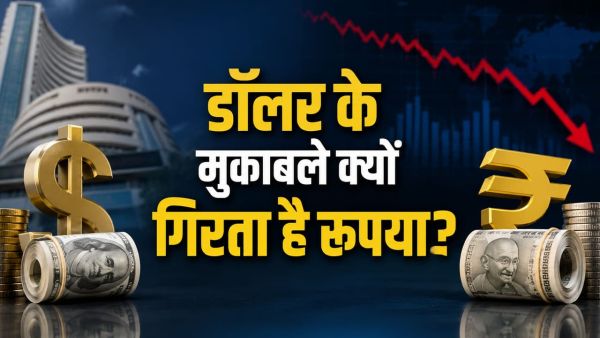
Why Rupee Falls: Why does the rupee weaken against the dollar? Know how the value of the Indian rupee is decided against the dollar, the advantages and disadvantages of weakening of the rupee and 5 interesting facts.
Rupee vs Dollar: It is often heard that the rupee has become weak against the dollar. This does not mean that the ₹100 note in your hand becomes small or worthless. This only means that you will have to spend more money than before to buy foreign currency, especially US dollars. For example, if earlier 1 US dollar was ₹ 90 and later 1 dollar became ₹ 95, then it means that the rupee has weakened, because now you will have to pay 5 more rupees to buy one dollar. Let us know why the rupee becomes weak? How is its value determined against the dollar? And every information related to it...
Why does the rupee weaken?
1. When demand for dollars increases
India has to buy crude oil, electronic items and many other things from abroad. Their payment is mostly in dollars. When Indian companies need more dollars, the demand for dollars increases. As demand increases, the dollar becomes expensive and the rupee becomes weak. For example, if the price of crude oil increases in the world market, India will have to spend more dollars.
2. When imports are high and exports are low
If a country buys or imports more goods from abroad and sells or exports less goods, then it will need more foreign exchange. This also increases pressure on the rupee.
3. When foreign investment decreases
When foreign investors invest money in India, they convert dollars into rupees. This increases the demand for the rupee, but if they take their investments out of India, they sell the rupee and buy dollars. This also weakens our rupee.
4. Effect of inflation
If inflation in a country lasts longer and increases faster than other countries, its currency may come under pressure. However, many other economic factors also impact the value of the currency.
5. Global events also have an impact
Events like war, global economic crisis, crude oil price, changes in interest rates and international conflicts also impact the value of dollar and rupee.
Is a weak rupee always bad?
No. There are some disadvantages, like petrol and diesel can become expensive. The price of goods coming from abroad may increase. Studying or traveling abroad can be expensive. There are some advantages too, like- if the rupee weakens a bit, then Indian goods may become cheaper in foreign countries. Due to this, exporting companies get benefit in some cases.
Who decides the value of rupee?
The exchange rate of rupee in India is mainly fixed on the basis of demand and supply in the foreign exchange market. RBI (Reserve Bank of India) helps in reducing excessive fluctuations by intervening in the foreign exchange market when needed.
5 rare facts and interesting statistics
1. The world's largest foreign exchange market
According to the BIS Triennial Survey for 2025, the global forex market will trade an average of $9.6 trillion per day, up 28% from $7.5 trillion by 2022, making it the world's largest financial market.
2. India imports a large part of its crude oil
India fulfills most of its oil needs from abroad. Therefore, the price of crude oil and the speed of the dollar have a big impact on the rupee.
3. Dollar is the world's main reserve currency
Central banks of many countries of the world keep a large part of their foreign exchange reserves in US dollars.
4. India has large foreign exchange reserves
India's foreign exchange reserves are used to cushion the economy from external shocks and bring stability to the market when needed. India's forex reserves increased by $7.26 billion to $674.19 billion in the week ending July 3, 2026 and are still about $54 billion less than the all-time high of $728.49 billion made in February 2026.
5. Every weakness is not a sign of economic crisis
Many times, fluctuations in the rupee are a part of normal changes in the world market, interest rates and investments. Therefore, every decline should not be considered an economic crisis.
Content Sources: Reserve Bank of India, International Monetary Fund, World Bank, Bank for International Settlements, Ministry of Commerce and Industry.
-
8th Pay Commission: If a fitment factor of 2, 2.5, or 3 is granted under the 8th Pay Commission, the salary will rise to this level..

-
PPF Account Loan Rules: How to get the cheapest personal loan against a PPF account? Find out the interest rate and rules..
-
Retirement Planning: Want a regular income after retirement? Find out which scheme is best for you..

-
SIP vs SSY: If you invest ₹2,000 per month in Sukanya Samriddhi and an SIP, which one will generate higher returns?
-
ICSI CSEET Result 2026: CSEET June 2026 result date announced; results can be checked at icsi.edu.