One of the first lessons every football fan learns is to hold tightly to fleeting moments of joy. For most supporters, whose teams rarely taste silverware, these moments become treasured memories, trophies in themselves.
This sentiment is amplified when it comes to England. With nearly all of the 1966 heroes having sadly passed on, individual matches and moments have taken on mythical status, compensating for decades of heartbreak at major tournaments.
The famous 5-1 win in Munich remains a favourite for many England fans, though German supporters often look puzzled by the obsession — after all, both sides qualified for the 2002 World Cup, and only one, Germany, went on to reach the final.
The England-Germany rivalry, in truth, has always been somewhat one-sided. While England view Germany as their great adversary, the Germans reserve their fiercest competitive energy for the Netherlands. Meanwhile, England themselves are often the focus of Scotland’s passionate rivalry, much like Frank Grimes’ frustration with Homer Simpson.
Yet, England do share one truly mutual rivalry — with Argentina. It’s said that no one has managed to properly control the ball in an England-Argentina match since 1962.
The flashpoints in this fiery history are well known: Antonio Rattin’s dismissal in 1966 for supposedly having an unfriendly expression; Diego Maradona’s infamous and glorious goals in 1986, fuelled by his desire for revenge after the Falklands conflict; and the heartbreak of David Beckham’s red card and Michael Owen’s brilliance at France ’98.
The Argentine reaction after that 1998 clash revealed the depth of animosity between the two nations, as their players mocked the defeated Englishmen even as they boarded their team bus.
When England gained revenge with a 1-0 victory at the 2002 World Cup, Trevor Sinclair accidentally wandered onto Argentina’s team coach afterwards. “They weren’t too pleased to see me,” he quipped wryly.
Given this deep-rooted history, the decision to stage a friendly match between the sides in November 2005 in neutral Geneva made perfect sense. Both teams had already booked their places at the following summer’s World Cup in Germany and were seen as potential contenders for the title.
That assumption, however, was only partly accurate. England’s so-called Golden Generation was at its peak, yet their qualifying campaign had been underwhelming — most notably marked by a shock defeat to Northern Ireland at a fired-up Windsor Park.
Manager Sven-Göran Eriksson, once seen as beyond reproach, was now facing growing scrutiny. The team had much to prove but began sluggishly. Paul Robinson was forced into early saves, including a vital stop from Juan Roman Riquelme in the fifth minute, before Hernan Crespo had a goal wrongly ruled out for offside.
When Chelsea’s Crespo finally found the net after a pull-back from Maxi Rodriguez just past the half-hour mark, it felt inevitable. Argentina’s line-up brimmed with class — Roberto Ayala, Riquelme, Crespo, Carlos Tevez, and Javier Zanetti formed a formidable core.
By contrast, England’s full-backs for the evening — Luke Young, Wayne Bridge and Paul Konchesky — were less glamorous names.
Still, England fought back bravely. Six minutes before half-time, Frank Lampard’s pass deflected off Ayala and was headed down by Beckham, allowing Wayne Rooney to pounce and level the score before Ayala could recover.
Rooney, just 20 and still basking in his early England stardom, played with infectious energy — a mix of youthful enthusiasm and raw aggression. One of his chipped efforts nearly forced Roberto Abbondanzieri into injury as the goalkeeper stretched to save it.
Though rattled briefly, Argentina regained control with poise. Journalist Kevin McCarra described their play as an “extravaganza of sophistication” in his report for The Guardian.
England’s defensive shape, however, faltered. The back line rarely pushed forward, and the midfield failed to close ranks around Ledley King, who was filling in as a holding midfielder. The confusion proved costly when Riquelme’s precise cross was headed home by Walter Samuel to restore Argentina’s advantage.
On another day, England might have crumbled. But on this chilly Geneva evening, they pressed relentlessly for the final 25 minutes, even if clear chances were scarce.
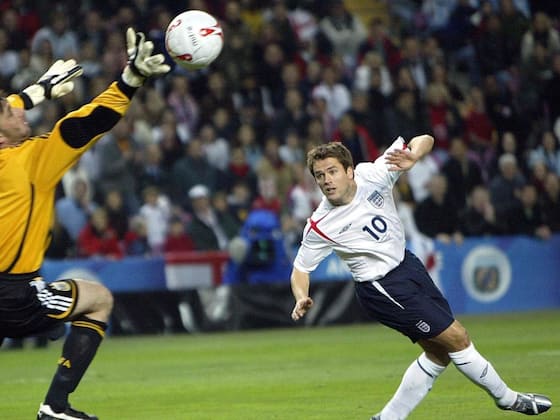
The late drama was worth the wait. Steven Gerrard, who had been shuffled across multiple positions throughout the match, delivered a superb cross in the 88th minute. Michael Owen met it perfectly, sending a downward header past Abbondanzieri to make it 2-2.
Moments later, Beckham’s powerful header was saved, and Gerrard appeared to foul Julio Cruz in the box as Argentina broke forward — but no penalty was given. As Cruz protested, England countered swiftly. Joe Cole collected the ball on the left flank and floated a teasing cross into the area. Owen, displaying impeccable awareness, darted ahead of Peter Crouch and powered home another header — once again tormenting Argentina.
For Owen, whose later career would be marred by injuries and mixed punditry, this was perhaps his last great performance in an England shirt. Despite his mature demeanour, he had been the team’s leading marksman before Rooney’s rise, and this brace against Argentina was a fitting reminder of his class.
On the sidelines, assistant coach Sammy Lee led jubilant celebrations as England’s players rejoiced. They had shown grit, skill, and spirit to defeat elite opposition — rekindling hope ahead of the 2006 World Cup.
As history would show, that hope didn’t translate into glory. But for supporters, believing it might was part of the magic.
By Michael Lee
-
What are Reusable Cloth Sanitary Pads|faq what are reusable cloth sanitary pads how much it cost safety uses

-
UP became ‘TB control model’ from ‘TB capital’, a big achievement recorded in the top-6 states of the country.

-
Anthropic Introduces Claude AI India Pricing: Check Price For Pro, Max, And Team Subscription

-
Indian women’s team created history in the Mecca of cricket ‘Lord’s’!
-
IND W vs ENG W: India’s historic victory at Lord’s, won the test match on England’s soil after 12 years