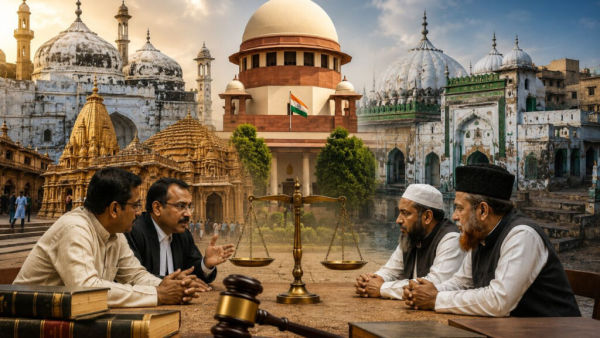
New Delhi: An important initiative has come to light regarding the three most talked about religious disputes of the country, the Gyanvapi Masjid case of Varanasi, the Shri Krishna Janmabhoomi-Shahi Eidgah dispute of Mathura and the Harihar Temple-Jama Masjid case of Sambhal. Amidst the long legal process, efforts will now be made to resolve these matters through negotiations and mutual consent outside the court. For this purpose, the Supreme Court has decided to send these disputes to the Special Lok Adalat. This process will be held in the court premises, where both the parties will get an opportunity to find a solution through dialogue.
A special Lok Adalat will be organized in the Supreme Court premises from 21st to 23rd August. This program has been named ‘Samadhan Samaroh’. Its main objective is to settle the cases pending in the courts for years peacefully and mutually. Under this process, the court has issued notices to Hindu and Muslim parties to all three cases asking them to join the Lok Adalat. It is expected that both sides will try to reach a common solution through negotiations.
Reconciliation efforts started before Lok Adalat
The Supreme Court has not limited the process only to Lok Adalat, but even before that, work has been started on the possibilities of compromise. According to the information, the process of mediation and conciliation is going on through lower courts since April 21. According to the programme, a pre-settlement hearing to the Gyanvapi dispute will be held in Varanasi on July 14. In this meeting, efforts will be made to reach a consensus between both the parties. At the same time, an attempt at mediation was made earlier also in the Shri Krishna Janmabhoomi-Shahi Eidgah case of Mathura, but it could not be successful on July 5. After this, the Supreme Court also decided to include this dispute in the special process of Lok Adalat.
What is the Gyanvapi Masjid controversy?
The Gyanvapi dispute of Varanasi is pending in the courts for many years. The Hindu side claims that at the place where Gyanvapi Mosque is present today, there was earlier an ancient Kashi Vishwanath temple, which was demolished during the Mughal rule and a mosque was constructed. The petitioners have demanded permission for worship in some parts of the mosque complex. He has also raised questions in the court regarding the interpretation of the Places of Worship (Special Provisions) Act, 1991.
On the other hand, Anjuman Intezamia Mosque Committee, representing the Muslim side, says that the mosque is protected under the 1991 law and such petitions have no legal basis. At present this matter is pending in the court with various legal aspects.
Shri Krishna Janmabhoomi-Shahi Eidgah dispute
The dispute in Mathura is to the Shahi Idgah Mosque and the Shri Krishna Janmabhoomi complex. The Hindu side says that the ancient temple present at the birthplace of Lord Krishna was demolished during the reign of Aurangzeb and a royal Eidgah was built there. The petitioners have demanded the court to return the disputed land and remove the mosque. He claims that there are many evidences present in the complex, which point towards the existence of a temple there earlier. However, the Shahi Idgah Mosque Committee completely rejects these claims. The committee says that the matter comes under the purview of the Places of Worship Act, 1991 and hence these petitions cannot be heard.
Sambhal Jama Masjid-Harihar Temple dispute
The controversy regarding the Shahi Jama Masjid located in Sambhal district of Uttar Pradesh has also been in the news continuously. The matter came to light when a civil court ordered a survey of the mosque premises. It was claimed in the petition that Harihar Temple was earlier situated on the site of the mosque. Tension increased in the area over the survey conducted after the court order and violence also took place in November last year, in which many people lost their lives and many were injured. This case is also currently pending before the Supreme Court and the court is considering the legal issues to it.
Place of worship law also at the center of discussion
The common legal issue in all three cases is the interpretation and validity of the Places of Worship (Special Provisions) Act, 1991. This law talks about maintaining the status of any religious place as it was on August 15, 1947. During the hearing of these cases, the Supreme Court is also considering the scope of this law, its interpretation and the constitutional aspects to it.
This initiative of the Supreme Court is being considered an important step towards the peaceful resolution of long-running sensitive religious disputes. If both the parties reach a conclusion by mutual consent, then it may be possible to resolve the cases pending for years outside the court. However, the final decision will depend on the consent of both the parties and the process of Lok Adalat.
-
Health Tips: Do not accidentally eat ‘this’ food after 5 pm; Otherwise health may deteriorate

-
Giloy Water Benefits: Drink 1 glass of Giloy water every morning. These 5 surprising changes start happening in the body

-
BSNL Recharge Plan: Forget data worries! The government company came up with a new plan; Lots of benefits at low cost
-
Such is the condition of Chinese EV, its lifespan is less than that of a mobile phone.

-
After Apple’s case, Elon Musk and Sam Altman clashed again, war of words broke out on X